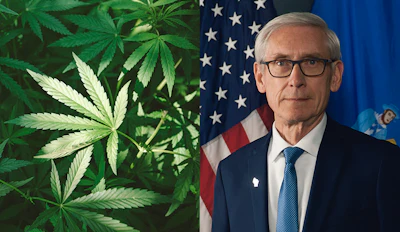

Wisconsin Gov. Tony Evers is once again calling on his state’s delegation in the U.S. Congress to work toward averting the federal government’s forthcoming ban on intoxicating hemp products.
The Democratic governor sent a letter July 21 to Wisconsin’s two U.S. senators and eight U.S. House representatives, asking them to help push the 2026 Farm Bill across the finish line with a revision for the definition of hemp “to prevent mass disruption” of the state’s industry.
Evers sent a similar letter in February to the seven Republicans and three Democrats who make up his state’s delegation in Washington after Congress passed an appropriations package in November 2025 that included language to close a loophole in the 2018 Farm Bill by redefining hemp as containing no more than 0.3% total THC (including THCA) or other cannabinoids with similar effects starting on Nov. 12, 2026.
The new definition will also ban hemp-derived products containing more than 0.4 milligrams of total THC per serving, as well as synthetic (delta-8 THC) or unnatural (HHC) cannabinoids.
Evers said this new definition threatens “legitimate hemp businesses and producers” across the Badger State, jeopardizing $700 million in economic impact and nearly 3,500 jobs, citing a Wisconsin State Journal report that backs those numbers. Wisconsin had 470 federally licensed hemp producers as of November, according to the U.S. Department of Agriculture.
“I must reiterate the importance of Congress providing a stable and workable path forward for Wisconsin’s hemp industry in the next farm bill or standalone legislation,” the governor wrote. “Hemp has become an increasingly important tool for agricultural diversification, rural economic development and value-added manufacturing, creating new opportunities for Wisconsin farmers, processors, retailers and consumers across our state. As Congress considers the future of federal hemp policy, it is essential that any changes provide the certainty and regulatory clarity needed for this emerging industry to continue growing and investing in Wisconsin.”
Wisconsin is one of eight states without a medical or adult-use cannabis program, despite Evers’ budget proposals calling for legalization, leaving consumer demand strong for hemp-derived products with similar effects.
The U.S. House passed the 2026 Farm Bill in April. In its current form, the legislation would redefine hemp as a cannabis plant that does not test higher than 0.3% total THC, replacing the delta-9 THC threshold established in the 2018 Farm Bill that led to the proliferation of intoxicating hemp products sold in gas stations, smoke shops and convenience stores, especially in states with less permissive cannabis laws such as Wisconsin.
The House-passed 2026 Farm Bill does not alter the federal government’s forthcoming ban on intoxicating hemp-derived products in their final forms, as House Committee on Agriculture Chairman Glenn “GT” Thompson, R-Pa., who orchestrated the bill’s advancement, argued that the farm bill deals with hemp as an agricultural commodity, not a finished good.
Wisconsin’s six Republican House members supported the 2026 Farm Bill’s passage, while its two Democratic representatives did not. The Senate received the legislation in May but has yet to act on it.
Evers said the 2026 Farm Bill should ensure that Wisconsin farmers and businesses can build on the progress they’ve made since the 2018 Farm Bill federally legalized the commercial cultivation of hemp by removing it from the Controlled Substances Act – not roll back the allowances that Wisconsinites have built their existing business models on.
“As Wisconsin’s federal delegation, I urge you to ensure the farm bill remedies this issue and encourage you to pursue a science-based federal framework that supports innovation, protects lawful businesses and allows Wisconsin farmers and producers to compete in a rapidly evolving marketplace,” the governor wrote. “More broadly, the farm bill should strengthen hemp research, improve access to crop insurance and financial services, and invest in processing and supply chain infrastructure to help this industry reach its full potential.”
Should the 2026 Farm Bill fail to address Evers’ concerns, he asked that Wisconsin’s federal delegation support additional legislation that would avert the definition change set to take effect later this year.
Since November 2025, U.S. lawmakers have introduced bills to repeal the forthcoming ban on intoxicating hemp products altogether, delay it by two years, or replace it with a regulatory and taxation structure.
Evers said that hemp represents “a strong diversification option for Wisconsin farmers” and that without timely federal legislative action, Wisconsin’s producers may be forced to abandon hemp cultivation altogether, resulting in lost income and diminished economic opportunities, especially in rural communities.
“The farm bill is more than agricultural policy; it is economic policy, nutrition policy, conservation policy and rural development policy,” he wrote. “Its impacts are felt in every corner of our state, and I urge you to continue working across the aisle to advance a comprehensive farm bill that protects Wisconsin’s farmers, strengthens our food systems, safeguards our natural resources and invests in the future of rural communities.”