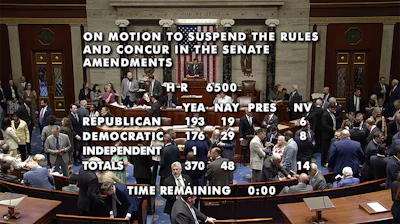

Intoxicating hemp products, including those containing delta-8 THC, will likely remain federally legal until at least Dec. 11, after U.S. House lawmakers voted, 370-48, in favor of the Senate’s stopgap funding measure on Sept. 1.
The Continuing Appropriations and Extensions Act, 2027, which aims to keep the government funded at current levels until Dec. 11, includes a provision to postpone a forthcoming ban on most hemp-derived cannabinoid products by four weeks beyond an original Nov. 12 implementation date.
The delay provision excludes products containing cannabinoids “not capable of being naturally produced by a Cannabis sativa L. plant,” which will still be prohibited on Nov. 12.
However, cannabinoids like delta-8 THC, delta-10 THC and THCP, which are often synthetically derived from hemp, are capable of being naturally produced by the plant, and therefore will remain on the shelves at gas stations, smoke shops and convenience stores until at least Dec. 11 – pending President Donald Trump’s signature on the overarching appropriations package, often referred to as a continuing resolution (CR).
Without Trump’s signature, the federal government would shut down at the end of the fiscal year on Sept. 30, representing a setback for lawmakers hoping to return to their campaign trails ahead of the 2026 midterm election. But this likely won’t happen: The White House indicated last month that the president supports the resolution.
To avoid a potential delay in passing the measure, U.S. Majority Leader Steve Scalise, R-La., moved to suspend the rules for consideration, a political procedure that prevents floor amendments and limits debate; however, the procedure requires a two-thirds supermajority vote to pass legislation.
Although the House’s vote easily eclipsed that two-thirds threshold, not all lawmakers agreed with using Congress’ power of the purse to change policies that lawmakers previously established.
Rep. Chip Roy, R-Texas, outlined his concerns with delaying the intoxicating hemp product ban in an Aug. 31 letter to House Appropriations Committee Chair Tom Cole, R-Okla., and House Budget Committee Chair Jodey Arrington, R-Texas.
“This CR presents myriad other problems, including its treatment of harmful intoxicating hemp products and other policies Congress should address rather than simply extend,” Roy wrote. “We cannot spend months working to change these policies through reconciliation and the appropriations process only to perpetuate them through the next must-pass spending bill.”
When the Senate passed the measure on Aug. 10, Sen. Ted Budd, R-N.C., offered an amendment that intended to strip the extension of the hemp product ban and keep the scheduled Nov. 12 implementation date in effect. That amendment failed, 61-32, before the upper chamber supported the overarching appropriations package, 90-6.
“Nine months ago, both Republicans and Democrats, they overwhelmingly voted to close the hemp loophole,” Budd said before last month’s vote. “Happened right here. They wanted to stop intoxicating hemp products from being sold and marketed to kids. It’s no accident that these products are made to look exactly like something that a kid would want.”
The vote he was referring to happened in November 2025, when Congress found middle ground to end a 43-day government shutdown.
As part of that deal, lawmakers included a 141-page agricultural spending bill containing the hemp prohibition language to redefine hemp as a cannabis plant containing no more than 0.3% total THC (including THCA) or other cannabinoids with similar effects.
The legislation also stipulates that, beginning on Nov. 12, 2026, hemp-derived cannabinoid products will be federally illegal if they contain:
- cannabinoids that are synthesized or manufactured outside the plant (delta-8 THC);
- cannabinoids that are not capable of being naturally produced by the plant; or
- more than 0.4 milligrams of total THC per container.
These provisions would close what many cannabis industry stakeholders, and lawmakers for that matter, have called a loophole in the 2018 Farm Bill, which defined hemp based on a single THC isomer – delta-9 THC – as tested in the field, allowing intoxicating hemp-derived products to proliferate nationwide.
While some lawmakers in Washington, notably Rep. Nancy Mace, R-S.C., felt trapped between reopening the government and voting their conscience on hemp in 2025, others, such as Reps. Andy Harris, R-Md., and Pete Sessions, R-Texas, have continued to push for the ban to take effect as scheduled.
Most lawmakers agree that consumer safety and preventing youth use are primary concerns associated with hemp-derived products, but major disagreements remain on whether to prohibit or regulate these products.
One safety concern revolves around synthetic derivatives and lab-made cannabinoids. Although some media outlets reported that hemp products containing synthetic derivatives would still be banned on Nov. 12 under the continuing resolution, the American Trade Association for Cannabis and Hemp (ATACH) begs to differ.
According to ATACH, the continuing resolution was “cleverly written” to allow and protect synthetic conversions of nonintoxicating cannabinoids like CBD into intoxicating cannabinoids like delta-8 THC. As such, as long as the molecule is found somewhere in nature, chemical manufacturers would be protected under the continuing resolution – at least until Dec. 11.
"As expected, Congress passed the one-time extension of the Farm Bill loophole that the White House requested," said Chris Lindsey, vice president of policy and state advocacy at ATACH. "While we're disappointed, our sights are set on December. The loophole empowers bad actors, threatens public health and undermines state regulations. We urge Congress to end the scourge of 'gas station weed.'"
Meanwhile, many hemp industry stakeholders view the four-week reprieve as a major victory, representing an opportunity to lobby lawmakers to craft a long-term solution that incorporates regulations over prohibition.
Hemp Beverage Alliance founder and President Christopher Lackner said, "The hemp beverage industry looks forward to working with Congress to create a regulatory framework that protects public health, keeps products away from minors, and permanently removes the bad actors that sell untested, high-potency, copycat gummies and candies that target children."
Rep. Jim Baird, R-Ind., recognized the potential of a federal regulatory framework following Tuesday's vote.
“This short extension of the current hemp definition will provide Congress and farmers the time needed to develop a long-term solution," he said. "Producers deserve as much certainty as possible in deciding what to plant. Farmers should have the freedom to plant the crops that best serve their operations and profits.”