
The Senate Agriculture Committee failed to advance its 2026 Farm Bill package before the chamber’s August recess, leaving the nation’s policies on agriculture, rural communities and food security in jeopardy.
The body voted, 11-10, on Aug. 6 not to advance the long-overdue legislation that regularly addresses these policies. Congress typically reauthorizes a farm bill package every five years to ensure critical programs are funded, but the most recent farm bill, the Agriculture Improvement Act of 2018, is in its third consecutive year of an extension that will expire on Sept. 30.
While the House passed its version of the 2026 Farm Bill, the Farm, Food, and National Security Act of 2026, in a 224-200 vote on April 30, the Senate Agriculture Committee members sparred over nutrition aid cuts this week – particularly the GOP’s plan to shift Supplemental Nutrition Assistance Program (SNAP) costs to states and counties in what they called the SNAP benefit cost share.
Democrats argued during the committee’s markup hearing on Thursday that the plan would unfairly reward or penalize states based on their error rates and how quickly they reduce those rates within their SNAP benefit programs.
The GOP-controlled committee agreed to a one-year delay in the SNAP benefit cost share plan, but Democrats wanted a two-year delay, “so all states will be on the same footing in working to reduce their error rates,” said Sen. Amy Klobuchar, D-Minn., the committee’s ranking member.
Senate Agriculture Committee Chairman John Boozman, R-Ark., pointed the finger back across the aisle.
“Democrats remain fixated on a partisan policy that allows states to continue the incredible wasteful spending of taxpayer dollars, ignoring our negotiated proposal,” he said. “This debate was about the FARM BILL, not protecting the mismanagement of billions of dollars in food aid.”
Boozman indicated that key GOP absences, including Sens. Mitch McConnell, R-Ky., and Tommy Tuberville, R-Ala., stalled the farm bill’s advancement, telling reporters after the failed vote that he plans to reconvene committee members for another vote in September, Politico reported
“We’re going to come back in that first week [after recess] and have another vote on the same bill again,” Boozman said.
The Senate’s proposed farm bill package, the Agricultural Act of 2026, includes 983 pages of legislation. However, unlike the House-passed farm bill from April, the Senate’s proposal includes no provisions on hemp. It fails to mention “hemp” or “tetrahydrocannabinol” in its entirety.
This means the Senate Agriculture Committee members who drafted the 2026 Farm Bill proposal likely do not intend to lean on the 2018 Farm Bill’s definition of hemp – through renewing or redefining it – but instead on an unrelated appropriations package that Congress passed in November 2025 to redefine hemp as a cannabis plant containing no more than 0.3% total THC (including THCA) beginning on Nov. 12, 2026.
The House-passed 2026 Farm Bill, meanwhile, included provisions to align its definition of hemp with the new federal standard, rather than the delta-9 THC threshold established in the 2018 Farm Bill that led to the boom in intoxicating hemp products nationwide.
The federal government’s new definition of hemp also will prohibit hemp-derived products containing more than 0.4 milligrams of total THC per container, as well as products containing synthetic (delta-8 THC) or unnatural (HHC) cannabinoids upon the November implementation date.
While cannabinoid hemp industry stakeholders had lobbied House lawmakers to include amendments in the 2026 Farm Bill to delay, repeal or amend the prohibition language on hemp-derived products, House Agriculture Committee Chairman Glenn “GT” Thompson, R-Pa., made it clear that the farm bill should deal with hemp solely as an agricultural commodity and not as a vehicle to regulate finished goods.
“The ag appropriations bill that passed last fall brought clarity to the industry on what is or is not allowable under the definitions of hemp,” Thompson said in April. “Importantly, to many in this room today, that language addressed the issue of final form products that have been the source of many public health concerns since the 2018 Farm Bill, because they lacked a federal regulatory structure. A comprehensive regulatory framework for these products falls outside the jurisdiction of this committee.”
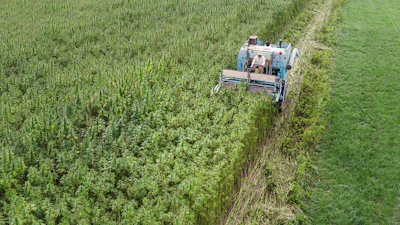
The House-passed 2026 Farm Bill does, however, aim to lift regulatory burdens on industrial hemp producers, such as those who grow the plant for grain or fiber. The House-passed farm bill would allow hemp farmers to self-designate their production type, with those who designate as “only industrial hemp” farmers given the leeway to reduce their sampling or testing requirements through “visual inspections, performance-based sampling methodologies, certified seed or a similar procedure when developing sampling plans.”
The House package would also remove a requirement that labs be DEA-registered to test hemp, instead allowing the U.S. Department of Agriculture to establish a process to accredit laboratories. In addition, industrial hemp farmers would no longer have a 10-year ineligibility period for felony convictions related to controlled substances.
Should the Senate Agriculture Committee advance its 2026 Farm Bill proposal following the August recess, hemp-related amendments could be added on the Senate floor to harmonize with the House’s hemp provisions.
Still, those who’ve built businesses around or benefitted from the 2018 Farm Bill’s definition of hemp are hoping to find reprieve from the federal government’s looming Nov. 12 implementation date.
Most recently, they’re hoping the Senate Appropriations Committee’s proposal to delay the ban on some intoxicating hemp products until Dec. 11 – as part of a continuing resolution to keep the federal government funded – will provide more time for a potential legislative fix to their impending cliff.
The Lawful Hemp Protection Act, sponsored by Reps. Andy Barr, R-Ky., and Angie Craig, D-Minn., would also provide them relief through a federally taxed and regulated system for hemp-derived products.
But with Congress focused on 12 must-pass appropriation bills for the next fiscal year, none of which have passed the Senate, it’s unlikely that standalone legislation will be the hemp industry’s saving grace before the midterms.
Any effort to delay or avert the federal government’s impending intoxicating hemp product ban will likely come as an amendment to broader legislation.