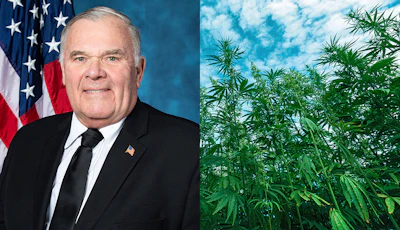

House Rep. James Baird, R-Ind., and a quartet of bipartisan co-sponsors are attempting to throw the U.S. hemp industry an extended lifeline on an impending product ban.
Baird introduced legislation on Jan. 12 to delay the implementation of the federal ban on intoxicating hemp products until November 2028, two years after the ban is supposed to go into effect.
The two-page legislation, the Hemp Planting Predictability Act, would amend the Agriculture, Rural Development, Food and Drug Administration (FDA), and Related Agencies Appropriations Act of 2026, which President Donald Trump signed into law in November, ending the longest government shutdown in U.S. history.
While the FDA spending bill included nearly $26.7 billion in nondefense funding, it also contained a provision to close what Sen. Mitch McConnell, R-Ky., called an unintended “loophole” in the 2018 Farm Bill that led to intoxicating cannabinoid products proliferating in often unregulated retail settings, and online, throughout the U.S. The 2018 Farm Bill federally legalized the commercial cultivation of hemp but did not regulate finished goods.
Baird indicated his intentions for the Hemp Planting Predictability Act are focused on supporting American farmers.
“Planting and growing crops requires planning well in advance,” Baird said. “Congress created a regulatory environment in the 2018 Farm Bill that allowed for certain investments, and farmers were operating within this environment. The hemp provision included in the continuing resolution and appropriations bills passed in November 2025 disrupted planting decisions that had already been made. Congress should not have passed such a sweeping policy change that upends a growing industry. Instead, Congress should have given farmers more time, creating a more stable environment for farmers to modify their future planting decisions. I am proud to introduce this legislation to ensure farmers have predictability and sufficient time to adjust to new laws that affect their livelihood.”
As part of the deal to reopen the government, the hemp-related language in the FDA spending bill will recriminalize most consumable hemp THC products on today’s market by Nov. 13, 2026. Products will be banned if they contain:
- cannabinoids that are synthesized or manufactured outside the plant (delta-8 THC);
- cannabinoids that are not capable of being naturally produced by the plant (HHC);
- more than 0.3% total THC (including THCA) or other cannabinoids with similar effects; or
- more than 0.4 milligrams of total THC per container.
The legislation Baird introduced on Monday would simply kick the effective date two years down the road by striking “365 days” and inserting “3 years” in Section 781 of the federal appropriations package.
The legislation would also help hemp-derived product brands.
“The Baird hemp extension is a positive step that brings greater stability to a fast-growing sector of the U.S. economy," Nowadays CEO and co-founder Justin Tidwell told Cannabis Business Times. Nowadays is a growing leader in the hemp-derived beverage market.
"It ensures businesses, farmers and retailers can continue operating responsibly as policymakers work to establish a new, effective framework for the hemp category," he said. "This bill recognizes that good regulation takes time, and by providing a longer transition period, it creates space for clear standards that protect consumers and support long-term growth across the hemp industry."
Baird’s bill is co-sponsored by House Oversight and Accountability Chair James Comer, R-Ky., House Agriculture Committee Ranking Member Angie Craig, D-Minn., and Reps. Gabe Evans, R-Colo., Tim Moore, R-N.C.
"This common-sense extension gives farmers and America’s hemp industry the time they need to adapt while Congress works to establish a clear, reasonable regulatory framework,” Comer said. “I have championed the hemp industry since my time as Kentucky’s Commissioner of Agriculture and remain committed to bipartisan solutions in Washington that support our local farmers and provide certainty for this growing industry.”
While Baird ultimately voted in favor of reopening the government in November, he was among 13 GOP House members who signed a letter in September opposing the federal ban on intoxicating hemp products that was under consideration earlier in the year.
“If the language contained in the FY26 Agriculture-FDA Appropriations Bill were to become law, it would deal a fatal blow to American farmers supplying the regulated hemp industry and small businesses, and jeopardize tens of billions of dollars in economic activity around the country,” the letter signers wrote.
Comer and Moore also signed the letter, which pointed to the more than 70% of hemp acres grown in the U.S. being dedicated to cannabinoid production (versus gain or fiber), according to the USDA National Hemp Report published in April 2025.
The Midwest Hemp Council, a trade organization with members in 23 states, applauded Baird for introducing the bipartisan legislation on Monday.
According to the organization, the two-year delay would allow farmers time to properly prepare, and for Congress to engage with farmers, state regulators, public health officials and other stakeholders to “address legitimate market concerns” before moving forward.
“This two-year extension gives farmers the certainty they need to make planting decisions with confidence,” Midwest Hemp Council President Justin Swanson said. “Congressman Baird understands that hemp farmers cannot operate in an environment of constant uncertainty.”
Other lawmakers have also introduced legislation aiming to address the hemp product prohibition language that was included in the continuing resolution to reopen the government.
In November, Rep. Nancy Mace, R-S.C., introduced the “American Hemp Protection Act,” legislation that would repeal the federal government’s hemp-related provisions by striking Section 781 entirely.
“Rather than have a substantive, open debate on the future of hemp policy in America, prohibitionists slipped this provision into a must-pass government funding bill, forcing members of Congress to choose between voting their conscience on hemp and paying our military servicemembers,” Mace said on the congressional record in November. “This is wrong.”
Baird is co-sponsoring Mace’s legislation.
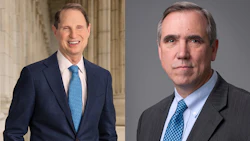
In addition, U.S. Sens. Ron Wyden and Jeff Merkley, both Democrats from Oregon, introduced the “Cannabinoid Safety and Regulation Act (CSRA)” in December, a proposal that would replace the forthcoming hemp product ban with a more tightly defined federal regulatory structure.
The 84-page legislation aims to limit consumable hemp products to 5 milligrams of THC per serving and 50 milligrams per container for edibles, topicals and inhalable products, while beverages could contain up to 10 milligrams per container.
Wyden and Merkley’s bill also includes public health and consumer safety standards geared toward setting a federal age limit at 21 years, as well as establishing testing standards, packaging and labeling requirements, and restrictions on pesticides, heavy metals, chemical byproducts and additives.
“There’s no question that more needs to be done to protect kids and consumers from unsafe, untested hemp products,” Wyden said in December. “We learned from the failed war on drugs that a one-size-fits-all approach banning hemp products from the market outright does nothing to protect kids and consumers, and will be a gut-punch to thousands of jobs and small businesses across the country.”
Also in December, Trump signed an executive order directing Attorney General Pamela Bondi to expeditiously complete the process a reclassifying cannabis from a Schedule I to Schedule III drug under the Controlled Substances Act.
In that order, the president also directed his White House staff to work with Congress to ensure Americans have regulated and safe access to hemp-derived CBD products, many of which would be wiped out of the marketplace under the prohibition provisions included in November’s continuing resolution.
Coinciding with Trump’s order, the Centers for Medicare and Medicaid Services is expected to adopt a new policy allowing doctors to recommend CBD products to older Americans as an alternative treatment, starting as soon as April 2026, and to allow their medical coverage to pay for it. Some have questioned whether that policy shift could collide with the federal government’s consumable hemp product law.
Baird and his co-sponsors are hoping to give lawmakers more time to