
The U.S. Senate voted, 61-32, on Aug. 8 to postpone the federal government’s ban on intoxicating hemp THC products in a move that would provide Congress more time to consider regulating those products instead.
Under the Senate’s plan, which now heads to the House, intoxicating hemp products containing cannabinoids capable of being naturally produced by the hemp plant, including delta-8 THC, delta-10 THC and THCP, would remain on the shelves at gas stations, smoke shops and convenience stores until at least Dec. 11, providing industry stakeholders with a four-week reprieve from the federal government’s forthcoming ban that’s scheduled to take effect on Nov. 12.
The Senate included the provision to delay the ban on most hemp-derived products – excluding those containing cannabinoids not capable of being naturally produced by the plant – in a continuing resolution that would keep the government funded at current levels until Dec. 11, providing lawmakers additional time to avoid a possible government shutdown at the end of the fiscal year on Sept. 30.
The Senate voted, 90-6, shortly before 5 a.m. on Aug. 8 to pass this stopgap funding measure – its last order of business before adjourning for its August recess.
Before the final vote on the continuing resolution, Sen. Ted Budd, R-N.C., offered an amendment that intended to strip the extension of the hemp product ban and keep the scheduled Nov. 12 implementation date in effect.
“Nine months ago, both Republicans and Democrats, they overwhelmingly voted to close the hemp loophole,” Budd said early Saturday morning on the Senate floor. “Happened right here. They wanted to stop intoxicating hemp products from being sold and marketed to kids. It’s no accident that these products are made to look exactly like something that a kid would want.”
Budd was referring to Congress’ vote in November 2025 to pass an appropriations package to end the longest government shutdown in U.S. history. Included in that appropriations package was an agricultural spending bill containing language to redefine hemp as a plant containing no more than 0.3% total THC or other cannabinoids with similar effects.
The language also included provisions to ban hemp-derived products containing more than 0.4 milligrams of total THC per container, as well as those containing synthetic or unnatural cannabinoids, providing hemp-related businesses with a one-year offramp for the Nov. 12, 2026, implementation date.
Those provisions are intended to close what many have called a loophole in the 2018 Farm Bill, which defined hemp as having no more than 0.3% delta-9 THC, as tested on pre-harvested plants in the field, a definition that led to the proliferation of intoxicating hemp products nationwide.
“My opponents have asked, ‘What’s the harm in a month-long delay?’” Budd said. “So, I’m going to tell you: The goal is not an extra month to work on policy, as many have said. The well-oiled hemp lobbying machine – it’s already had nine months to do that. The real goal is to jam us in December on a must-pass package and to permanently entrench their intoxicating products into the machinery of government.”
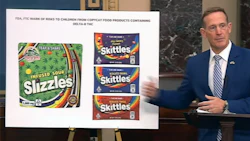
Days earlier, when introducing his amendment alongside Sen. Pete Ricketts, R-Neb., Budd displayed images of intoxicating hemp products in packages that resembled popular children’s candy and snacks, such as Skittles, Oreos and Cheetos. He then displayed a graphic showing a 461% increase in pediatric cannabinoid-related emergency room visits in children 11 and younger from 2018 to 2023.
 U.S. Sen. Ted Budd, R-N.C., speaking in support of his amendment on Aug. 5 on the Senate floor.U.S. Sen. Ted Budd, R-N.C., speaking in support of his amendment on Aug. 5 on the Senate floor.
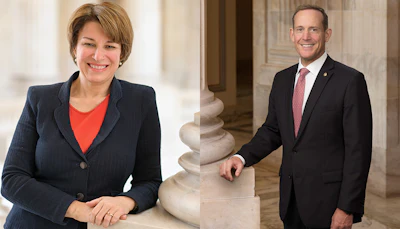
After Budd officially brought his amendment to the Senate floor during the early morning hours on Aug. 8, Sen. Amy Klobuchar, D-Minn., introduced a motion to table the amendment – to effectively kill it – which was adopted on the 61-32 vote.
“I represent farmers, small businesses, brewers and consumers in my state,” she said. “And I urge my colleagues to table Senator Budd’s amendment and give this body four more weeks to work towards legislation that supports a thriving hemp industry, ensures proper regulation and protects kids from dangerous products. As is the bipartisan continuing resolution that is before us delays a ban on naturally produced hemp products for four weeks while taking synthetic hemp derivatives off the market.”
 U.S. Sen. Amy Klobuchar leads the motion to table Sen. Ted Budd's amendment Aug. 8 on the Senate floor.c-span.org
Minnesota’s law governing edibles and beverages containing THC derived from hemp took effect in July 2022, before the state legalized adult-use cannabis. Under the state’s law, Minnesotans 21 and older can purchase cannabinoid products containing no more than 5 milligrams of THC per serving and 50 milligrams per package.
“We have safety rules in place that have worked very well,” Klobuchar said of Minnesota’s hemp regulations. “The product is taxed. We have not had issues with it since we put those rules in place.”
While Klobuchar said the Senate’s continuing resolution would provide a four-week reprieve for products containing natural hemp derivatives while still taking synthetic hemp derivatives off the market on Nov. 12, as planned, not all industry stakeholders agree with that assessment.
According to the American Trade Association for Cannabis and Hemp (ATACH), an organization that promotes licensed markets, the Senate’s hemp provision in the continuing resolution was “cleverly written” to allow and protect synthetic conversions of natural, nonintoxicating cannabinoids, such as CBD, into intoxicating cannabinoids, such as delta-8 THC.
In other words, as long as the molecule is found somewhere in nature, chemical manufacturers would be protected under the Senate’s plan, according to ATACH.
“When Prohibition ended in 1933, Congress did not yield to the makers of bathtub gin and call it a day – or allow dangerous products to continue without regulation – yet that is exactly what is happening today,” ATACH President Michal Bronstein said in a statement provided to Cannabis Business Times.
“The Senate’s actions will be seen as undermining state laws and efforts to regulate synthetic hemp products such as delta-8 THC, delta-10 THC and THCP,” he said. “These products are not ‘hemp,’ and they aren’t even marijuana. Cannabis and hemp licensees want responsible legalization and regulation – not a reprieve for lab-created intoxicants, which have no business on gas station shelves or being sold to kids online. The Senate’s vote in the short term will embolden those who rely on the loophole to bypass the law, selling synthetics and deceptively market[ing] marijuana as THCA ‘hemp’ flower, while penalizing real and compliant businesses. In the longer term, Congress must do better.”
After the Senate Appropriations Committee first released the continuing resolution containing the hemp reprieve language on Aug. 2, a bipartisan coalition of 35 state and territorial attorneys general sent a letter to congressional leaders, urging them not to advance the proposed delay.
Following Congress’ November 2025 appropriations package to redefine hemp and close the 2018 Farm Bill loophole, many states either aligned or are in the process of aligning their laws, regulations and enforcement efforts to mirror the federal posture, the attorneys general argued.
“If the loophole is reopened or the new definition is weakened or repealed, states will face renewed litigation, inconsistent enforcement, regulatory uncertainty, increased youth access to intoxicating products and disruption of lawful businesses that have already adjusted their operations to comply with the new federal framework,” they wrote. “Equally as concerning, change at this stage would allow the return of unregulated intoxicating cannabis products that Congress appropriately chose to address.”
While Congress passed those November 2025 hemp provisions, some argue that lawmakers were forced to choose between reopening the government and “voting their conscience on hemp,” as U.S. Rep. Nancy Mace, R-S.C., put it. In other words, the congresswoman doesn’t believe that lawmakers who voted to end the shutdown necessarily supported the hemp THC product ban language.
The Senate’s current plan to delay the ban’s implementation by four weeks would allow lawmakers to attach a “legislative fix” to other must-pass appropriation measures, such as Rep. Andy Barr’s Lawful Hemp Protection Act. The Kentucky Republican’s legislation would regulate and tax hemp-derived products, not ban them.
The U.S. Hemp Roundtable, a national hemp business advocacy organization, called Saturday’s defeat of Budd’s amendment a “major win” and “a moment worth celebrating” for the industry.
“The extension gives us something invaluable: time,” organization officials said in a news release. “Time to work with lawmakers, regulators, stakeholders and industry leaders to advance a responsible framework that protects consumers, prevents youth access to intoxicating products, supports farmers and businesses, and preserves access to lawful hemp products for millions of Americans.”
The Hemp Beverage Alliance (HBA), a trade association for the hemp beverage industry with 375 members in the U.S. and Canada, also applauded the Senate outcome.
“This morning’s vote was a huge turning point in the pursuit of safe, responsible federal regulation,” HBA President Christopher Lackner said. “On behalf of our members and their responsible adult customers, we thank the Senate for this critical and reasonable extension.
”The next chapter begins today. The Hemp Beverage Alliance stands ready to work with Congress, the White House and stakeholders throughout the country to pass federal legislation that is strong, sensible, reliable and prioritizes public safety.”
The House passed its version of a stopgap funding measure on July 20 to fund federal agencies at existing levels through Dec. 4. The House version did not include an extension for the hemp industry.
House members are expected to address the cross-chamber differences when they return from recess.