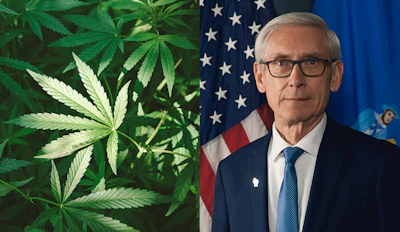

Wisconsin Gov. Tony Evers is pleading his case to the state’s U.S. congressional delegation that a federal ban on intoxicating hemp products would be to the detriment of the Badger State’s economy and farmers.
The Democratic executive sent a letter on Feb. 27 to Wisconsin’s two U.S. senators – Republican Ron Johnson and Democrat Tammy Baldwin – and eight U.S. House members, including six Republicans and two Democrats, asking them for a "legislative solution."
The federal ban, set to take effect in November 2026, will prohibit hemp products containing synthetic (delta-8 THC) or unnatural (HHC) cannabinoids, as well as those with more than 0.3% of total THC (including THCA) or 0.4 milligrams of total THC per container.
“Without legislative modification, this change will have significant implications for Wisconsin hemp farmers, processors, retailers and our broader economy,” Evers wrote to the delegation. “Hemp-derived products currently support a growing sector of legitimate businesses across Wisconsin.”
The governor pointed to a report from the Wisconsin State Journal that the state’s hemp industry provides $700 million in economic production, including nearly 3,500 workers who contribute to their local communities.
As one of eight states nationwide that does not have a medical cannabis program, let alone an adult-use program, Wisconsin’s consumer demand for hemp-derived products remains strong, offering an “important” revenue source for in-state businesses, Evers wrote.
“Under the new federal definition, which would set the legal limit of THC in final hemp-derived cannabinoid products at 0.4 milligrams per container, many of these existing lawful products would be reclassified in a manner that effectively eliminates existing business models, forcing closures, layoffs and lost investment,” Evers wrote.
The federal hemp provisions were tucked into Congress’ deal to reopen the government in November, when President Donald Trump signed an appropriations package to end a 43-day shutdown. Sen. Rand Paul, R-Ky., and Rep. Thomas Massie, R-Ky., opposed the deal because of the hemp-related provisions.
But the appropriations package drew support from nearly all other Republicans in Congress, some of whom chose not to prolong the longest shutdown in U.S. history over their opposition to the hemp-related provisions.
Five days later, Rep. Nancy Mace, R-S.C., who voted in favor of reopening the government, filed legislation to repeal the federal hemp ban altogether.
“Rather than have a substantive, open debate on the future of hemp policy in America, prohibitionists slipped this provision into a must-pass government funding bill, forcing members of Congress to choose between voting their conscience on hemp and paying our military servicemembers,” she said. “This is wrong.”
Paul, Massie, Mace and other U.S. lawmakers on both sides of the aisle in Washington also voiced their concerns about the impacts the forthcoming ban on intoxicating hemp products will have on the nation’s farmers.
Evers shared this concern in his letter.
“Farmers, who have been the backbone of Wisconsin’s culture and economy for generations, must make planting decisions well in advance of each growing season, often committing seed, land, equipment, labor and financing months before harvest,” the governor wrote, adding that hemp crops offer Wisconsin farmers a “strong” diversification option.
According to the U.S. Department of Agriculture, Wisconsin had 470 federally licensed hemp producers as of November.
“Regulatory uncertainty surrounding the definition of hemp undermines their ability to plan responsibly and threatens to disrupt crop selection, with the potential to leave fields sitting idle for the 2026 season and beyond,” Evers wrote. “Without timely federal legislative action, Wisconsin producers may be forced to abandon hemp cultivation altogether, resulting in lost income and diminished economic opportunities, especially in our rural communities.”
The governor called on his state’s delegation to work with their colleagues in Washington to avert “unnecessary economic harm” by pursuing legislation that creates “a workable, science-based hemp definition.”
At the very least, he asked them to support the Hemp Planting Predictability Act, legislation introduced by Rep. Jim Baird, R-Ind., on Jan. 13 in the House to delay the forthcoming federal ban by two years. Two days later, a trio of bipartisan senators filed the same legislation in the upper chamber.
“Congress should not have passed such a sweeping policy change that upends a growing industry,” Baird said with his bill’s introduction. “Instead, Congress should have given farmers more time, creating a more stable environment for farmers to modify their future planting decisions.”
The House version of the Hemp Planting Predictability Act has 30 representatives signed on for co-sponsorship – 17 Republicans and 13 Democrats – including Wisconsin Republican Reps. Tony Wied and Derrick Van Orden, and Democratic Rep. Mark Pocan.
Evers piggybacked on Baird’s comments.
“A longer implementation timeline would provide farmers and their families and small businesses with the certainty and flexibility needed to adjust operations, make responsible planting decisions, and avoid abrupt economic disruptions,” he wrote.
The governor also called attention to what he said were “reckless trade wars and erratic tariff taxes” coming out of Washington that cause “constant chaos and confusion,” making the already strenuous job of farming more difficult.
“Our farmers already deal with enough,” Evers wrote. “State and federal leadership must not turn its back on the farming communities and families who have long been, and always will be, the bedrock of our nation’s continued success.”