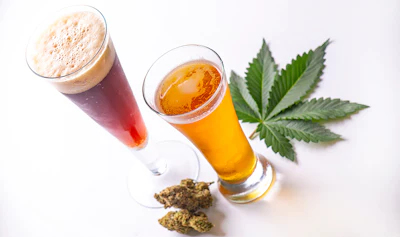

American restaurants that serve hemp-derived THC beverages joined the battle to keep those products legal as they stare down a November 2026 federal prohibition timeline for products containing more than 0.4 milligrams of THC per container.
The National Restaurant Association, which represents the business interests of more than 1 million restaurants and foodservice outlets throughout the U.S., sent a letter June 17 to congressional leaders, asking them to delay the federal government’s forthcoming ban on intoxicating hemp products.
While the association specifically wants to keep hemp-derived beverages legal through a regulated framework, the forthcoming ban also includes any product containing more than 0.3% total THC (including THCA), as well as those containing unnatural (HHC) or synthesized (delta-8 THC) cannabinoids.
Hemp-derived THC beverages, the association asserts, represent not only the difference between profit and loss for many restaurants operating on “razor-thin” margins, but also a “real and growing” consumer interest, said Sean Kennedy, the group’s chief advocacy officer who penned the letter.
“Consumer demand for THC beverages is driven by a shift in drinking habits, particularly among younger diners whose lifestyles are diverging from traditional beverage alcohol,” he said. “For operators – especially those running high-volume beverage venues – these products offer an alternative for guests who want a social drinking experience without alcohol.”
Roughly 5% of the National Restaurant Association’s members who serve alcohol also offer hemp-derived THC beverages, while 26% of all restaurants would be interested in offering the products under clear regulatory guidelines from Congress, according to the business group, which estimated a potential annual market of $1.6 billion.
Under federal cannabis prohibition, restaurants in many states alternatively sell hemp-derived THC beverages that mirror similar products sold in state-licensed cannabis dispensaries, which play by a much more stringent set of rules – from license fees and tax penalties to testing standards, packaging and labeling requirements, marketing and advertising restrictions, and age verification protocols.
While state-licensed cannabis programs that allow cannabis consumption lounges require special permitting, restaurants that offer hemp-derived THC beverages alternatively abide by language in the 2018 Farm Bill defining hemp by a 0.3% delta-9 THC threshold that has largely allowed manufacturers and retailers of intoxicating cannabinoid products to skirt legislative intention.
But the National Restaurant Association is now urging congressional leaders to help establish hemp-derived THC beverage regulatory parity with the cannabis and alcohol industries to ensure “consumer safety while meeting growing market demand,” according to the letter.
“The association supports a regulated market for hemp-derived THC beverages for consumption at restaurants – one built on clear federal standards covering age verification, production and quality assurances, marketing and labeling requirements, dosing disclosures and operationalizable impairment standards,” Kennedy wrote in the letter. “A federal framework that sets baseline standards while empowering state and local governments to tailor market-specific rules – similar to that of alcoholic beverages – would create a safe foundation.”
The letter was addressed to House Speaker Mike Johnson, R-La., House Minority Leader Hakeem Jeffries, D-N.Y., Senate Majority Leader John Thune, R-S.D., and Senate Minority Leader Chuck Schumer, D-N.Y.
The association suggested that its nearly 16-million-member workforce is well-positioned to serve hemp-derived THC products responsibly after having established training and impairment management practices for serving alcoholic beverages.
“Consumers have made it clear that they want hemp-derived THC beverages,” Kennedy said. “The only question is whether Washington will create a way they can enjoy them safely or if they will allow a thriving market supporting small business owners to disappear because they wouldn’t create a sensible regulatory framework.”
According to the association, the median full-service restaurant’s pre-tax margin fell from 4% in 2019 to 2.8% in 2024, with 42% of operators reporting no profit at all in 2025. The group argued that hemp-derived THC beverages can help the industry remain competitive.
Meanwhile, 73% of state-licensed cannabis operators, which compete against hemp-derived THC products, reported no profit at all as recently as 2024, according to a Whitney Economics U.S. cannabis business conditions survey.
The restaurant association asked the congressional leaders to at least delay the forthcoming hemp product ban by two years to “provide the predictability operators need” and to allow Congress to rethink its approach for a regulatory alternative that responsibly meets consumer demand.
“Time is short – the existing market will shut down in November due to legislation enacted last year,” Kennedy said. “We urge Congress to act now: Delay implementation and commit to the deliberate, safety-focused regulatory process which this emerging market deserves.”
The National Restaurant Association’s letter comes at a time when President Donald Trump is calling on Congress to update legislation so that “Americans can continue to access the full-spectrum CBD products they have come to rely on,” suggesting that the forthcoming federal ban’s definition is too narrow for the majority of hemp-derived products in today’s marketplace.
It also comes as U.S. lawmakers have proposed modifying, delaying or stopping the ban’s forthcoming implementation altogether.