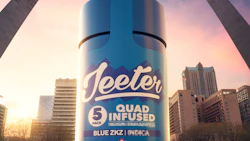


Missouri House lawmakers decided that their state’s intoxicating hemp product laws need to align with a forthcoming federal ban, despite their cannabis laws doing just the opposite.
The chamber voted, 109-34, on Feb. 19 to pass House Bill 2641, legislation that would redefine hemp and establish the “Intoxicating Cannabinoid Control Act,” prohibiting most hemp-derived cannabinoid products from being sold outside the state’s licensed cannabis framework by Nov. 12, 2026, if enacted. The bill now heads to the Senate.
Before the House vote, lawmakers debated whether the bill would create a carve-out for drinkable cannabinoid hemp products and if it would establish a “marijuana monopoly” by putting 2018 Farm Bill-compliant mom-and-pop shops out of business to the benefit of licensed cannabis dispensaries.
“What my bill does is it aligns with the new federal definition of hemp, and it puts it in there exactly as the federal definition is,” said Rep. Dave Hinman, R-O’Fallon, who sponsors the legislation.
“The federal government is saying, if it is an intoxicating product, then it could not be sold out publicly. Any intoxicating product has to be sold in a regulated market,” he said. “Basically, what we are doing is just following the federal government’s new law. We are not giving anything over to the marijuana industry.”
The 15-page Missouri bill aligns with federal provisions tucked away into a government-reopening appropriations package that President Donald Trump signed in November 2025, which provided a one-year exit ramp for unregulated retailers – like gas stations, convenience stores and smoke shops – to remove noncompliant products from their shelves.
The federal government’s forthcoming ban includes hemp products containing synthetic (delta-8 THC) or unnatural (HHC) cannabinoids, as well as those with more than 0.3% of total THC (including THCA) or 0.4 milligrams of total THC per container.
Hinman later said that the intent of aligning Missouri’s hemp statutes with the federal government’s definition was to allow state law enforcement, highway patrol, local prosecutors and the Missouri attorney general’s office to “work in tandem with our federal partners – no gaps; no loopholes.”
Rep. LaKeySha Bosley, D-St. Louis, voted against the bill, offering her concerns on the floor.
Bosley said she believes the language on the last page of the bill would create a carve-out for beverage products, because it states that hemp-derived cannabinoid products sold to consumers in the form of “any solid candy, gummy, chewable product, tablet, capsule, oil, baked good, or other solid edible product” would become prohibited on Nov. 12 no matter what happens at the federal level.
Under the Missouri bill, should Congress choose to delay its ban by two years – there are House and Senate proposals to do just that – or to withdraw the pending ban entirely, then hemp-derived beverage products would remain legal in the Show-Me State.
“I think that it is disingenuous to say that we’re trying to give the federal government an opportunity to change their mind when the language explicitly says in the amendment, everything in [paragraph A] shall be illegal except for ‘all other hemp-derived cannabinoid products not described in paragraph A,’ which means drinks are not included in this; period,” Bosley said.
Bosley also said she favored regulations to safeguard youth and public health over a prohibition measure that she believes would force family businesses to close in rural communities that struggle with access to health care.
Rep. Matthew Overcast, R-Ava, also took issue with the bill for what he said plays favorites to hemp-derived beverage stakeholders and affords monopolization to the cannabis industry.
“It created a carve-out for a single sector: the beverage industry,” he said. “In practical effect, it eliminates roughly 90% of Missouri’s federally lawful hemp industry, while preserving a narrow lane for the favored few, further entrenching Missouri’s existing marijuana monopoly. That is not public safety; that is not safety policy. This is picking winners and losers.”
Overcast argued that the Missouri Constitution already defines marijuana by “expressly” excluding hemp.
“We cannot rewrite voter-adopted language by statute simply because certain market participants prefer less competition,” he said. “If protecting children was truly the goal, we know what works: age restrictions, testing standards, clear labeling, packaging safeguards, responsible retail rules.”
Later in the floor debate, House Minority Leader Ashley Aune, D-Kansas City, questioned whether Overcast had a conflict of interest, flagging a written disclosure Overcast filed last month for a potential equity ownership in a Minnesota-based THC beverage company, Lagom Naturals LLC, which ships its products through online orders.
“I’m curious if you plan on voting on this piece of legislation,” Aune said.
“Actually, yes, I do,” Overcast said. “I don’t have a conflict. I filed that as a preemptive thing … I was offered a job, and I was contemplating it. But no terms have been discussed. There was no agreement. So, I was trying to be completely transparent.”
Aune asked, “So you don’t have a conflict yet, but I guess I’m curious if we get this bill passed, and you have taken a vote on it, what are the chances that in the next few weeks you do end up with inequity?”
“If it would make the body feel better, I’ll vote present,” Overcast said. “This is not about that. This is about simple policy.”
“I would love for everything in this room to be about simple policy,” Aune said. “It rarely is.”
Aune voted in favor of the legislation. Overcast voted against it.