
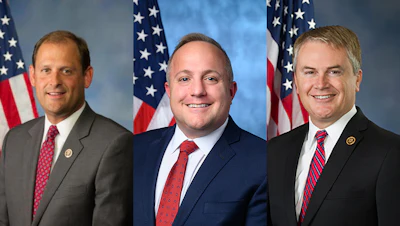

Three U.S. House Republicans are hoping to either regulate intoxicating hemp products, delay an upcoming federal ban by two years, or prevent the ban’s implementation altogether in separate proposals filed this week.
The congressmen submitted their amendments ahead of a May 28 deadline for the Agriculture, Rural Development, Food and Drug Administration (FDA), and Related Agency Appropriations Act of 2027. The House Committee on Rules reserves the power to consider amendments for the legislation, House Resolution 8646, before the underlying funding package advances to the lower chamber’s floor.
The three hemp-related amendments, if considered, would disrupt, in one form or another, the Nov. 12, 2026, implementation of legislation that upends the 2018 Farm Bill’s federal definition of hemp that has allowed products containing intoxicating derivatives to swell the shelves of gas stations and smoke shops nationwide.
The new definition, set to take effect later this year after President Donald Trump signed legislation to reopen the government last year, will ban hemp-derived products containing more than 0.4 milligrams of total THC per container, or those containing synthesized (i.e., delta-8 THC) or unnatural (i.e., HHC) cannabinoids. In addition, the new law defines hemp as containing no more than 0.3% of total THC (including THCA).
Rep. Andy Barr, R-Ky., one of the three lawmakers who offered hemp-related amendments this week, is hoping to overhaul those prohibitive restrictions on intoxicating products with a proposed taxed and regulatory framework. Barr’s bill (detailed below) is the most comprehensive of the three amendments.
Rep. Russell Fry, R-S.C., filed an amendment that aims to delay the November 2026 implementation by two years, through simply striking “365 days” and inserting “3 years” into Section 781 of the 141-page agricultural spending bill that Trump signed last year as part of the government reopening deal.
And Rep. James Comer, R-Ky., filed an amendment that attempts to halt the forthcoming ban’s enforcement mechanisms altogether, by stating that “none of the funds made available by this act may be used to implement Section 781” of the Trump-signed appropriations package.
In April, when the U.S. House passed the 2026 Farm Bill, leaving the forthcoming hemp product ban intact, Comer unsuccessfully sought a one-year delay in the ban’s enactment.
“The hemp industry is facing significant challenges and growing uncertainty, and it is long past time for Congress to provide farmers and business owners with the clarity they need to succeed,” he said at the time. “This uncertainty is already having a negative effect, and it is impacting real people, real jobs and real communities across the country, particularly in rural America.”
Barr’s amendment, the “Lawful Hemp Protection Act,” is much broader, offering a regulated pathway to “promote responsible industry growth, protect consumers and reinforce confidence in lawful hemp commerce.”
The 25-page bill would redefine hemp to include a 1% delta-9 THC threshold on a dry-weight basis, but that delta-9 concentration would be measured on the finished consumer product (not on raw, floral hemp material or work-in-progress material) and would exclude cannabinoids not found in or capable of being naturally produced by the plant.
The bill also intends to add hemp-derived consumable product labeling requirements to show how many milligrams of THC per serving and package a product contains, as well as the following statement: “GOVERNMENT WARNING: (1) According to the Surgeon General, women should not consume hemp products during pregnancy because of the risk of birth defects. (2) Consumption of hemp products impairs your ability to drive a car or operate machinery and may cause health problems.”
Barr’s proposal also aims to prevent hemp-derived consumable product packaging from imitating or mimicking a trademarked or well-known product, or from targeting anyone under 21 years old, and to require in-person or virtual age verification for all sales.
“Protecting minors and preventing children’s access to hemp products is central to the public interest and to the long-term credibility of the hemp industry,” the bill’s finding section states. “Strong age-control measures are necessary to prevent misuse and safeguard public health.”
Barr’s proposal also contains a provision to allow for Medicare coverage of certain hemp-derived products, aligning with a new Centers for Medicare and Medicaid Services (CMS) CBD pilot program that commenced on April 1 under former FDA Commissioner Marty Makary’s direction and with Trump’s blessing.
“Many Americans, including veterans and seniors, rely on consumer hemp products for wellness,” the bill states. “Ensuring that such products are consistently manufactured, accurately labeled, and domestically sourced is essential to maintaining public trust and protecting consumers.”
The legislation would also impose a 5% federal tax on hemp-derived consumable products that are sold in interstate commerce, excluding beverages. Hemp-derived beverages would be taxed at a rate of 5 cents per THC milligram, with revenue helping support enforcement of a zero-tolerance policy for impaired driving.
Barr’s proposal also intends to protect states’ rights to implement their own regulatory authorities on intoxicating hemp products that don’t disrupt federally compliant interstate commerce.