
As part of Donald Trump’s 2026 National Drug Control Strategy, his administration claimed a “new legal authority” to combat intoxicating hemp-derived substances thanks to a “hemp loophole closure” the president signed into law last year.
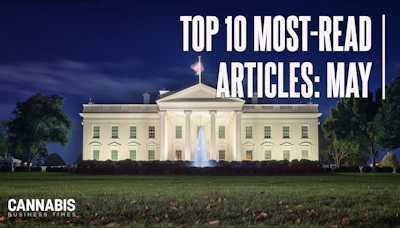
This storyline captivated the attention of cannabis and hemp industry stakeholders alike as the No. 1 most-trafficked article in May for Cannabis Business Times readers.
The biennial report, prepared by the White House Office of National Drug Control Policy (ONDCP), provides a strategic roadmap to dismantle the illicit drug supply in the U.S., including unregulated psychoactive derivatives of hemp, such as delta-8 THC, delta-10 THC, THC-O, THCP and other analogues.
“Enforcement will focus on substances falling outside regulatory frameworks or being sold illegally,” the ONDCP report states. “Shutting down these domestic sources of harmful substances is crucial to degrading the overall availability of illicit drugs within our communities.”
Other articles CBT readers did not want to miss this month included those on the U.S. House passing the Farm Bill; the “need” for medical cannabis businesses to register with the Drug Enforcement Administration (DEA); a warning to industry operators about jumping the DEA registration bandwagon from a former federal prosecutor and an IRS law expert; and the DEA responding to CBT on its intentions for the registration process.
In the No. 2 spot, the federal government’s forthcoming intoxicating hemp product ban remained in place in the House passage of the 2026 Farm Bill, despite multiple lawmakers continuing to assure farmers, manufacturers and retailers that they’re working on potential fixes to keep those products on the market.
In the No. 3 spot, a legal sidebar from the nonpartisan Congressional Research Service states that “all entities” other than end users that handle medical cannabis products that are covered under Acting Attorney General (AAG) Todd Blanche’s Schedule III order “will need to register with DEA in order to do so lawfully.”
RELATED: The Biggest Things About Schedule III You Haven’t Thought Of
However, taking the No. 4 spot in this month’s Top 10 most-read articles, former federal prosecutor Julie Werner-Simon and former IRS lawyer Jonathan Kalinski warn medical cannabis operators about the implications of “jumping” on that DEA registration “bandwagon.”
“Becoming a part of the new federal ‘registration pathway’ (AAG order, page 21) cedes tremendous authority to federal authorities,” Werner-Simon and Kalinski wrote. “The DEA’s discretionary denial doorway (DDDD) is extensive. Federal approval can be denied if the DEA finds that granting a state-licensed business federal (DEA) registration is ‘inconsistent with the public interest’ or inconsistent with drug treaty requirements.”
And in the No. 5 spot, the DEA responded to CBT’s inquiry about red-flag questions on the Schedule III registration application, including one question related to an admission of past federally noncompliant actions. “It is not intended to serve as a categorical barrier, but rather to support a complete and fair evaluation of each application,” the DEA told CBT.
Don’t miss out on the rest of our Top 10 stories from May 2026.