
While it comes as no surprise to industry advocates, hemp’s future extends far beyond flower, cannabinoids, fiber and grain. New research reveals that hemp-derived cannabidiol (CBD) could someday play a significant role in replacing petroleum-based plastics—opening the door to entirely new industrial markets for hemp growers.
In a recent study published in the journal Chem Circularity, researchers unveiled a breakthrough CBD-based thermoplastic that could one day rival or even replace common petroleum-derived plastics. This includes PET (polyethylene terephthalate), widely used in single-use water bottles and other packaging.
The first of its kind, the CBD-derived thermoplastic combines the heat resistance, strength and processability manufacturers depend on in conventional plastics while introducing a renewable, CBD-based alternative with intriguing new capabilities.
As such, the newly released polymer, aka polycannabidiol carbonate (pCBDC), represents a milestone not only for hemp-derived materials but for the broader future of hemp cultivation and large-scale CBD extraction.
Reimagining Plastics Through Hemp
The research team behind the innovation includes Gregory Sotzing, Ph.D., a University of Connecticut chemistry professor whose work focuses on polymers from natural resources and cannabinoids, and Purdue University’s Mukerrem Cakmak, Ph.D., a professor of materials and mechanical engineering who specializes in polymer processing. Dr. Greg SotzingPhoto courtesy of Greg Sotzing
In a collaboration that spans 16 years, Sotzing synthesizes the polymers, then Cakmak engineers them into practical, useful products. Recently, CBD-based polymers have taken the spotlight with the team.
Cakmak explains that small CBD molecules, or monomers, extracted from hemp possess functionalities that allow them to serve as building blocks for long-chain polymers. These CBD molecules can be engineered into a wide range of plastics, including polycarbonates and polyesters, each with distinct properties and applications.
“That’s one of the exciting things about CBD monomers,” Cakmak says. “They can be combined to make all kinds of different plastics, not just simply one plastic, but a variety of plastics with different purposes.” These purposes include high-performance materials.
In a “bird’s-eye view of plastic,” Cakmak explains that plastics generally fall into two categories: commodity plastics, such as polyethylene, and higher-value engineering plastics designed for demanding applications involving elevated temperatures or mechanical stress. Until now, bio-based plastics have struggled to compete in the engineering category. Dr. Mukerrem CakmakPhoto courtesy of Mukerrem Cakmak
“We’ve never had a bio-based plastic in the engineering category that can be used for high-temperature, high-value applications,” Cakmak notes.
For a bio-based plastic to provide a viable alternative to petroleum-based plastics, it must balance specific requirements. It needs enough thermal stability to withstand medium to high temperatures during use, yet it must also melt and flow easily during manufacturing so it can be shaped into bottles, films or molded components.
According to the researchers, the new 92% bio-based pCBDC is the first hemp-derived polycarbonate to successfully achieve that balance.
Capitalizing on Stretch, Strength and Heat Resistance
Sotzing notes that the new material’s remarkable properties are very rare among plastics made from natural resources.
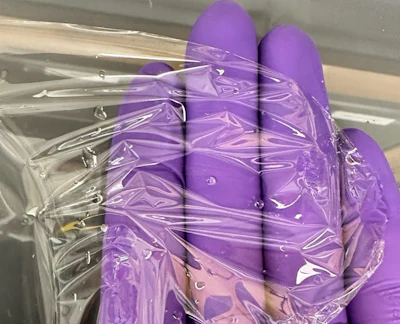
The polymer can stretch up to 1,600% of its original size without significantly changing its gas diffusion properties. At the same time, the material has a high “glass transition temperature”—the point at which a material’s physical properties shift and rigid polymers become flexible.
In practical terms, the pCBDC retains its shape, stability and strength under CBD polycarbonate films stretched under crossed polarizers (P = polarizer, A = Analyzer directions)Photo courtesy of Mukerrem Cakmak, Ph.D.
In addition, many bio-based plastics require catalysts during production, requiring additional purification steps to remove the catalyst from the final product. Those extra processes add cost and complexity. But the new CBD-based polymer can be produced from CBD isolate without the need for catalyst additives.
The resulting polymer also exhibits a “very high contact angle with water,” which translates to a water-repellent surface. That low wettability could prove valuable in medical applications such as catheter coatings or nanoparticles used in targeted drug delivery systems.
In one more benefit, Sotzing says the molecular structure of CBD is surprisingly similar to BPA (bisphenol A). BPA, the endocrine-disrupting industrial chemical commonly used in plastics and epoxies, has raised concerns because of its ability to leach into food and beverages (hence the emergence of BPA-free plastic water bottles, among others).
“What we’re doing,” he explains, “is replacing the BPA with CBD and making polycarbonate high-performance plastic.”
Transcending Common Packaging
While sustainable packaging remains an obvious future market, the researchers are already looking well beyond disposable bottles and containers.
At the center of Sotzing and Cakmak’s long-running collaboration (and newly formed company) is a growing focus on energy applications. The pair has participated in a $20 million U.S. Navy project developing polymer films for high-temperature capacitors used in advanced energy systems, including electromagnetic aircraft launch systems.
Dr. Cakmak explains that modern capacitor technology relies heavily on polypropylene, a material with limited heat tolerance. As a result, most capacitor systems require separate cooling units, adding weight and complexity.
“Capacitors are what give you acceleration in a car,” Sotzing adds. “It’s what launches these aircraft off aircraft carriers,” noting capacitors store the energy and then release it quickly.
Higher-temperature polymers, such as the new CBD-derived materials, could eliminate the need for additional cooling systems, meaning the devices involved can be lighter. This opens the door to applications from automotive and electrical to aerospace technologies and beyond.
Addressing the Challenge of Scale
Despite the promise of PET-replacing polymers, the researchers acknowledge that hemp-based plastics remain in the early stages of commercialization. The biggest challenge is the underlying expense of the raw material, driven by the cost of CBD-hemp cultivation and CBD extraction at an industrial scale.
Cakmak says inconsistent demand has made CBD-hemp production volatile, leaving farmers uncertain about long-term markets. But as demand for new CBD-based polycarbonates stabilizes and increases, the researchers hope CBD-hemp could expand and be “grown like corn” and other major commodity crops. They also note that genetic modifications may allow hemp to produce even higher concentrations of CBD, increasing efficiency and lowering costs further.
But for now, Cakmak and Sotzing are focused on lower-volume, high-value markets where premium price points support the current economics of CBD. While they didn’t share details right now, a soon-to-be-released CBD-based polymer is aimed at performance-driven industries willing to invest in advanced materials.
Sotzing recalls one recent moment that underscored both the opportunity and the challenge ahead.
“I did have a major corporation ask for 50 tons of material. Now you get a 50-ton order, and it’s like where do I get 35 tons of CBD [to produce 50 tons of pCBDC]? So, it’s one of those things,” he says. “… Once you get this to catch on to a plastics-type industry, there can be a steady supply or need of that CBD.”
For growers still searching for stable long-term markets, the emergence of hemp-based plastics could represent more than a scientific breakthrough. If innovation, demand and supply can coalesce, hemp’s next industrial chapter may be as a cornerstone of high-performance manufacturing.