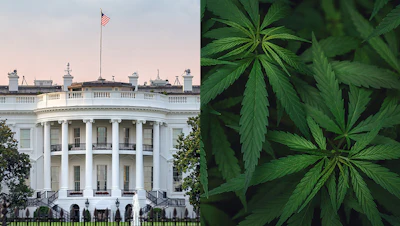

White House officials will review a Food and Drug Administration (FDA) proposed rule concerning CBD product compliance and enforcement policies during a series of meetings on April 1 and April 2.
The White House Office of Management and Budget’s (OMB) Office of Information and Regulatory Affairs (OIRA) informed the public on March 13 that it received the CBD guidance recommendation from the FDA.
But the April meeting dates weren't released until this week, and the OIRA has yet to publish the proposed rule that’s now under its review.
The meetings were requested by David Heldreth, CEO of Panacea Plant Sciences (3 p.m. on April 1); Trent Woloveck, chief strategy director of Jushi Holdings (3:30 p.m. on April 1); Earl Ramey, an Iowa hemp farmer (10 a.m. on April 2); and Mackie Barch, of Story Cannabis (11 a.m. on April 2), according to the OIRA.
The meetings, less than a week away, come after the FDA missed a 90-day deadline mandated under federal legislation that President Donald Trump signed in December, which will recriminalize most consumable hemp-derived THC products that are on the market today.
Beginning in mid-November, hemp-derived products containing more than 0.4 milligrams of THC “per container,” as well as those containing “synthetic” (delta-8 THC) or “unnatural” (HHC) cannabinoids, will be federally prohibited, addressing what many lawmakers in Congress call a “loophole” in the 2018 Farm Bill that allowed intoxicating hemp products to proliferate.
The Trump-signed legislation ordered the FDA to publish a list of natural and synthetic cannabinoids and provide a definition for “container” by Feb. 10, a deadline that has come and gone.
While it’s unclear if the FDA’s proposed rule with the OIRA will address the congressional mandate, or perhaps include guidance related to Trump’s executive order to reclassify cannabis as a Schedule III drug, the FDA has long resisted setting forth regulations for the production, marketing and sale of CBD products following the 2018 Farm Bill federally legalizing commercial hemp cultivation.
Without FDA regulations and oversight, some argue that many CBD products aren’t accurately labeled and tested, and good manufacturing practices aren’t always adhered to, sometimes leading to misleading product claims that can put consumers at risk.
In January 2023, the FDA acknowledged that a “regulatory pathway for CBD is needed that balances individuals’ desire for access to CBD products with the regulatory oversight needed to manage risks,” but, instead of doing the heavy lifting, the federal agency kicked the can to Congress.
At that time, the FDA also denied a trio of citizen petitions, urging the agency to conduct rulemaking to allow for the marketing of CBD in dietary supplements, conventional foods or animal products, such as chicken feed.
Instead of providing guidance, former FDA Principal Deputy Commissioner Janet Woodcock said the agency would continue to crack down on companies illegally selling CBD in violations related to the Federal Food, Drug, and Cosmetic (FD&C) Act.
“The FDA will continue to take action against CBD and other cannabis-derived products to protect the public, in coordination with state regulatory partners, when appropriate,” Woodcock said. “We will remain diligent in monitoring the marketplace, identifying products that pose risks and acting within our authorities. The FDA looks forward to working with Congress to develop a cross-agency strategy for the regulation of these products to protect the public’s health and safety.”
More recently, when Trump issued his executive order in December, he also acknowledged the need for CBD regulations and research to better inform patients and doctors.
More specifically, he directed the FDA to coordinate with the Department of Health and Human Services (HHS), the Centers for Medicare and Medicaid Services (CMS) and the National Institutes of Health (NIH) to develop research methods and models “utilizing real-world evidence” to improve access to hemp-derived cannabinoid products.
The FDA, CMS and NIH all operate under the HHS.
“A recent study found that some commercially available CBD products evaluated were inaccurately labeled regarding CBD isolate, broad-spectrum, or full-spectrum composition, posing safety risks for consumers,” the president wrote in the order. “In short, the current legal landscape leaves American patients and doctors without adequate guidance or product safeguards for CBD.”
But the FDA’s proposal under OIRA doesn’t mention research in its title; it includes “compliance and enforcement.”
Separately, the CMS, through Administrator Mehmet Oz, is working toward adopting a new policy to allow doctors to recommend hemp-derived CBD products to older Americans as an alternative treatment, including up to $500 per year in coverage for those products, beginning in April.
Eligible products under the CMS program would include those containing no more than 0.3% delta-9 THC and “expressly excludes” inhalable products or those containing more than 3 milligrams per serving of THC (including delta-8, delta-10 and THCA) in orally transmitted form. However, once the federal government’s forthcoming ban on intoxicating hemp products is implemented in November, the CMS would change its rules to align with federal law.
While the public awaits the specifics of the FDA’s proposed rule concerning “Cannabidiol (CBD) Products Compliance and Enforcement Policy,” the next stage is scheduled to unfold during the OIRA’s meetings with at least three requestors next week.