
Five months after lawmakers in Washington failed in their attempt to block the Trump administration from rescheduling cannabis, they’re back at it in preparing a similar appropriations bill for the next fiscal year.
The U.S. House Appropriations Subcommittee on Commerce, Justice, Science (CJS) and Related Agencies voted on April 30 to advance the fiscal year 2027 CJS spending bill, which proposes $38.6 billion in discretionary spending for the Department of Justice (DOJ). The bill also provides annual appropriations for the Department of Commerce, the National Aeronautics and Space Administration (NASA) and other federal agencies.
The current version of the 148-page bill intends to block the DOJ from using its funds to “reschedule marijuana … or to remove marijuana from the schedules established under section 202 of the Controlled Substances Act [CSA].”
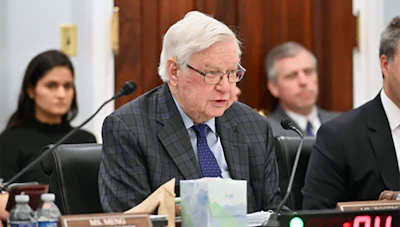
During his opening remarks, Rep. Hal Rogers, R-Ky., the subcommittee’s chairman, said Congress is dedicated to meeting “the needs of the American people” and to “support the administration’s efforts” through crafting and improving the fiscal year 2027 CJS bill and other appropriation packages.
“That’s why I’m proud to present the fiscal year 2027 CJS legislation, which carries on our work of right-sizing our federal government to ensure Washington, D.C., is working on behalf of our citizens and not against them,” he said. “The bill before us today provides a total of discretionary allocation of $77.341 billion, a $670 million decrease in spending below the fiscal year 2026 enacted level, to support President Trump’s fight against fraud.”
During the nearly 90-minute markup, none of the subcommittee members mentioned that the anti-rescheduling provision goes against the American people and President Donald Trump’s wishes to loosen restrictions on cannabis and support scientific research into the plant, with Acting Attorney General Todd Blanche signing two orders on April 23 to follow through on the president’s Schedule III directive.
The executive branch’s authority to schedule, reschedule or remove substances from the CSA is delegated to the attorney general, but Republican lawmakers in the CJS subcommittee are hoping to reserve that power exclusively for congressional action within the legislative branch.
The CJS bill now heads to the full House Appropriations Committee, where it is scheduled for a May 13 markup. The Republican-controlled committee included the same rescheduling-stripping cannabis provisions when it advanced the fiscal 2026 federal funding bill last year, but House and Senate appropriation leaders ultimately removed that language in a bicameral agreement before its final passage.
Also included in the subcommittee’s 2027 CJS proposal is a 12-year-old rider that would continue to prevent the DOJ from interfering with specific states and U.S. territories when it comes to allowing them to implement “their own laws that authorize the use, distribution, possession or cultivation of medical marijuana.” There are no adult-use protections provided in the rider, but the federal government has mostly taken a hands-off approach to state-sanctioned operations.
The rider specifically protects 48 states, Washington, D.C., the Northern Mariana Islands, the U.S. Virgin Islands, Guam and Puerto Rico, explicitly excluding two states and one territory: Idaho, Kansas and American Samoa, which maintain some of the least permissive cannabis laws in the nation.
This long-standing rider’s inclusion by the subcommittee comes after Darin Smith, the U.S. Attorney for the District of Wyoming, indicated in November that the DOJ, under former Attorney General Pam Bondi, rescinded Biden-era guidance and gave U.S. district attorneys nationwide the green light to enforce federal prohibition laws by “rigorously” prosecuting Americans who possess personal amounts of cannabis on federal land.
A spokesperson for Smith’s office told WyoFile at the time that the Trump administration believes cannabis use is a “public safety hazard,” but the president’s actions to loosen restrictions on cannabis suggest otherwise.
When Trump signed an executive order in December directing his administration to move cannabis to Schedule III, recognizing its medicinal value, 26 House Republicans sent the president a letter attempting to talk him out of that decision.
“Schedule I drugs are addictive and have no medical value. Marijuana fits squarely into this category,” they wrote. “Rescheduling marijuana will not make America great. You have always been a role model for America’s youth, telling young people for years that they should never do drugs. We hope that you consider the harms of marijuana rescheduling and continue sending that strong message of hope to the next generation.”
The letter signers included several House Appropriations members, including Reps. Andy Harris, R-Md.; Robert Aderhold, R-Ala.; John Rutherford, R-Fla.; Chuck Edwards, R-N.C.; Michael Simpson, R-Idaho; and Michael Cloud, R-Texas.
In terms of CJS Subcommittee Chair Rogers’ comments about Congress working on behalf of its citizens, researchers at Johns Hopkins University and the University of California San Diego reported on April 29 that Americans overwhelmingly support cannabis rescheduling.
The researchers used artificial intelligence to analyze more than 42,000 public comments in the proposed rescheduling rule from 2024, finding that 63.5% support even more reform, 28.9% support Schedule III as proposed, and 6.7% oppose any change.
“Many commenters have lived under state legalization for medical or adult use for years already,” said study co-author Johannes Thrul, an addiction researcher at Johns Hopkins. “Their expectation of federal policy reflects that reality.”