
California craft indoor cannabis grower Moon Valley Cannabis uses thick soil beds teeming with life to achieve award-winning top-shelf cannabis. It’s radically different from hydroponically grown, bottle-fed farming where plants are devoid of the bacteria, fungi, and other living organisms that roots coevolved with and derive nourishment from. But how practical is employing roly-polies, nematodes, and funky fermentations in modern cannabis’s industrial jungle?
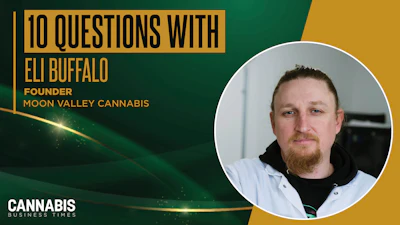
Founder Eli Buffalo’s first garden was a 10-lighter in a barn that he had to shutter in 2017. He got the keys to his current facility in 2018, started legal sales in 2021, and has won multiple awards out of Santa Rosa, Calif., since.
The 11-year-old company has two grow locations (licensed under Moon Valley Organics, Inc. and Moon Valley Pharms LLC), 350 lights, and produces about 60 to 80 pounds of top-shelf, dried, cured flower buds per month. Just 10 employees manage the entire chain, from cloning to compliance. Buffalo does all the graphic design work himself. Moon Valley's Neon Panther cultivarPhoto courtesy of Moon Valley
Based in west Sonoma County, the former motorcycle mechanic turned biodynamic cannabis farmer takes us from soil microbiology to macroeconomics in this “10 Questions With …” interview for Cannabis Business Times.
Editor’s note: This interview has been edited for length and clarity.
David Downs: When you look back at all the trophies you’ve won, which ones are going to stand out the most and why? Which one makes you smile?
Eli Buffalo: We're proud of all of them. But the first one would have been winning 1st Place for Environmentally Conscious Indoor at the Emerald Cup 2022.
I thought that was really cool because we had just finished building this facility that we’re in in Santa Rosa … and getting recognized right at that first Emerald Cup after finishing the facility and finishing our first garden.
And then getting these recent Zalympix awards. We got second place for best-tasting flower, and then that qualified us into the Winner’s Flight.
The awards that we’ve won at the Zalympix are [2nd Place] Best Tasting [for Watermelon Z] and [3rd place] Best Terps [for Super Boof]. I’m doing this because I want my flowers to taste the best, and I want the best-smoking flower. I don’t need it to necessarily look all that flashy and pretty as much as I want it to taste and feel good, as well as being something that’s produced in a way that I feel comfortable and good about.
Downs: What’s the biggest misconception about living soil that you wish would go away forever? A Moon Valley soil bed under canopyPhoto courtesy of David Downs
Buffalo: People thinking that you need to flush your weed is kind of probably the biggest one. Maybe when you’re [using] synthetic fertilizers and whatever people are using—that’s something you don’t really want in your finished flower.
But with what we’re doing, if we were to try to flush our soil beds, it just doesn’t really make sense, and it doesn’t really work and function.
Downs: Do you recommend other growers switch to living soil or try it if they’ve been working in hydroponics?
Buffalo: That’s one of the main reasons why we set out and did all of this. I wanted to show the world that you can produce high-quality flower indoors – something that’s better for the people and better for the planet.
Downs: Can the results of living soil be achieved by any other means?
Buffalo: I have no clue. I’ve just not seen it personally. I’ve seen a lot of salt-grown weed that looks really purple and frosty. I’ve tried a lot of it and gotten to the point where I don’t really want to try other people’s weed anymore because of the amount of times it’s just harsh on my throat. I don’t like the taste. … It’s just this weird sterile thing.
And then the high that I get from it, it’s just so night and day different.
It’s similar to saying “Can you replicate the sun?” Which we can’t do. We do as best as we can, but there’s no comparison to what the sun’s going to produce. We can’t do what the sun’s doing, but we can try our hardest to replicate the natural soil that’s found in the earth and the different natural processes that occur outside, and bring that inside and try to control the environment and the lighting.
I think there’s a difference in the high related to how the soil is working with the plant symbiotically and letting the plant fully express all these things that you’re just not really going to be able to replicate because of all the different types of things that are going into our soil and all the different microbes that are doing all those different processes and the exchanges that they’re having with the plants. I don’t really see how it could be replicated.
With how we do it, we have different micro and macronutrients as well as macro and microbiology that’s doing a lot of that work. The fermentations that we do encompass a lot of biology. And that biology is breaking down organic matter and making plant-available nutrients.
Downs: Are people right to believe what they have heard that living soil does not scale or is not controllable enough compared to other commercial methods? A Moon Valley flower roomPhoto courtesy David Downs
Buffalo: Yeah. Totally. It’s very difficult to scale living soil the proper way. The way that we do it, it’s really difficult, just because we’re making our own compost. We’re making our own ferments.
You could do it, but you would have to have a farm on the side that produces lots of plants and herbs and different things that we use that we produce either on-site here or at other locations that we have.
I’ve talked to some people that are trying to set up multiacre greenhouses and have asked me, like, could they do that with living soil?
You could, but you would probably want to have at least an acre of non-cannabis sitting next to those greenhouses to be able to create all of the stuff that you need.
Downs: Is the market getting better or worse for your terpy top-shelf flower?
Buffalo: It’s getting better. It’s been kind of up, down, and all around. The difficult thing that we’ve struggled with is we’re a small group of people up here in Sonoma County, and California is a really big state.
To be able to get what we’re doing and what makes our flower different across to every consumer in the entire state is a challenge for us.
Downs: Moon Valley consistently seems like a bargain at $40 per eighth, given how good it is.
Buffalo: Our prices are competitive for how good our flower is, and it’s not really where I wanted to be.
We had started out at $25 wholesale and then we would be a little bit flexible with the pricing.
And then just as time went on, working a little bit in the bulk market, that’s something I don’t really want to participate in.
So, I would rather drop the price on my flower a little bit to sell more volume in jars and just not have to participate in the whole bulk market. That was our decision. I wasn’t really too hip with it, but it’s helped out. And it makes the flower more accessible to more diverse budgets.
Now that we’ve brought the pricing down a little bit, we have to follow up with more education, more presence in the dispensaries.
That’s something that I’m actively working on right now, just trying to be able to navigate how I can put myself in 300 different stores in California and talk to staff members and talk to the budtenders and talk to the consumers and all that stuff.
It’s a tricky balance. It’s not necessarily where I want to be price-wise.
But getting it out there and just trying to continue to be innovative and work on our internal COGS [cost of goods sold] and efficiencies to get our cost to produce down a little bit more is a better way for us and for everybody.
Downs: Where did you learn [Korean Natural Farming], and where do you recommend people start?
Buffalo: I learned KNF through a multi-stage process. A good friend of mine is a biodynamic farmer. Josh [Weigleitner] here, my head cultivator, was also highly influenced through biodynamics. Back in 2005, my first garden was with Josh.
I worked for [American viticulturist] Phil Coturri in Sonoma who’s a pioneer of biodynamic grape growing in Sonoma County and pretty much all over the place.
And then working at Benziger Winery, another big biodynamic winery and working directly with Mike [Benziger] as his mechanic. He knew that I was interested in it. We’d get to make the preparations. It was super-fascinating how it’s all fermentation. That was something that I didn’t really get until taking some classes with [world-renowned soil biologist] Dr. Elaine Ingham.
I came across the [founder of Korean Natural Farming] Master Cho’s handbook. And that was just a real eye-opener for me because it was all the things that I wanted from fermentation without a lot of the things that I didn’t like from fermentation that I had known previously.
It’s a very easy to read, step-by-step breakdown: when you use it, why you use it, how you use it, and it’s very simple.
I’ve been doing KNF since 2013. We’ve had ferments tested to see what the nutrient content is of them, and they’re packed full of nutrients. It’s definitely something that works. There’s a free PDF that you can download on the internet.
I got to meet Master Cho, hang out with him and took one of his classes and was able to spend the night at the property where he was staying. We had this big dinner together, and it was a really cool experience.
One of the things I learned when taking his class was, “Don’t go out trying to buy stuff that’s not from your local area.” If you’re getting into Korean Natural Farming – I prefer to just call it natural farming because I’m not in Korea – focus on the things that you have available to you. You can always look and see what kinds of nutrients you find in different plants, what kind of minerals, what types of things are in different things that you have available to you.
Downs: What are some of the most beneficial bugs or companion plants or micro-organisms that help regulate your garden?
Buffalo: The roly-polies are a blessing and a curse. They’re great, but they reproduce really quickly, and you have to keep them fed. If you don’t feed them, they’re just kind of a pain in the *ss.
That’s actually an issue that we’ve had over at our Sonoma facility. We’ve been trying to get our cover crop reestablished, but there’s so many roly-polies that will come through and just eat the seeds as fast as we can sprout them. We have to trap them.
We’ll probably be putting some little pieces of fruit throughout the beds, and those roly-polies will kind of all flock to those pumpkins or apples, and then we come through and scoop them out and put them in a bucket and put them outside.
The worms are great. The beneficial insect predators, those are great. The nematodes are really cool. All the biology is really cool and special in its own way. They all have their own purpose and their own thing that they do. They’re all kind of working for the same end goal. They’re all cycling nutrients and breaking things down and making food available for our plants. I’m happy with all of the workers that we have in the soil and in the facility and everything.
Downs: What is your maximum amount of lights you want in your life?
Buffalo: I don’t want any more lights. I honestly prefer less.
What I wanted to do in the beginning was just get a 2,000-square-foot warehouse set up with two 10-lighters and a half room, and that was all I wanted.
We went through … getting shot down from building to building, and then finally went the bigger route. That’s great. I like it. It’s just a lot.
Award-winning freelance journalist and best-selling author David Downs is the former Leafly.com Senior Editor. He authors the Fire Follower genetics newsletter on Substack. His work appears in High Times, Leaf Magazine, GreenState, Cannabis Now, Cannabis Business Times, and beyond. Downs’ work has appeared in San Francisco Chronicle, New York Times, Scientific American, Wired, Rolling Stone, The Onion A/V Club, Columbia Journalism Review, Billboard, and many more. He holds a bachelor’s degree in English Literature from UC Santa Barbara, and was a Fellow at the Medill School of Journalism’s Academy of Alternative Journalism in Chicago.