In the modern high-performance plant factory cultivation setting, we often find ourselves focusing on the new information and latest variables, including new spectral distribution, CO2 enrichment strategies, or differences between fertility regimes. Yet, more often than not, the difference between a record-breaking harvest and a catastrophic crop failure comes down to the most fundamental of tasks.
As we push toward increased efficiency, watering can no longer be viewed as a chore of hydration. It is a tool of plant growth manipulation.
Embrace the Dry-Down
The "science of the dry-down" is the art of balancing the moisture content to keep the plant in a state of growth without being too far in either direction to result in saturated conditions, or so dry that wilt occurs.
To quantify this, it is important to use the 1-to-5 moisture scale. Level 5 represents total saturation (the pot is heavy, potentially with free water), while a Level 1 is the substrate pulling away from the container sides and is at the plant's wilting point. For the commercial cultivator, the goal is a disciplined oscillation between a Level 4 (wet and water drips when pressed) and a Level 2 (water is not extracted when pressed and substrate crumbles).
The most common mistake in commercial rooms is the fear of the dry-down. Growers who fear the stress of wilting events will maintain a moisture level of 4 or 5. On the surface, the plants look turgid. But beneath the surface, the pot feels heavy; plant growth is not optimized.
The Iron-y of Overwatering
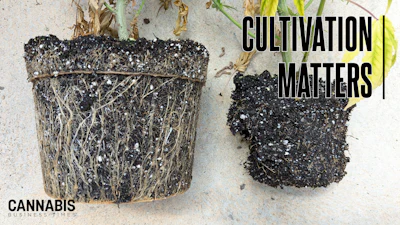
Overwatering is rarely about the volume of water; it is about the absence of oxygen. When pore spaces in the media remain saturated, the root zone becomes oxygen-deficient for the required gas exchange. Roots, like the rest of the plant, require oxygen for cellular respiration. When oxygen is depleted, root hairs begin to die, turning from white to a translucent brown. Common signs of Pythium in the greenhouse are single plants exhibiting wilt symptoms even if the root zone is saturated (Fig. 1).
 Figure 1: Pythium, often observed as plant wilt, is common if plants are consistently overwatered and in a saturated root zone.Photo by Brian Whipker
Overwatering can also inhibit iron (Fe) uptake, resulting in nutrient deficiencies. Iron deficiency is commonly observed as interveinal chlorosis of the upper foliage (Fig. 2).
 Figure 2: Iron deficiency observed as interveinal chlorosis of the upper foliage as a result of high substrate pH.© Photo by Brian Whipker
This issue often arises when plant water needs decrease, such as during seasonal transitions in greenhouses from summer to fall, but irrigation practices are not adjusted accordingly. Overly frequent irrigation or failure to reduce watering during lower demand periods can lead to oversaturation of the root zone, limiting oxygen availability and reducing the plant’s ability to take up Fe.
Pick Up the Pot
Actually picking up the pot (or container) is the most critical and effective way to train yourself and staff on when to water. While looking at the substrate can be an aid in determining water requirements, it does not replace picking up the pots to gauge the water weight of the pot. This will also prevent overwatering due to surface drying that occurs when the top layer of the substrate is significantly drier compared to the rest of the pot.
For operations using automated watering, it is essential to still monitor the water content of the pot. Water requirements shift both as the plant grows and with the season for a fall crop. The water requirement decreases as temperatures and solar radiation also decrease, even though the plants are still growing.
The grower's job is to manage the "push and pull." If plants stay at Level 4 and 5, the chances of Pythium and nutrient deficiencies increase. If we dry down too far to Level 1, we cause irreversible damage to the root hairs and permanent yield loss. Mastering the move from 4 to 2 is where the profit is found. It builds a robust root system for optimal plant growth. By understanding the science of the dry-down, we can dial in fertility management and reduce potential disease issues.