

It’s been five weeks since the U.S. Treasury Department and the Internal Revenue Service (IRS) announced plans to issue guidance to state-licensed medical cannabis businesses seeking Section 280E tax relief under a new federal Schedule III listing.
Now, seven U.S. House Democrats are pushing the agencies to pick up the pace.
Led by Reps. Steven Horsford, D-Nev., and Steve Cohen, D-Tenn., the lawmakers wrote a letter on May 28 to IRS CEO Frank Bisignano and Treasury Secretary Scott Bessent, asking that they “provide prompt guidance” and urging them to collaborate with the Small Business Administration and other federal partners to “ensure this guidance is widely disseminated.”
Reps. Betty McCollum, D-Minn., Eleanor Holmes Norton, D-D.C., Rashida Tlaib, D-Mich., Jared Huffman, D-Calif., and Jesús “Chuy” García, D-Ill., also signed the letter.
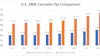
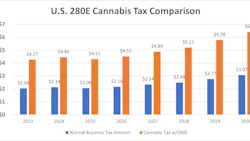
Section 280E of the Internal Revenue Code prevents businesses that “traffic” Schedule I or II drugs from deducting standard business expenses, such as payroll, marketing/advertising, rent, utilities, insurance and other ordinary and necessary expenses that traditional American businesses aren’t taxed on.
“The Department of Justice has recently taken steps to place ‘FDA-approved products containing marijuana’ and ‘marijuana products regulated by a state medical marijuana license’ to Schedule III of the Controlled Substances Act, as well as the initiation of an expedited administrative hearing process to consider the broader rescheduling of cannabis from Schedule I to Schedule III,” the lawmakers wrote. “As a result of qualifying cannabis placement under Schedule III, Section 280E is no longer applicable to qualifying state-legal cannabis-related trades or businesses. This change materially alters the federal tax framework governing the cannabis industry.”
The sevensome also said that timely guidance is “vital” for both industry taxpayers and tax professionals.
“The absence of clear and timely guidance for the cannabis industry will leave taxpayers uncertain as to how they can benefit from the tax code – whether it is the treatment of ordinary and necessary business deductions or accessing of tax credits,” they wrote. “While we acknowledge that the Treasury has announced guidance is forthcoming, we urge swift and clear action. Clarifying guidance will promote uniform compliance, reduce potential tax disputes, and support efficient tax administration.”
In signing an April 22 order to immediately reschedule state-licensed medical cannabis to Schedule III, U.S. Acting Attorney General Todd Blanche encouraged Treasury Secretary Bessent “to consider providing retrospective relief from Section 280E liability for taxable years in which a state licensee operated under a state medical marijuana license.”
In the subsequent Treasury/IRS announcement on April 23, the agencies indicated that their forthcoming guidance “is expected to clarify the ways in which, for businesses with multiple activities, Section 280E applies only to those activities related to trafficking in Schedule I or II controlled substances (e.g., by apportioning expenses).”
In other words, for state-sanctioned businesses that cultivate, manufacture or dispense both Schedule III medical cannabis and Schedule I adult-use cannabis, guidance could provide clarity on how to segregate activities, such as what percentage of an HVAC bill or monthly rent is tax-deductible when both medical and adult-use plants are grown under the same roof. The same can be said for payroll in instances where workers handle both medical and adult-use cannabis.
In their letter, the seven lawmakers laid out two “key areas” that require “unambiguous” guidance from the Treasury Department and IRS to address this bifurcation:
- Businesses that operate state-issued cannabis licenses which cover both adult-use (recreational) and medicinal purposes. E.g., one store which sells both adult-use and medicinal cannabis.
- Businesses that operate separate state-issued cannabis licenses for adult-use and medicinal purposes.
“We respectfully urge the IRS to issue guidance to address these and other issues and facilitate an orderly transition under current law,” they wrote.
The Treasury Department and IRS also indicated their forthcoming guidance would include a transition rule that’s expected to allow medical cannabis businesses to take the permissible ordinary deductions for at least the “full taxable year” included in the effective date of Blanche’s Schedule III order.
Whether or not the agencies take up Blanche’s recommendation to provide 280E relief for past tax years, a business must file a refund request within three years of the filing of a return, or two years from the date the tax was paid, whichever expires later, to fall within the statute of limitations for the refund request, unless a company filed a protective claim with the IRS before the expiration date.
In addition to working with federal partners, the lawmakers suggested that the IRS extend its reach beyond.
“The IRS should seek input from the states, and from businesses in the cannabis sector to ensure the guidance is robust and complete,” they wrote. “Additionally, any guidance should promptly be shared with relevant agencies to ensure businesses have access to this timely information.”