
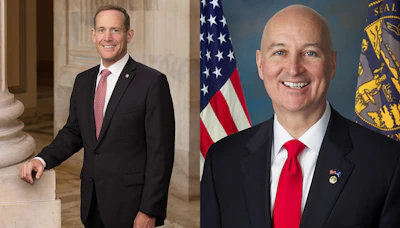

A pair of U.S. Republican senators collaborated with a cannabis prohibition group to file legislation on April 20 that aims to discourage federal reform by showcasing what they say is a strain on health care costs.
Sens. Ted Budd, R-N.C., and Pete Ricketts, R-Neb., introduced the Marijuana Impact on Medicaid Act on Monday, coinciding with the 4/20 cannabis holiday.
The two-page legislation, supported by anti-legalization group Smart Approaches to Marijuana (SAM), would require the U.S. Secretary of Health and Human Services (HHS) to collect data on Medicaid spending associated with hospital inpatient and outpatient care, and with emergency room visits related to cannabis use.
Budd, the primary sponsor, said the bill aims to provide transparency.
“The health consequences tied to marijuana use are serious, leading to increased risk for heart attacks, strokes, psychotic disorders and further addictions,” he said in a statement announcing the bill. “When legislating on this issue, Congress needs to put the health and safety of the American people first, full stop. This is exactly why lawmakers need access to reliable data that details Medicaid spending associated with marijuana abuse. Millions of Americans rely on Medicaid health care benefits, and my legislation will ensure Congress understands the dangers of this drug and its impact on federally funded health programs.”
The legislation comes as SAM is attempting to halt the Centers for Medicare and Medicaid Services’ CBD pilot program that commenced on April 1. The federal program allows doctors to recommend hemp-derived CBD products containing as much as 3 milligrams of THC per serving to Medicaid patients with up to $500 per year in coverage for those products.
In addition to collecting data, Budd and Ricketts’ bill would require the HHS to report to Congress a summary of its findings within one year of enactment, including a recommendation for potential legislative or administrative actions.
“Marijuana is a dangerous drug,” Ricketts said. “The average THC potency in marijuana has more than tripled since 1995. High-potency marijuana is an increasingly concerning threat to public health. It is important for Congress and HHS to understand the costs and impact to health care of increased marijuana usage.”
The senators failed to mention a study published in 2025 by the National Institute of Health, in which researchers concluded that medical cannabis use was associated with reduced health care utilization and improved quality of life among chronic pain patients.
The study’s authors reported that chronic pain affects approximately 20% of U.S. adults, “imposing significant burdens on individuals and health care systems,” and that medical cannabis has emerged as a potential therapy.
The study’s researchers also concluded that medical cannabis exposure is associated with a lower risk of urgent care and emergency department visits, when comparing patients who used medical cannabis for at least one year to cannabis-naïve patients.
“This underscores the potential for not only [quality of life] gains associated with medical cannabis use, but also positive downstream effects on the health care system resulting from treatment,” the authors wrote.
A separate study, supported by medical cannabis company Leafwell, estimated that if all 50 states enacted medical cannabis laws, the nation would save $29 billion in annual health care expenditures. According to the study, companies in states with medical cannabis have 3.4% lower premium costs for individual coverage plans compared to companies in states where medical cannabis remains prohibited, representing an annual savings of $238 per employee.
Applied Health Economics and Health Policy published the study in September 2024, after researchers analyzed state-level data from 2003 to 2022.
SAM and its CEO, Kevin Sabet, regularly reject pro-cannabis studies like these, arguing that the public health and societal costs of cannabis legalization, including health care utilization, outweigh any tax benefits, while also focusing on individual stories of those who have had negative experiences with cannabis.
Budd and Ricketts included Sabet’s views with the introduction of their bill.
“We enthusiastically support this important piece of legislation, which advances public awareness of marijuana’s costs to society,” Sabet said. “Senator Budd’s bill calls for an accounting of taxpayer-funded health programs and the impact of normalizing this dangerous drug on their costs – and that’s long overdue. In study after study, significant data appear linking marijuana to serious physical and mental health issues like heart attacks and schizophrenia. Enough is enough.”