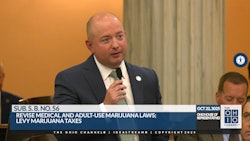


Ohio residents like their cannabis dispensaries and support the construction of more in their communities, whether in new or retrofitted buildings, according to a new survey.
Ohioans also had positive opinions on cannabis dispensaries’ impacts in their communities, including economic, environmental and quality of life, according to pollsters at Ohio Northern University’s Institute for Civics and Public Policy (ICAPP), who surveyed 1,638 Ohio adults from Oct. 7-13.
The poll covered four “backyard” zoning issues: solar farms, multifamily housing, cannabis dispensaries, and AI/data centers.
“There is overall support for cannabis dispensaries in Ohio, especially when it comes to their economic impact, but that support drops considerably when discussing other impacts of the issue like public safety,” said Dr. Brian King, assistant professor of political science and faculty associate at ICAPP, who co-led the project in collaboration with SurveyUSA.
Overall, support for new cannabis dispensaries drew positive responses, with a net support of +19 among all Ohioans: 47% of participants strongly or somewhat supported new store openings, 28% were opposed, and 24% were indifferent.
Key demographic findings for the overall support of new cannabis dispensaries included:
- Race: Hispanic (+42) and African-American (+39) respondents are noticeably more supportive than white (+17) respondents.
- Party: Ohioans who consider themselves strong Democrats (+44) are far more supportive than strong Republicans (-3).
- Urbanicity: Urban residents (+34) are more supportive than both suburbanites (+15) and rural residents (+13).
- Age: Those aged 18 to 34 years (+38) and 35 to 49 years (+33) are more supportive than those aged 50 to 64 years (+19), while Ohioans 65 and older (-17) oppose new dispensaries.
- Kids in Home: Ohioans with two kids in their homes (+43) are more supportive than those with no kids (+13), while those with one kid (+25) and three-plus kids (+37) are also supportive.
Ohio adults also believe cannabis dispensaries have a positive impact on the economy (+42 net positivity), environment (+13) and quality of life (+12); however, they believe cannabis dispensaries negatively impact public safety (-7).
“Those over 65 have the most negative opinions of dispensaries overall, while conservatives and those making more than $100,000 annually also express negative opinions when it comes to dispensaries’ impact on public safety,” King said in a Nov. 5 press release announcing the results.
Here are the key findings on Ohioans’ attitudes toward dispensaries’ impact on the economy:
- Overall: Ohio adults believe cannabis dispensaries have a positive impact on the economy (+42 net positivity).
- Age: Those aged 65 and older (+15 net positive) are less enthusiastic about the positive economic impact than younger people: 18 to 34 years (+43); 35 to 49 years (+59); and 50 to 64 years (+47).
- Education: Those with a high school education (+44) are more enthusiastic about the positive economic impact than those with a graduate degree (+22).
- Party: Ohioans who consider themselves strong Democrats (+65) are more enthusiastic about the positive economic impact than strong Republicans (+23).
- Urbanicity: Urban residents (+56) felt more positive about dispensaries’ economic impacts than both suburbanites (+37) and rural residents (+39).
“With few exceptions, Ohioans across a multitude of demographic categories have a positive perception of the economic impact of dispensaries,” Dr. Keith Durkin, professor of sociology and director of ICAPP, told Cannabis Business Times.
These economic viewpoints come as Ohio’s nearly 180 licensed dispensaries are on pace to sell more than $1 billion in cannabis in 2025, including more than $800 million in adult-use transactions and roughly $245 million in medical transactions, according to the Ohio Department of Cannabis Control.
Under Ohio’s legalization law that voters approved in 2023, a 10% cannabis excise tax is levied on adult-use sales, equating to a projected $80 million in excise tax revenue for 2025. Thirty-six percent of this revenue, or about $30 million, is supposed to be reinvested in the communities where the sales take place.
Despite this economic enticement, 130 cities, towns and villages in Ohio have maintained their local moratoriums, preventing dispensaries from operating in their jurisdictions, according to research from the Ohio State University’s Drug Enforcement and Policy Center.
More than 1.7 million people live in these Ohio jurisdictions, meaning roughly 14% of the state’s population has restricted access to tested and regulated cannabis products.
Here are the key findings on Ohioans’ attitudes toward dispensaries’ impact on the environment:
- Overall: Ohio adults believe cannabis dispensaries have a positive impact on the environment (+13 net positivity); however, 40% of all survey participants were impartial.
- Age: Those 65 and older have very negative views (-19) compared to younger age groups: 18 to 34 years (+25); 35 to 49 years (+28); and 50 to 64 years (+12).
- Ideology: Ohioans who consider themselves very liberal (+46) have positive views, while those who are very conservative (-14) have negative views.
Here are the key findings on Ohioans’ attitudes toward dispensaries’ impact on the quality of life:
- Overall: Ohio adults believe cannabis dispensaries have a positive impact on the environment (+12 net positivity).
- Age: Those 65 and older (-25) have a much more negative impression than younger respondents: 18 to 34 years (+28); 35 to 49 years (+28); and 50 to 64 years (+11).
- Race: Hispanic (+44) and African-American (+34) respondents have a substantially more positive impression than white (+9) respondents.
- Income: Those in lower income brackets (less than $100,000) have double-digit net positive attitudes, while those earning $100,000 to $150,000 (-8) have negative views.
- Kids in Home: Ohioans with two kids (+42) in their homes are much more positive than those with zero kids (+5).
- Armed Forces: Those who currently serve (+48) have much more positive views on the quality-of-life impact than those who never served (+14).
- Party: Strong Republicans (-8) have a negative view, while strong Democrats (+34) have a positive view.
- Ideology: Those who consider themselves very liberal (+48) have very positive views, while those who are somewhat conservative (+2) lean positive, and those who are very conservative (-20) have negative views.
- Home: Homeowners (+2) are less supportive than renters (+29).
- Urbanicity: Urban residents (+31) rate this more positively than both suburban (+7) and rural (+4) residents.
- Region: People living in the Dayton area (-1) have a net negative view, while residents in Toledo (+13), Cincinnati (+10), Columbus (+26), Cleveland (+7) and Southeast Ohio (+33) have net positive views.
Here are the key findings on Ohioans’ attitudes toward dispensaries’ impact on public safety:
- Overall: Ohio adults believe cannabis dispensaries negatively impact public safety (-7 net positivity).
- Age: Older adults are more concerned about this, with both those aged 50 to 64 years (-5) and 65 and older (-23) having net negative ratings, while those aged 18 to 34 years (+11) and 35 to 49 years (+6) have net positive ratings.
- Income: Higher income respondents are more likely to have negative ratings for public safety: $75,000-$99,999 (-16); $100,000 and above (-23).
- Race: Hispanic (+34) and African-American (+18) residents have more positive views than white (-11) Ohioans.
- Ideology: Those who consider themselves very liberal (+40) have positive views on public safety, while those who are somewhat conservative (-26) or very conservative (-25) have negative views.
- Home: Homeowners (-14) are more concerned about public safety than renters (+10).
- Urbanicity: Urban residents (+13) have a more favorable view than both rural residents and suburbanites (both with net ratings of -12).
- Region: There are particularly strong concerns among residents of the Dayton (-18) and Cleveland (-14) areas compared to Toledo (+1), Cincinnati (-1), Columbus (+3) and Southeast Ohio (+1).