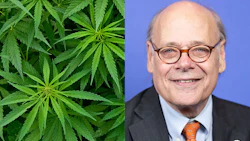
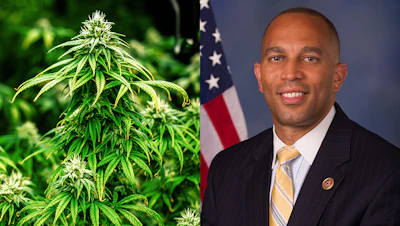

The last time Democrats controlled the U.S. House, they passed legislation to federally legalize cannabis in 2020 and 2022, and now the stars appear aligned in Washington for a third shot at reform.
Democrats, who flipped at least 43 House seats in the midterms to take a projected 259-176 majority in the chamber, nominated New York Rep. Hakeem Jeffries on Nov. 18 to be the next House speaker – a post that would put him second in line to the presidency. If elected in January, he’d become the first Black lawmaker to hold the position.
Jeffries secured the House speaker designation during a closed-door vote, 251-11, The Associated Press reported.
“Our message to the American people who are struggling in this failed economy is a simple one,” Jeffries said in a post-vote press conference. “We hear you, we see you, we feel you, and House Democrats are committed to making life better for you.”
The jury is still out on whether a better life for Americans includes ending federal cannabis prohibition, but the next Congress, when Democrats take control of both the House and Senate, will be telling.
As the presumptive House speaker, Jeffries would largely control what bills reach the floor for a vote next Congress, especially for unifying issues among his fellow Democrats, such as cannabis reform.
In 2021, Jeffries was among five initial co-sponsors for the Marijuana Opportunity Reinvestment and Expungement (MORE) Act, legislation that aimed to remove cannabis from the Controlled Substances Act, provide expungements for those with related offenses and impose a federal tax on cannabis sales to fund programs for those adversely affected by the drug war.
When the House passed the legislation in a 220-204 vote the next year, Jeffries pointed to President Richard Nixon’s “failed war on drugs,” which began when the CSA took effect in 1971.
“At the time, there were less than 300,000 Americans incarcerated in this country,” Jeffries said during a 2022 floor speech. “Today, there are 2.3 million, disproportionately Black and Latino. ... Many of those individuals who have been incarcerated are there because of nonviolent drug offenses, often marijuana possession and use.”
He called America’s “overcriminalization” problem a “stain” on Democracy.
“It’s time to end the federal cannabis prohibition,” he said. “ It’s time to deschedule it. It’s time to decriminalize marijuana. It’s time to invest in communities in a way that makes sense, both from a public safety standpoint, as well as a fairness, equity and justice standpoint. It’s time to pass the MORE Act.”
Jeffries also co-sponsored the MORE Act two years earlier, when it first passed the House in a 228-164 vote in 2020. But with the legislation needing a filibuster-proof 60 votes in the Senate, it never found the upper chamber’s floor, including under Republican control in 2020 and Democratic control in 2022.
Since assuming his current House minority leader post in 2023, Jeffries has refrained from co-sponsoring follow-up editions of the MORE Act, including when Rep. Jerry Nadler, D-N.Y., reintroduced the mostly partisan legislation in 2023 and in 2025.
RELATED: 40 House Democrats Introduce Bill to Federally Legalize Cannabis
When the 120th Congress convenes in January, the Democratic caucus will control a 56-44 majority in the Senate, meaning a cannabis reform bill will still need bipartisan support unless it’s attached to a budget reconciliation package or another piece of legislation that’s exempt from filibusters.
However, Jeffries has reached across the aisle on cannabis reform, including in 2025, when he teamed up with Rep. Dave Joyce, R-Ohio, to reintroduce the Preparing Regulators Effectively for a Post-Prohibition Adult Use Regulated Environment (PREPARE) Act in hopes of providing a smooth transition from individualized state markets to a national framework.
This marked the duo’s third Congress working together on the legislation, which would create a transparent process for the federal government to establish effective regulations when cannabis is “inevitably” legalized in the U.S., including allowing industry stakeholders, criminal justice reform advocates, substance use advocates, health care experts, state cannabis regulators, state and tribal justice departments, and the public to weigh in on an interstate market.
Under the PREPARE Act, the U.S. attorney general would be required to establish the “Commission on the Federal Regulation of Cannabis” to study a pathway to cannabis regulation in a federal framework that’s similar to alcohol.
“Since the failed war on drugs began more than 50 years ago, the prohibition of marijuana has ruined lives, families and communities, particularly communities of color,” Jeffries said last year. “The PREPARE Act is one of the bipartisan solutions that will lay the groundwork to finally right these wrongs in a way that advances public safety and boosts our economy.”
This bill, like other reform proposals, was largely ignored this Congress, despite 64% of U.S. adults supporting cannabis legalization, according to an October 2025 Gallup poll.
Although President Donald Trump’s administration reclassified state-licensed medical cannabis to Schedule III and reignited an administrative hearing process on President Joe Biden administration’s proposed rule to reschedule all cannabis to Schedule III, the fate of those efforts remains uncertain.
That fate should not be left in the hands of “bureaucrats and judges,” Morgan Fox, political director of cannabis advocacy group NORML, said after the midterm elections.
“It is Congress who initially prohibited marijuana, and it is Congress who ultimately needs to abolish this failed federal policy, specifically by descheduling cannabis and by passing other reforms that provide real-world relief and protections for millions of responsible consumers,” he said.
Fox also said cannabis-related legislation has historically fared better under Democratic control, pointing not only to the MORE Act but also to the Secure and Fair Enforcement (SAFE) Banking Act, which passed seven times between 2019 and 2022 in an effort to provide licensed cannabis businesses access to traditional banking services.
Sen. Jeff Merkley, D-Ore., led a bipartisan coalition of four senators, while Joyce led a bipartisan coalition of eight U.S. House members, in reintroducing the SAFE Banking Act in June 2026, but it, too, was neglected this Congress.
“Unfortunately, Republican leadership chose to ignore public sentiment and let popular cannabis policy legislation languish this session,” Fox said. “Hopefully Democrats will not make the same mistake and will provide the necessary leadership and bipartisanship to pass substantive, sensible reforms in the 120th Congress.”