
A Democratic congresswoman is trying to get to the bottom of a U.S. attorney’s left-field announcement that he plans to start “rigorously” prosecuting cannabis offenses occurring on federal land in Wyoming.
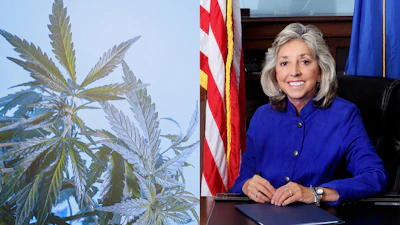
U.S. Rep. Dina Titus, D-Nev., sent a letter Nov. 21 to Attorney General Pamela Bondi to express her “deep concern” with the Department of Justice’s (DOJ) guidance that apparently directs U.S. district attorneys’ offices nationwide to start enforcing simple cannabis possession crimes in places like national parks and forests.
According to Darin Smith, the U.S. Attorney for the District of Wyoming, the DOJ directive was issued on Sept. 29, unbeknownst to the public or congressional lawmakers. Smith indicated in a press release last week that the DOJ’s new guidance rescinded Biden-era guidance that he said had instructed U.S. attorneys not to prosecute such offenses.
If the Biden administration provided such guidance, it was never made public.
Titus questioned Bondi’s motives in the letter.
“This reversal, revealed only through a regional announcement, raises significant concerns about transparency and the rationale underlying the [DOJ’s] enforcement priorities that will inevitably have a severe social and economic toll on communities throughout the country,” she wrote. “Simple marijuana possession poses no meaningful threat to public safety, and it is indefensible to revive prosecution under an outdated law that no longer reflects the current use of cannabis in the United States."
Whether Trump’s DOJ officially rescinded or reversed a Biden-era policy remains unconfirmed: Smith’s office and the DOJ did not respond to Cannabis Business Times’ requests to provide the current policy document.
Titus requested copies of both the current document and the previous policy that Smith claims was issued under Biden.
“The decision to resume prosecution for minor marijuana offenses demands immediate reconsideration,” she wrote. “I urge you to reverse course and to release, without delay, the Biden-era guidance and the rescission memorandum. The public deserves full transparency regarding the policies that shape federal enforcement priorities and determine how tax dollars are deployed.”
Titus also asked Bondi to answer the following questions by Dec. 3:
- What has the DOJ specifically instructed U.S. attorneys to do as it pertains to marijuana offenses on federal lands?
- What specific marijuana offenses will the DOJ prioritize for prosecution on federal lands under the renewed enforcement posture?
- What data and evidence informed your decision to resume prosecution of minor marijuana offenses?
- How many marijuana possession cases on federal lands has the DOJ prosecuted in the past decade, and how many does the department expect under this new directive?
The letter is unlikely to receive a response from Bondi, but it serves as a tool to gain public and media attention at a time when cannabis legalization remains a popular public policy: 64% of Americans support the issue, according to a Gallup poll released earlier this month.
In her letter, Titus pointed out that the federal government’s drug war on cannabis is a “costly venture” that has disproportionately impacted low-income and historically marginalized communities. Wyoming, in particular, has one of the highest racial disparity rates in the nation when it comes to cannabis arrests, with Black people 5.2 times more likely to be arrested than white people, according to the American Civil Liberties Union.
Titus also referenced a NORML report that revealed more than 40% of all state and local drug arrests in 14 states in 2024 were for cannabis-related violations. These states have some of the least permissive cannabis laws in the nation.
“Reverting to punitive criminalization at the federal level will not deter use or strengthen public safety; it will simply continue a cycle of incarceration and unequal enforcement,” Titus wrote. “The ripple effects of a charge for simple possession of cannabis can have life-altering consequences.”
Smith’s announcement of the policy change in Wyoming hasn’t been reciprocated publicly among other U.S. attorneys’ offices.
The Associated Press reported last week that spokespeople for the U.S. attorneys in Arizona and Montana did not return messages seeking comment, and the U.S. attorney’s office in Colorado declined to comment. There are 93 U.S. attorneys’ offices covering 94 federal judicial districts in the U.S.
“Marijuana possession remains a federal crime in the United States, irrespective of varying state laws,” Smith said last week from his office in Wyoming. “The detrimental effects of drugs on our society are undeniable, and I am committed to using every prosecutorial tool available to hold offenders accountable.”