
Editor's note: This article was updated Dec. 3, 2025, with a new quote from U.S. House Rep. Dina Titus, D-Nev., and to include additional information on previously unpublished Biden-era guidance related to presidential pardons.
Five former U.S. Attorneys under President Joe Biden’s administration dismissed a notion that surfaced last month that they were told to take a hands-off approach to prosecuting individuals for simple cannabis possession crimes.
The former top federal prosecutors from the districts of Montana, Southern Ohio, South Carolina, New Mexico and Northern Texas told Cannabis Business Times that they never received – or cannot remember receiving – an official policy memo that impeded their prosecutorial powers on the matter from the past administration’s Department of Justice (DOJ).
“I never received guidance or a directive from Main Justice or the White House that prevented our district from investigating or prosecuting marijuana cases,” said Jesse Laslovich, who served as the U.S. Attorney for Montana from June 2022 until February 2025. “With our limited resources, our district chose to pursue those trafficking methamphetamine, cocaine, heroin, and particularly fentanyl.”
This wouldn’t be news had Darin Smith, the current U.S. Attorney for the District of Wyoming, not indicated last month that he was under the guise that President Donald Trump’s DOJ rescinded Biden-era guidance of taking the hands-off approach to simple cannabis possession offenses.
According to Smith, his office received a policy memo from the Trump DOJ on Sept. 29 that he said rescinded Biden-era policy concerning the prosecution of simple cannabis possession. As a result, Smith said he “promptly” notified federal law enforcement agencies in Wyoming to “rigorously” prosecute related crimes.
“Marijuana possession remains a federal crime in the United States, irrespective of varying state laws,” Smith said on Nov. 13. “The detrimental effects of drugs on our society are undeniable, and I am committed to using every prosecutorial tool available to hold offenders accountable.”
Smith’s office and the DOJ did not respond to CBT requests for a copy of the new policy memo.
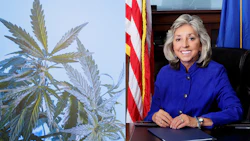
U.S. House Rep. Dina Titus, D-Nev., who wrote a letter last month to U.S. Attorney General Pamela Bondi demanding answers, has also come up empty.
As of Dec. 3, Bondi has failed to reply to Titus, who also asked for a copy of the new cannabis policy memo that was supposedly issued in September.
“The Trump Administration wrongfully rescinded Biden-era guidance that discouraged the prosecution of simple cannabis possession on federal property,” Titus told CBT. “Still, my questions to Attorney General Pam Bondi from two weeks ago about how the Trump Administration plans to handle these cases remain unanswered. This move is a step backward for commonsense cannabis policy reform and will further exacerbate the cycle of unfair prosecution and incarceration.”
Update: After this article was published, Marijuana Moment reported that it received a copy of the Biden-era "guidance" from February 2024 and the Trump DOJ's recission notice sent to U.S. Attorney's offices on Sept. 29, 2025.
However, Laslovich downplayed the significance of the Biden-era guidance regarding the former president's pardons for simple cannabis possession offenses issued on Dec. 22, 2023.
"I do remember the memo, which required us to dismiss any cases in which defendants had been pardoned for conduct occurring on or before December 22, 2023," Laslovich said. "The memo did not prevent prosecuting people for marijuana possession after that date, and indeed, specifically says [U.S. Attorneys] had the discretion to pursue such cases.
"As a practical matter, none of the cases we prosecuted in Montana were only for simple possession of dangerous drugs, as we were interested in those trafficking or distributing drugs, especially meth and fentanyl, both of which continue to poison our communities. The possession cases were deferred to our state partners. ... Our limited resources dictated this, as well as the collective opinion of our federal, state, local, and tribal partners that our focus should be on meth and fentanyl traffickers harming our people and communities."
According to a February 2024 guidance, the Biden DOJ's Executive Office for United States Attorneys (EOUSA) advised all U.S. Attorneys under the previous administration to be "extremely cautious and measured" when exercising their discretion to prosecute cases involving simple possession, use or attempted possession of marijuana.
This guidance – previously unpublished – came after Biden issued a Marijuana Pardon Proclamation in December 2023 for simple cannabis possession offenses.
Under the Biden-era guidance from February 2024, federal law enforcement agencies could only pursue simple possession charges with the approval of their U.S. Attorney's office, and all charging decisions were required to be reported to the EOUSA within 72 hours. The Trump DOJ's Sept. 29 memo rescinded these mandates, prompting Smith to "promptly" direct law enforcement agencies to enforce federal law in Wyoming.
Although Wyoming remains one of the least permissive states on cannabis reform, not all of Smith’s peers from prohibition states share his viewpoint.
Adair Ford Boroughs, the former U.S. Attorney for the District of South Carolina from July 2022 to February 2025, told CBT that while she couldn't remember receiving a specific cannabis possession policy memo while serving under Biden, targeting Americans for cannabis was not her office’s focus.
“As a practical matter, it would almost never make sense to use very limited federal resources to prosecute the simple possession of a small amount of marijuana,” Boroughs said. “Spending resources prosecuting simple marijuana possession would take resources away from things like violent crime, distribution of fatal amounts of fentanyl, and other crimes that involve serious harm to our community.”
Those words largely mirror what former U.S. Attorney General Merrick Garland said during a congressional hearing in April 2022: “The Justice Department has almost never prosecuted use of marijuana, and that’s not an efficient use of the resources, given the opioid and methamphetamine epidemic that we have.”
Garland’s comments were merely his informal stance. Garland never released an official, signed memo that mirrored the likes of the industry infamous Cole Memo that came under President Barack Obama.
The Biden-era guidance on his simple cannabis possession pardons was much different than the hands-off memo issued under the Obama administration.
“I do not recall an official memo [from Garland],” said Leigha Simonton, the former U.S. Attorney for the Northern District of Texas from December 2022 to January 2025. “I think [he] made some public remarks in a congressional hearing that signaled non-enforcement, but that was before I became U.S. Attorney, so, if something internally got distributed around that time, I did not get it.”
Alexander M.M. Uballez, the former U.S. Attorney for the District of New Mexico from May 2022 to February 2025, also told CBT he didn’t get a memo.
“To my recollection, we never received guidance on marijuana possession from Biden/Garland, beyond the broader ‘substantial federal interest’ outlined in [a general policy memo issued by Garland in December 2022],” Uballez said.
Uballez was referring to guidance Garland sent all U.S. Attorneys regarding charging, pleas and sentencing: Nothing in the memo mentions marijuana or cannabis.
Instead, the December 2022 Garland memo provided federal prosecutors “broad discretion” to enforce criminal laws, directing them to conduct “individualized” assessments to determine what particular charges fit specific circumstances. It also reaffirmed that prosecutorial discretion cannot be “unfettered.”
Garland referred to the Principles of Federal Prosecution as a guidance benchmark that’s been in place for more than four decades.
Under those principles, even if a prosecutor believes a person “will more likely than not be found guilty under a reasonable doubt,” a prosecutor should not commence a prosecution if the prosecution would not serve a substantial federal interest or if the person is subject to adequate alternatives to federal prosecution.
In other words, before prosecuting individuals for certain crimes, federal prosecutors should weigh certain considerations, such as enforcement priorities, the nature and seriousness of an offense, and the deterrent effect of such a prosecution.
“In determining whether adequate alternatives to federal prosecution are available, the prosecutor should consider whether the person is subject to effective prosecution by state, local, territorial or tribal authorities, or whether there exists an adequate non-criminal alternative to prosecution,” Garland wrote in the memo.
While this memo wasn’t specific to cannabis, the writing was on the wall.
Two months earlier, in October 2022, Biden became the first president to grant categorical pardons that were specific to the offense of simple possession of marijuana. These pardons were “unconditional” to all U.S. citizens and lawful permanent residents who committed the offense.
Although Garland never provided official guidance to U.S. federal prosecutors related to the issue – at least not publicly – these pardons spoke for themselves, said Kenneth L. Parker, the former U.S. Attorney for the Southern District of Ohio from November 2021 to February 2025.
“I do not recall there ever being any official policy memo on cannabis being issued by AG Garland,” Parker told CBT. “Some things were understood after President Biden issued the pardons, and there was a lot of discussion regarding the scheduling of marijuana.”
Although the Biden administration initiated the process to reclassify cannabis from a Schedule I to Schedule III drug under the Controlled Substances Act, with Garland signing a proposed rule in May 2024, the former administration failed to carry that reform proposal to the end zone.
And although Trump indicated during his 2024 campaign trail that he’d support the Schedule III proposal, his only move during his first year in office has been a promise to “look at” the proposed rule.
In the absence of federal reform, cannabis-related persecutions at the state and local levels remain the “primary driver” of drug-war enforcement, primarily in states that haven’t legalized adult-use cannabis, according to cannabis reform advocacy organization NORML.
This drug-war driver could expand to the federal level under Trump’s DOJ.