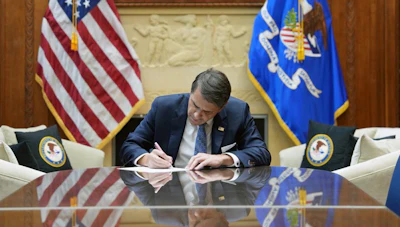

State-licensed medical cannabis businesses that applied for federal registration status with the Drug Enforcement Administration (DEA) in hopes of a smooth transition to Schedule III opportunities were dealt a curveball on Oct. 30.
The DEA warned Friday that businesses granted federal registration under U.S. Attorney General Todd Blanche’s April 2026 rescheduling order have until Nov. 29 to realign their supply chain partnerships with other federally registered businesses or with those whose applications remain pending under an expedited registration process.
The Department of Justice (DOJ) published these new guidelines on “permissible activities” alongside Friday’s announcement that the DEA issued more than 900 dispensary registrations across seven states – Alabama, Florida, Mississippi, South Dakota, Texas, Virginia, and West Virginia – in its first round of expedited approvals from businesses that applied during a 60-day window that closed June 26. Nearly 7,000 businesses nationwide applied for the expedited registration process.
“The American people deserve access to the best medical treatments in the world,” Blanche said. “The regulated distribution of medical marijuana by the applicants that have been granted registration by the Drug Enforcement Administration will help ensure broader access to chronic pain treatment and the safety of the American people. The Department of Justice will continue prosecuting illegal marijuana trafficking and related criminal activity in accordance with federal law.”
Also on Oct. 30, the Diversion Control Division released a list of the nearly 7,000 medical cannabis businesses that applied for registration status during the expedited window, including 4,197 dispensaries, 2,086 manufacturers and 710 distributors. This list provides business types and states, but not the applicants’ business names.
Oklahoma had the most applicants with 2,442 timely registrations, followed by Florida with 812, California with 771, Maine with 320, Pennsylvania with 227 and Missouri with 209.
The DEA referred to this list of nearly 7,000 businesses as “timely applicants” in the guidance published Friday, stating that these applicants “can engage in Schedule III medical marijuana activities with other timely applicants” but may not “lawfully engage in any Schedule III medical marijuana activities with entities that did not complete an application” until those entities become DEA registrants, adding that non-registered businesses remain subject to federal prohibition policies.
While the DEA opened a new Schedule III registration portal for medical cannabis manufacturers, distributors and labs last month, the agency won’t prioritize reviewing these applications until after processing “timely applicants” from the expedited window.
“If a timely applicant or DEA registrant engages in Schedule III medical marijuana activities with someone other than a timely applicant or DEA registrant, such conduct could be potential grounds for denial of a timely applicant’s application or revocation of a certificate of registration, respectively,” according to the guidance. “Timely applicants and registrants therefore should take adequate steps to confirm the status of all entities with which they will conduct Schedule III medical marijuana activities.”
The guidance further stipulated that the DEA does not plan to penalize registrants and timely applicants for sending small quantities of medical cannabis to state-licensed testing laboratories that don’t hold DEA registrations.
Otherwise, the DEA is providing state-licensed cannabis businesses one month to comply with new rules that forbid registrants and timely applicants from doing business with other state-licensed medical cannabis entities. According to the guidance:
“DEA recognizes timely applicants may require additional time to verify the status of their existing trading partners as timely applicants or registrants and to make necessary adjustments to their supply chain to comply with this information. Accordingly, timely applicants are expected to complete these activities and establish compliant supply chains no later than November 29, 2026.
“Timely dispenser applicants and timely distributor applicants may continue to possess, dispense and distribute existing inventories of Schedule III medical marijuana acquired prior to the issuance of this information, including inventory previously obtained from entities that do not qualify as timely applicants or DEA registrants. Such inventory may continue to be used in otherwise authorized activities.”
This announcement comes six months after Blanche indicated in his April rescheduling order that it was not his intention to disrupt state-licensed medical cannabis programs.
“The attorney general has determined that incorporating state licensing systems into the federal registration framework represents the most effective and efficient means of achieving the [Controlled Substances Act’s] objectives with respect to medical marijuana while promoting the medical benefits of marijuana and causing the least disruption for patients and existing state systems,” Blanche wrote in the order. “The rule accordingly leverages existing regulatory infrastructure while preserving the administrator’s authority to deny or revoke registration where specific public-interest concerns arise and to ensure compliance with the Single Convention.”
The DEA registrations “mark the first phase” of implementing Blanche’s order, the DOJ announced Friday. Each of the roughly 900 dispensaries initially approved had to complete a DEA investigation process before receiving Schedule III registration.
The DOJ said the dispensaries must maintain ongoing security, recordkeeping, inventory controls and other safeguards governing the handling of controlled substances to keep their federal Schedule III registrations.
The phased registration process will continue to prioritize timely dispensary applicants because reviewing applications from manufacturers and distributors “require additional review,” including facility inspections, production controls and quota determinations, the DOJ announced.
The DOJ announcement reaffirmed that Blanche’s order does not authorize adult-use cannabis activities, which remain subject to Schedule I controls while a separate rescheduling hearing process remains ongoing.
A major area of concern for many state-licensed medical cannabis licensees seeking DEA registration stems from their “dual-use” activities in states that permit both medical and adult-use operations.
The first seven states where the DEA issued more than 900 dispensary registrations on Friday have medical-only cannabis programs, leaving in question the 24 states where adult-use cannabis is legal, except for Virginia, which legalized adult-use cannabis but has yet to implement a licensed adult-use marketplace. The other 23 states include nearly 2,800 timely applicants: 1,769 for dispensaries, 707 for manufacturers and 289 for distributors.
On Oct. 30, the Minnesota Star Tribune reported that the DEA may reject all Schedule III applicants from these adult-use states, citing a DEA notification that Minneapolis-based In-Dispensary received that morning denying its registration application. The company’s retail facility serves both adult-use customers and medical cannabis patients under the state’s licensing structure, which the denial notification indicates “fails to provide ‘robust’ protections against diversion” and conflicts with federal law.
“They said they are giving me this because the DEA sees it as not in the public interest to let me have the medical [cannabis registration],” In-Dispensary owner Mark Eide told the Tribune. “They said they are serving a lot of other people today with this same document.”
The media outlet reported it was unclear if other state-licensed Minnesota cannabis businesses received similar letters.
Overall, 30 Minnesota cannabis businesses filed timely Schedule III registration applications with the DEA, including 26 dispensaries. The state’s other 300-plus dispensary licensees chose not to participate in the expedited application process.