
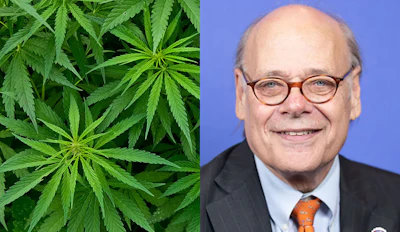

A U.S. congressman from a prohibitionist state is hoping to federally legalize cannabis by removing it from the Controlled Substances Act (CSA) while redesigning how drugs are scheduled altogether.
Rep. Steve Cohen, D-Tenn., introduced the Public Health and Research Reforms in Controlled Substances Act (CSA) on Oct. 29, legislation that would revise major portions of the CSA that President Richard Nixon signed into law more than 55 years ago. Cohen said his bill would update the foundational federal drug policy law to “align with public health, equal justice and scientific accuracy goals.”
The congressman touted the 89-page legislation as one that would make changes “to nearly every section” of the CSA, calling it the most “comprehensive package of reforms” to the CSA since its enactment.
“Most Americans believe the ‘war on drugs’ has been a failure at cross purposes with good public policy and aimed largely at minorities with draconian mandatory minimum sentences for minor offenses that most now believe aren’t really offenses at all,” he said. “This bill would set comprehensive policies on all aspects of drug regulation while also defining the purpose of federal involvement. A thoughtful review of national drug policy is long overdue. This measure would start the process of aligning the law with coherent public policy.”
The legislation would eliminate weight-based drug mandatory minimum penalties and direct the U.S. Sentencing Commission to provide for retroactivity in sentencing, all while maintaining sufficient enforcement tools for law enforcement to go after major narcotic traffickers, according to Cohen.
The legislation would also create a “dual-axis” scheduling framework with four numerical schedules (I-IV) based on risk of misuse/substance-use disorder and threat to public health, and five alphabetical schedules (A–E) based on therapeutic value (from high to none/unknown).
For instance, a Schedule 1A drug would pose a high risk/threat but would also have a high rate of therapeutic value, while a Schedule 4E drug would pose a low risk/threat but have no known therapeutic value.
 cohen.house.gov
“The new schedules would provide for review of all controlled substances to evaluate their new schedule, with about 30 substances, including fentanyl, morphine, methamphetamine, psilocybin and ibogaine, set as the first compounds to be evaluated,” Cohen wrote. “None of these would be descheduled, but rather more precisely tailored to the schedule, balancing harms with their benefits.”
The congressman also said that the new dual-axis framework would resolve scheduling contradictions and internal inconsistencies under the current CSA, where a substance with relatively low abuse potential and moderate dependence liability but no “currently accepted medical use” is placed into Schedule I.
Furthermore, the legislation would shift drug scheduling authorities from the U.S. Attorney General to the Secretary of the Department of Health and Human Services (HHS).
“The Attorney General may transmit relevant information, but HHS conducts the analysis and issues the rule,” Cohen wrote in a 27-page document explaining the rationale behind the legislation. “Research registrations shift from DEA to HHS and consolidate into a single controlled substances research license, streamlining applications while allowing DEA to maintain schedule-appropriate storage and security requirements. Import/Export/Production quotas will be managed by HHS rather than DEA, though DEA can transmit relevant information regarding quantities.”
The legislation would also replace an eight-factor analysis used to determine a substance’s appropriate schedule for control with a more comprehensive 14-factor analysis that takes a risk-benefit balancing approach to “more completely capture the drug’s characteristics and best define the adequate level of control.”
The congressman’s office provided the following highlights of the bill:
- Create new schedules that allow for greater granularity and eliminate internal inconsistencies.
- Create new statutory factor analysis for drug scheduling, adding an external advisory committee that scores and weighs each factor to improve transparency.
- Alter some delegations of authority from the Attorney General (delegated to DEA) to the Secretary of the Department of Health and Human Services (HHS);
- In setting production quotas for drugs, transfer authorities to the HHS Secretary from the AG.
- Researchers would obtain their registration from HHS, and the HHS Secretary would schedule substances rather than the AG.
- Strengthen scientific research language in 2025’s HALT Fentanyl Act.
- Create blanket Controlled Substances research licenses.
- Correct the definition of the term “controlled substance analogue.”
- Enhance White House Office of National Drug Control Policy (ONDCP) coordination efforts for emerging drug trends initially authorized in the SUPPORT Act.
- Update “emergency scheduling” of drugs or substances.
- Eliminate mandatory minimum drug penalties while preserving the ability for judges to issue sentences.
- Remove marijuana from the CSA.
Cohen’s bill was endorsed by the Multidisciplinary Association for Psychedelic Studies (MAPS), Students for Sensible Drug Policy (SSDP), the Drug Policy Alliance (DPA) and the National Organization for the Reform of Marijuana Laws (NORML).
“For more than half a century, America's failed drug policies have been built on the shaky and unscientific foundation of the scheduling system defined in the Controlled Substances Act,” NORML Political Director Morgan Fox said. “This system has never accurately categorized psychoactive substances based on rigorous analysis of their real-world uses and impacts, most clearly evidenced by the placement of cannabis in the most restrictive and dangerous class. The end result has been unfathomable human suffering around the globe. We commend Rep. Cohen for introducing this comprehensive and long-overdue legislation to fix the problem at its source and take the first big step toward rational, evidence-based drug policy in the future.”