
A quartet of Republican U.S. senators who want to close “gaps” in the 2018 Farm Bill is requesting that the Department of Justice (DOJ) investigate “the growing role” of Chinese transnational criminal organizations (TCOs) in the U.S. cannabis and hemp markets.
Led by Arkansas Sen. Tom Cotton, the senators sent a letter Sept. 30 to U.S. Attorney General Todd Blanche, asking him to direct the DOJ to address the criminal organizations’ contribution to harmful products that threaten Americans’ health and safety.
The senators cited the Drug Enforcement Administration’s (DEA) 2025 National Drug Threat Assessment, which found that Chinese and other Asian TCOs have “taken control” of the illicit U.S. cannabis trade in the U.S. and “have come to dominate” the cultivation and distribution of cannabis nationwide during the past 10 years, “a phenomenon noted from California to Maine.”
Maine Sen. Susan Collins, Nebraska Sen. Pete Ricketts and North Carolina Sen. Ted Budd also signed the letter.
“Chinese criminal networks are exploiting vulnerabilities in federal law to operate expansive illicit drug enterprises that threaten our communities and national security,” they wrote. “These organizations purchase and lease American land for illegal grow operations, traffic foreign workers, and use toxic pesticides and fertilizers shipped from China, including chemicals banned in the United States. The scale and complexity of these networks make them difficult to track and raise concerns about what other illicit or synthetic products they may be introducing into the U.S. market.”
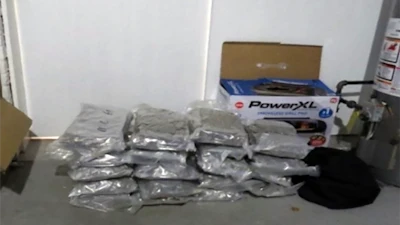
The senators pointed to a July 2025 DOJ release announcing that the U.S. Attorney’s Office for the District of Massachusetts had charged seven Chinese nationals in connection with a multimillion-dollar conspiracy to cultivate cannabis and distribute it across the Northeast.
The attorney’s office claimed the operation included interconnected grow houses concealed inside single-family properties in Massachusetts and Maine, alleging that Chinese nationals were smuggled into the U.S. and needed to repay their “smuggling debts” before gaining access to their passports.
“This case pulls back the curtain on a sprawling criminal enterprise that exploited our immigration system and our communities for personal gain,” U.S. Attorney Leah B. Foley said. “These defendants allegedly turned quiet homes across the Northeast into hubs for a criminal enterprise – building a multimillion-dollar black-market operation off the backs of an illegal workforce and using our neighborhoods as cover. That ends today.”
The senators also pointed to an April 2026 DOJ release announcing that the U.S. Attorney’s Office for the Western District of Oklahoma charged 29 Chinese nationals for their roles in a conspiracy to manufacture illicit cannabis in Oklahoma and distribute it to Texas, Mississippi, Kansas, North Carolina and elsewhere across the U.S.
“This case underscores the threat posed by nationwide criminal organizations that exploit Oklahoma’s marijuana laws to produce and distribute large quantities of black-market marijuana across the country,” U.S. Attorney Robert J. Troester said. “Working alongside our federal, state and local partners, my office remains committed to taking down these organizations and those who run them.”
Lastly, the senators pointed to a September 2026 article in the City Journal in which local authorities in Siskiyou County, Calif., detailed Chinese nationals “invading” a serene Northern California region to “build an illegal cannabis empire” while “terrorizing” rural communities.
“There is this dread out here of the criminal enterprise doing all kinds of things, from violent crime to stealing water,” County Sheriff Jeremiah LaRue told the news outlet. “With this illegal enterprise that we have, we have people that show up and are being kidnapped, or they’re being tied up, they’re being robbed, they’re being shot ... imagine having that as your neighbor.”
The four GOP senators wrote in their letter to Blanche that the Chinese TCOs’ scale and “shell game” of property records have complicated efforts to dismantle them.
The senators also drew attention to the federal government’s forthcoming ban on intoxicating hemp products that Congress voted in September to delay by four weeks, to Dec. 11, 2026, which many hemp industry stakeholders hope provides them with more time to lobby lawmakers to either push back the implementation further or replace the ban with a regulatory scheme.
Budd, Collins and Ricketts were among the 32 senators who opposed the extension, while Cotton did not vote.
“Congress has recognized the need to address vulnerabilities in this market, including closing gaps in the 2018 Farm Bill that allowed unregulated intoxicating hemp and THC products to proliferate,” the quartet wrote this week. “These reforms are set to take effect on December 11, 2026. Leaving the loophole unaddressed would give these networks additional time to flood American commerce with synthetic products. This would also further entrench their operations on American soil, fund their enterprises with illicit revenue and expose consumers to unregulated, dangerous synthetic products masquerading as legal hemp.”
The forthcoming ban stipulates that hemp-derived cannabinoid products will be federally illegal if they contain:
- cannabinoids that are synthesized or manufactured outside the plant;
- cannabinoids that are not capable of being naturally produced by the plant; or
- more than 0.4 milligrams of total THC per container.
The legislation also redefines hemp as a cannabis plant containing no more than 0.3% total THC (including THCA) or other cannabinoids with similar effects.
This will close off what many call the 2018 Farm Bill’s “loophole” that’s allowed products containing intoxicating amounts of delta-8 or delta-9 THC, HHC and other derivatives, as well as THCA hemp flower, to proliferate in gas stations, smoke shops and convenience stores across the nation.
“While this will address harmful products currently in the market, questions remain about who is financing and supporting these organizations operating within the industry,” Cotton and his colleagues wrote. “We therefore request that the DOJ fully investigate these criminal networks, including their financing, land usage, chemical imports and any connections to the Chinese Communist Party.”