
Those banking on the 2026 Farm Bill to change the course of federal policy surrounding intoxicating hemp products must now take their concerns to the Senate.
The U.S. House voted, 224-200, on April 30 to pass the Farm, Food, and National Security Act of 2026 (the 2026 Farm Bill), legislation that regularly addresses the nation’s agriculture and food policies by, in part, funding programs used by farmers and rural communities. Congress is nearly eight years removed from when it passed the 2018 Farm Bill, which federally legalized commercial hemp cultivation.
The House-passed 2026 Farm Bill would redefine hemp as a cannabis plant that does not test higher than 0.3% total THC (including THCA), rather than using the delta-9 THC threshold established in the 2018 Farm Bill that led to the boom in intoxicating hemp products, especially in states with strict cannabis laws.
While the federal government passed legislation to ban these products, specifically those containing more than 0.4 milligrams of total THC per serving, or synthetic (delta-8 THC) or unnatural (HHC) cannabinoids, beginning on Nov. 12, 2026, industry stakeholders have advocated for lawmakers to use the 2026 Farm Bill as a vehicle to delay the ban or to restructure the forthcoming definition altogether.
While some argue the farm bill deals with hemp as an agricultural commodity, not a finished good, others argue that farmers are part of the supply chain and are impacted by the downstream definition, with many set to lose meaningful diversification in their crop portfolios.
Earlier this week, Rep. James Comer, R-Ky., introduced a bipartisan amendment to the 2026 Farm Bill in the Rules Committee, seeking a one-year delay in the product ban.
“The hemp industry is facing significant challenges and growing uncertainty, and it is long past time for Congress to provide farmers and business owners with the clarity they need to succeed,” he said. “This uncertainty is already having a negative effect, and it is impacting real people, real jobs and real communities across the country, particularly in rural America. … Hemp supports 320,000 American jobs, generates $28.4 billion in market activity and contributes one and a half billion dollars in state tax revenue.”
In September 2025, Comer spearheaded a bipartisan coalition of 27 House representatives – 13 Republicans and 14 Democrats – in asking Speaker Mike Johnson, R-La., to oppose anti-hemp-related provisions in a previous spending package.
But as Democrats and Republicans alike sparred with the Rules Committee over multiple days earlier this week on obtaining a favorable rule for floor consideration of any amendments, Comer withdrew his hemp proposal.
Rep. Andy Barr, R-Ky., also filed an amendment to include his draft bill, the Legal Hemp Protection Act, which proposed a taxed and regulatory framework for the intoxicating hemp product marketplace.
The proposal aimed to redefine hemp to include a 1% delta-9 THC threshold on a dry-weight basis, but that delta-9 concentration would be measured on the finished consumer product (not on raw, floral hemp material or work-in-progress material) and would exclude cannabinoids not found in or capable of being naturally produced by the plant.
“I’m working in Congress to deliver these critical reforms so farmers have certainty and Americans can continue to access safe, reliable hemp-derived products,” Barr said on X last week in response to President Donald Trump calling on Congress to fix language in the forthcoming ban to ensure nonintoxicating, full-spectrum CBD products can continue to be made available to Americans.
Some hemp industry advocates argue that the scope of the federal government’s new hemp definition is so narrow that, when the November implementation date arrives, many nonintoxicating products will also become noncompliant.
But, as Barr continues to work with the White House on his draft language, he withdrew his amendment to the 2026 Farm Bill before it arrived at the Rules Committee.
In addition to tightening the definition of a hemp plant to include total THC, the House-passed 2026 Farm Bill aims to loosen regulatory burdens for industrial hemp producers by allowing the U.S. Department of Agriculture to reduce or eliminate testing requirements and background checks. This would also extend to state and tribal government hemp programs.
Specifically, the House-passed 2026 Farm Bill would allow industrial hemp farmers to satisfy their sampling requirements through “visual inspections, performance-based sampling methodologies, certified seed, or a similar procedure when developing sampling plans.” Hemp farmers could self-designate their type of production as “only industrial hemp,” such as fiber or grain, or as “hemp grown for any purpose other than industrial hemp,” such as cannabinoids.
In addition, industrial hemp farmers convicted of a controlled-substance-related felony would no longer have to abide by a 10-year ineligibility period to participate.
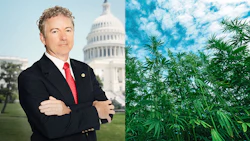
The 2026 Farm Bill now heads to the Senate, where hemp-related provisions are likely to be addressed by Sen. Rand Paul, R-Ky., who filed the Hemp Safety Enforcement Act on April 16 in an attempt to let states “opt out” of the intoxicating product ban, and Sen. Mitch McConnell, R-Ky., who helped orchestrate language for the forthcoming ban.