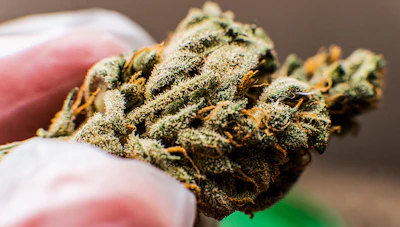

Smokable THCA flower, which some argue is high-THC cannabis masquerading as hemp, is back on convenience store shelves in Texas after a district judge granted a temporary restraining order (TRO) on April 10.
The TRO halts the enforcement of administrative agency rules banning smokable hemp flower and pre-rolls through altering testing methodologies for the popular products by including a total THC limit ((THCa×0.877) + THC) instead of a 0.3% delta-9 THC limit.
THCA, or tetrahydrocannabinolic acid, is a nonintoxicating precursor to THC found in cannabis flower. When THCA is heated through smoking, vaping or manufacturing processes, it converts into intoxicating THC through decarboxylation.
The rules, adopted by the Texas Department of State Health Services (DSHS) and the Texas Health and Human Services Commission (HHSC), went into effect on March 31, but Travis County District Court Judge Maya Guerra Gamble granted the relief to hemp industry stakeholders who filed a 330-page complaint last week.
The TRO is effective for two weeks, with Gamble ordering an April 23 hearing to consider the plaintiffs’ request for a temporary injunction. The judge outlined eight findings to support granting the TRO, including public interest.
“The public interest is served by preserving a stable and lawful regulatory framework and by ensuring that administrative agencies act within the authority delegated by the Legislature,” she wrote. “Maintaining the statutory framework enacted by the Legislature while the legality of the challenged rules is determined promotes regulatory certainty, protects lawful business activity and upholds the constitutional separations of powers.”
The Texas Hemp Business Council (THBC), the Hemp Industry Farmers of America (HIFA), and a group of state hemp manufacturers and retailers argued in the lawsuit that the DSHS and HHSC overstepped their authority after the Texas Legislature and Gov. Greg Abbott failed to reach a middle ground on 2025 legislation to either prohibit or regulate intoxicating hemp products in the Lone Star State.
The plaintiffs argued that administrative agencies can just implement their own policies that collide with state law when lawmakers fail to act.
“When an agency substitutes its own policy judgments for those of the Legislature, it crosses a structural boundary that Texas courts have repeatedly enforced,” the lawsuit states.
Gamble appeared to side with the plaintiffs on this argument.
“Absent injunctive relief, plaintiffs and other businesses operating in the Texas hemp industry will suffer immediate and irreparable harm to their businesses and legal rights,” the judge wrote. “By contrast, temporarily retraining enforcement of rules that likely exceed statutory authority and are unlawful under the Texas Constitution and Texas Administrative Procedure Act imposes no cognizable harm on defendants.”
The judge’s TRO also halted new agency rules that had prohibited the transport of hemp plants and materials into Texas for processing, which the plaintiffs argued disrupted lawful interstate commerce and in‑state manufacturing. In addition, the TRO halted escalating daily penalties for violations, which the plaintiffs argued undermined statutory notice‑and‑cure protections and exposed businesses to disproportionate enforcement risk.
But the TRO wasn’t a sweeping victory for the plaintiffs.
Gamble did not suspend new rules imposing fee increases, including raising manufacturer license fees from $250 to $10,000 per facility and retail registration fees from $150 to $5,000 per location.
Texas Rep. Vikki Goodwin, D-Austin, who intends to challenge Republican incumbent Dan Patrick for lieutenant governor, called the new agency rules “wrong” in a video she posted on social media April 9, claiming that Patrick twisted agency arms through a “backdoor” rulemaking process.
As the presiding officer in the Senate, Patrick spearheaded the failed attempt to ban intoxicating hemp products last year, before Abbott vetoed the proposal and called for regulation.
“The new rules set by DSHS are wrong,” Goodwin said. “The state agency created rules that are not in line with what a state agency should be doing. When laws pass, agencies create rules to help implement the law. But in the case of hemp, the law didn’t pass. Yes, Dan Patrick got his way through coercion in the Senate, and ultimately in the House, despite many of us voting against his No. 1 priority of banning THC. But due to a huge uproar from veterans, business owners and people who use cannabis products for a variety of reasons, the governor vetoed the bill that would have created an all-out ban on THC products.
“But then, just months later, a state agency decides to create rules that, in essence, implement the law that was vetoed. That is overreach. That is inappropriate.”
Gamble granted the TRO the day after Goodwin’s comments. The judge found that the hemp industry plaintiffs have a probable right to relief, and they demonstrated probable, imminent and irreparable injury, with no adequate remedy at law.
The judge also drew attention to Texans who provide demand for the state’s estimated $4.3 billion hemp-derived cannabinoid industry at retail, according to Whitney Economics.
“Consumers statewide utilize these naturally-derived hemp products for wellness, including the relief of chronic pain, sleep disorders, PTSD, anxiety, nausea associated with cancer treatment, and as a means to avoid the use of alcohol or chemical drugs,” Gamble wrote. “Many of the consumers are military veterans and members of the service community. If these products are not lawfully available on the market, consumers are likely to turn to less safe or illicit alternatives.”
The judge also pointed to the economic impacts.
According to Whitney Economics, the state’s hemp-derived cannabinoid market includes more than $10 billion in overall economic impact activity, from $268 million in sales tax revenue to roughly 53,000 workers who receive more than $2 billion in wages.
“In the absence of a temporary restraining order, not only will the plaintiffs suffer economic harm, but the state of Texas will suffer a broader economic loss,” Gamble wrote.