
The question in Wisconsin after Tuesday’s midterm election may not be whether the Badger State will reform its cannabis prohibition policies, but whether it’ll legalize both medical and adult-use cannabis in one fell swoop.
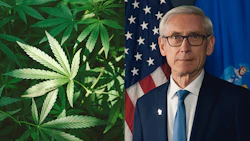
Not only did Wisconsinites elect a pro-cannabis governor who supports “full legalization,” but the state’s Democrats flipped both the House and Senate to capture their first government trifecta since 2010.
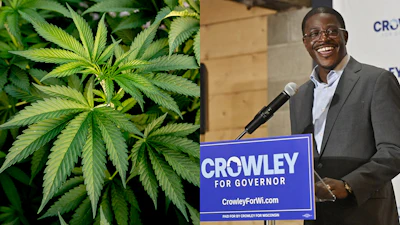
Democratic Gov.-elect David Crowley, who defeated Republican challenger Tom Tiffany by an 8-point margin on Nov. 3, said during an Oct. 21 gubernatorial debate that he believes Wisconsin should implement an adult-use program “because this is an opportunity that we’re missing out on as a state” when it comes to tax revenue funding programs like health care.
“Look, Governor [JB] Pritzker literally thanks Wisconsin residents because [Illinois has] made $30 million in sales tax collection just from Wisconsin residents,” Crowley said. “If we were to go to full legalization, we could bring in anywhere between $80 [million] to $170 million, helping to invest in health care all across the state of Wisconsin without allowing our money, nor these opportunities, to go to Illinois, Minnesota or Michigan.”
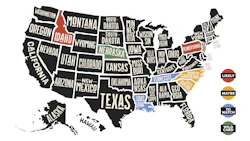
Despite living in one of eight remaining states without a regulated medical cannabis program, Wisconsin residents 21 and older can drive across the border and legally visit adult-use dispensaries in three of their four neighboring states.
For those in Milwaukee or Madison, that often means a day trip to Illinois, where out-of-state residents make up nearly 20% of a $1.4 billion adult-use marketplace in 2026, according to the Illinois Department of Financial and Professional Regulation.
Crowley also stressed the importance of Wisconsin adopting a licensed-and-regulated framework requiring strict age-gating protocols and testing standards to ensure public health and consumer safety, as seen in 24 states where adult-use cannabis is legal.
“We have to make sure that we have guardrails in place,” Crowley said. “We have to protect our children. We want to make sure that all of the labels are clearly identifiable, making sure that people know exactly what’s in their product.”
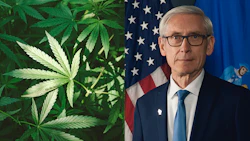
Crowley will replace current Democratic Gov. Tony Evers, who, during his eight years in office, repeatedly called for full cannabis legalization in his biennial budget proposals. He also said he’d concede to medical cannabis legalization proposals by the GOP-controlled Legislature that never made it to his desk.
In 2025, Evers even pushed Republican lawmakers to create an initiative process that would allow citizens to collect signatures and place statutory measures or constitutional amendments on the ballot because “the people should be the law of the land.”
At the time, Evers pointed to a February 2024 survey conducted by Marquette Law School pollsters who found 86% of registered Wisconsin voters supported legalizing medical cannabis, including 78% of Republicans, while 63% of registered voters supported legalizing adult-use cannabis.
Although the Republican-controlled Legislature showed promise to legalize medical cannabis that year, cross-chamber disagreements emerged from the party leaders. Assembly Speaker Rob Vos, R-Rochester, backed a plan for state-run dispensaries, but Senate Majority Leader Devin LeMahieu, R-Oostburg, called the untested idea a “nonstarter.” Neither leader budged, dealing the state’s 2024 legalization hopes a fatal blow.
In late 2025, Senate President Mary Felzkowski, R-Tomahawk, and Senate President Pro Tempore Patrick Testin, R-Stevens Point, introduced a new medical cannabis legalization bill. The Senate Committee on Health held a public hearing on the bill that October and passed the legislation on a 4-1 vote in February, when it carried over. But that’s as far as it went.
In the meantime, Wisconsin maintains some of the least permissive cannabis laws in the nation, including up to six months in jail and a $1,000 fine for possessing any amount, and a felony charge with the possibility of 3 1/2 years of incarceration on subsequent offenses.
Entering 2027, cannabis advocates have renewed hope that new Democratic leadership will prioritize reform after the Wisconsin Legislature adjourned in mid-March without taking up a Republican-sponsored medical legalization bill or a Democratic-sponsored adult-use legalization bill.
Although medical cannabis legalization has been the prelude to all 24 states that now have adult-use cannabis programs, that didn’t stop 47 Wisconsin Democrats – including 14 of 15 Senate Democrats and 33 of 45 House Democrats– from filing legislation to knock out two birds with one stone earlier this year.
“Wisconsinites have been clear for years that they support legalizing cannabis, and it is past time the Legislature listens,” said Sens. LaTonya Johnson, who sponsored the bill.
The Republican-controlled Legislature never entertained a committee hearing on the legislation.