While often associated with fire, brimstone, and the smell of rotten eggs, sulfur (S) actually plays an important role in cannabis cultivation. It contributes to structural growth, metabolic function (i.e., terpene production), and disease management in cannabis.
S can often be ignored in cannabis nutrient programs, but as a secondary macroelement, it is still important for plant growth, so knowing the telltale signs and common causes of deficiencies is crucial.
Although not a common occurrence, S deficiency can be observed, especially in hydroponic and/or soilless substrates. It can also easily be conflated with a nitrogen (N) or iron (Fe) deficiency, making diagnosing the issue that much trickier.
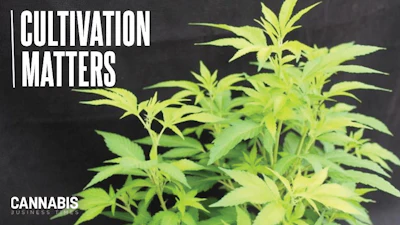
Similar to N deficiency, S deficiency is observed as chlorosis of the entire leaf, generally beginning in the middle of the plant and extending up to the youngest growth (Fig. 1). The lower leaves can still remain dark green, making this difficult to diagnose, particularly for cultivators utilizing stacked vertical growing systems.
The main difference between S-deficient and N-deficient plants is that the latter generally exhibit stunted growth and more severe symptoms in the bottom foliage compared to starting in the middle foliage.
To determine whether cannabis plants are S- or N-deficient, growers can conduct an in-house PourThru test to determine the electrical conductivity (EC) to confirm if N fertility is not sufficient. If the EC is within the appropriate range for the plants’ growth stage, reducing the possibility of N deficiency, S-deficiency may be the chlorosis culprit.
Upper leaf interveinal chlorosis (initial stage) to overall yellowing (advanced stage) of an Fe deficiency is likely the second most common cannabis nutritional disorder. However, Fe deficiencies generally appear in new growth (Fig. 2). In most cases, conducting a PourThru pH test of the substrate pH can confirm the diagnosis. In general, any time the substrate pH is above ~6.5, Fe deficiency symptoms begin to appear. Figure 2: Iron deficiency is a common mimic of sulfur deficiency; however, iron deficiency begins as interveinal chlorosis of the new foliage. Photo by Brian Whipker
Where Does S Come From?
Sulfur can be supplied in a variety of ways; first, it is in the substrate. S can be supplied by a preplant charge or various amendments that may be added. However, inert or inorganic substrates such as rockwool or hydroponics will not contain S, resulting in the need to supply S beginning at the time of transplant.
Irrigation water can also be a source of S. Municipal water can contain 5-30 ppm S; however, this is not always sufficient for vigorous cultivars or long-term stock plants with high nutrient demand.
What Causes S Deficiencies in Cannabis Cultivation?
Most S deficiency problems occur due to the lack of S being supplied through the fertilizer program. Very few, if any, preblended fertilizers contain the appropriate amount of S, if any (generally, 1 to 3 parts S).
For example, growers operating in areas with low concentrations of alkalinity may use Cal-Mag fertilizer blends. Cal-Mag formulas contain a higher percentage of nitrate-nitrogen and tend to be basic-reacting fertilizers, which helps avoid substrate pH drop. Many formulas rely upon magnesium nitrate as the magnesium source instead of magnesium sulfate. This is done to avoid precipitation between calcium (cation) and sulfur (sulfate anion), which will result in a visible solid forming at the bottom of the mixing tank.
In turn, this results in only trace amounts of S being available if any sulfate form of micronutrients were used in the fertilizer formulation. These trace amounts are insufficient to support the plant’s needs. The problem is compounded if the operation’s water supply also lacks any significant concentration of S.
Also, if one looks at the analysis provided on a fertilizer bag label, in most cases, the concentration of S is not listed. Historically, agricultural fertilizers utilized salts that contained S, such as potassium sulfate, and S was available from the atmosphere as a result of burning high-S-containing coal.
To prevent S deficiencies and cannabis stalls, it is crucial for growers to understand water quality and what elements are supplied from fertilizer formulas.
Read more Cultivation Matters columns here.