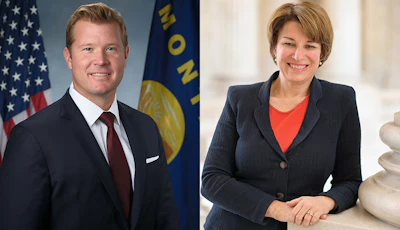

U.S. Sens. Tim Sheehy, R-Mont., and Amy Klobuchar, D-Minn., revealed their plan to avert the federal government’s forthcoming ban on intoxicating hemp products and instead establish a regulatory framework.
The senators introduced the bipartisan Hemp Guardrails Act on Nov. 17, legislation that aims to impose “strict” regulations on hemp-derived cannabinoid products and address “every issue” raised by lawmakers supporting a federal ban scheduled to take effect on Dec. 11.
Without legislative intervention, products containing more than 0.4 milligrams of total THC per container, as well as those containing synthetic cannabinoids, will be federally illegal next month. This will close what many call a loophole in the 2018 Farm Bill that defined hemp as having no more than 0.3% delta-9 THC in a pre-harvest field test, which opened the door for finished products mimicking the intoxicating effects of marijuana to proliferate in gas stations, convenience stores and smoke shops nationwide.
Hemp-derived products containing unnatural cannabinoids, like THC-O, already became federally illegal on Nov. 12 in the first phase of the government’s ban.
Now, Sheehy and Klobuchar hope to replace the second phase of the federal ban with a structure that keeps “good actors” in business.
“We’re taking a commonsense approach to this issue,” Sheehy said in announcing the legislation. “Our bill will put every bad actor in the hemp space out of business and keep intoxicating products out of the hands of children. It will also stop Congress from turning the farmers, veterans and cancer patients who rely on these products into criminals overnight.”
The bipartisan proposal would prohibit those younger than 21 from purchasing or possessing consumable hemp products. It would also direct the U.S. Food and Drug Administration (FDA) to establish requirements for child-resistant packaging, labeling, manufacturing and testing.
The Hemp Guardrails Act would outlaw misleading packaging, imitation branding and advertising that targets children, and also require appropriate health warnings.
“Minnesota is a national leader in hemp, and our state has shown that we can protect kids and support responsible hemp businesses,” Klobuchar said. “But a looming federal ban on hemp products is threatening farmers, brewers, small businesses and consumers across Minnesota and the country. This new bill with Senator Sheehy would keep safe hemp products on store shelves, protect consumers from dangerous products and ensure that farmers and small businesses can continue to operate, grow and create jobs.”
In addition, the 17-page bill would ban raw floral hemp material, smokable hemp flower and hemp pre-rolls intended for inhalation, something the senators refer to as “gas station weed. It would also prohibit delta-8, delta-10 and THC-O products, as well as synthetic cannabinoids, which the senators said often originate in China.
Where it differs from the intoxicating product ban that’s set to take effect on Dec. 11 is that the Hemp Guardrails Act would set the allowable THC threshold for hemp cultivation at 1% total THC on a dry-weight basis, instead of a 0.3% limit, in what the senators said would avoid unintentionally criminalizing farm operations.
RELATED: Hemp’s Regulatory Reckoning: What Lawmakers Still Don't Understand
But not all senators are convinced by this legislative fix.
Sen. Ted Budd, R-N.C., said when Congress voted in November 2025 to include intoxicating hemp prohibition language as part of a larger appropriations package to end a 43-day government shutdown, lawmakers chose to close a loophole that “never should have existed.”
“I’ve heard from countless constituents whose loved ones’ addictions began with the very products the Sheehy-Klobuchar bill would legalize at even higher, more dangerous potency,” Budd wrote Nov. 17 on social media. “I will not support any year-end package that extends, delays or builds a regulatory framework around products that fuel addiction, endanger our children and weaken our workforce.”
According to the Sheehy-Klobuchar proposal, they hope to avoid the “destruction of a $30 billion American industry that supports 350,000 jobs,” statistics attributed to a September 2026 Whitney Economics report.
Sheehy and Klobuchar also said their bill would:
- Strengthen enforcement: Authorizes FDA to inspect facilities, seize adulterated or misbranded products and enforce federal requirements for consumable hemp products entering interstate commerce.
- Establish federal oversight: Creates categories for hemp-derived cannabinoid products and dietary supplements under the Federal Food, Drug, and Cosmetic Act.
- Protect American farmers: Requires consumable hemp products to be cultivated, processed, finished and packaged in the United States.
- Preserves access to CBD: Protects access to qualifying hemp-derived CBD products through the Trump administration’s Centers for Medicare and Medicaid Services (CMS) initiatives.
- Respects states’ rights: Preserves states’ authority to enact stricter hemp regulations.
Sheehy and Klobuchar now face the task of gaining support for their legislation during the lame-duck session, when freestanding bills face steep uphill battles. Currently, the Senate remains focused on crafting a temporary government funding measure – often referred to as a continuing resolution – to avoid a shutdown on Dec. 11.
As Rep. James Comer, R-Ky., who also supports averting the federal hemp product ban, indicated last week, the “best opportunity” to delay or rewrite the prohibition language is through attaching legislation to a continuing resolution.