
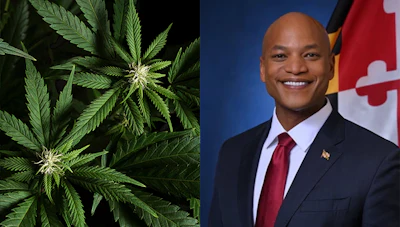

Although congressional Democrats are set to take the reins next year, 16 Democratic governors are calling on Congress to pass the SAFE Banking Act now, so cannabis businesses “can bank like everyone else.”
Maryland Gov. Wes Moore spearheaded a letter to congressional leaders on Nov. 9, urging them to push the longstanding Secure and Fair Enforcement (SAFE) Banking Act across the finish line during this Congress’ lame-duck session.
The legislation would help ensure state-licensed cannabis businesses can access federally regulated banking and financial services by providing safe harbor to banks and credit unions that choose to serve the industry.
While the U.S. House passed previous versions of the SAFE Banking Act seven times between 2019 and 2022 – all under Democratic control – the Senate repeatedly squashed those efforts under the majority leadership of Sens. Mitch McConnell, R-Ky., and Chuck Schumer, D-N.Y.
Now, on the heels of Schedule III reform for medical cannabis and proposed Schedule III reform for nonmedical cannabis under the federal Controlled Substances Act, Moore and his chief executive colleagues are nudging Congress to seize the opportunity.
“Almost every state has made cannabis legal in some way, but federal law still treats the money from legal cannabis businesses as illegal,” Moore, who chairs the National Governors Association, wrote Monday on social media. “That forces them to run largely on cash, and stops them from easily getting loans and accepting credit cards.
“It’s another ridiculous federal issue our entrepreneurs face, and it actually makes communities less safe by making those businesses targets for robbery.”
Without federal banking reform, many state-licensed cannabis businesses deal primarily in cash and face substantial barriers to accessing traditional financial services, including business loans, payroll systems and credit processing.
Also signing Monday’s letter were: Colorado Gov. Jared Polis, Connecticut Gov. Ned Lamont, Delaware Gov. Matt Meyer, Illinois Gov. JB Pritzker, Kentucky Gov. Andy Beshear, Maine Gov. Janet Mills, Massachusetts Gov. Maura Healey, Michigan Gov. Gretchen Whitmer, Minnesota Gov. Tim Walz, New Mexico Gov. Michelle Lujan Grisham, New York Gov. Kathy Hochul, Oregon Gov. Tina Kotek, Virginia Gov. Abigail Spanberger, Washington Gov. Bob Ferguson, Wisconsin Gov. Tony Evers.
Colorado, Michigan, Minnesota, New Mexico and Wisconsin will all have new Democratic governors in 2027, but that did not stop these states’ chief executives from signing the letter. Overall, Democrats flipped six governors’ seats in the Nov. 3 election and are expected to have governors in at least 29 states next year (the Kansas governor’s race remains uncalled, where Democratic candidate Cindy Holscher holds a 50.35% to 49.65% lead over Republican candidate Ty Masterson with 99% of expected votes counted, according to The Associated Press).
“Across our communities, we have witnessed firsthand the public safety, economic and regulatory challenges that arise from the disconnect between state cannabis laws and federal law,” the letter signers wrote. “The SAFE Banking Act is common-sense legislation that will improve the safety of Americans who live in states where medical and/or adult-use cannabis has been legalized.”
The 16 Democratic governors further reiterated that the legislation “respects state decision-making authority” to legalize or prohibit cannabis, while it would also maintain the federal government’s classification of cannabis.
In 2026, 42 states have adopted medical cannabis programs, while 24 states have legalized both medical and adult-use cannabis.
While the SAFE Banking Act was nowhere to be seen for the majority of this Congress, Sen. Jeff Merkley, D-Ore., led a bipartisan coalition of four senators, while Rep. Dave Joyce, R-Ohio, led a bipartisan coalition of eight U.S. House members in reintroducing the legislation in June 2026.
“State-licensed cannabis businesses employ thousands of Americans and generate significant tax revenue, yet many remain effectively shut out of the traditional banking system,” Joyce said this summer. “Forcing businesses to operate in cash not only hinders economic growth, but it also opens the doors for illegal activity like money laundering and organized crime.”
Neither chamber has provided the SAFE Banking Act of 2026 a committee hearing under House Speaker Mike Johnson, R-La., and Senate Majority Leader John Thune, R-S.D., who have opposed cannabis industry reform.
Although Schumer and Rep. Hakeem Jeffries, D-N.Y., are positioned to take the top leadership roles of their respective chambers in 2027, that didn’t stop the coalition of 16 Democratic governors from calling on current leadership to get the SAFE Banking Act job done now.
The governors called attention to the need for congressional action even under federal rescheduling policies, where federally regulated financial institutions are still required to comply with stringent Bank Secrecy Act (BSA)/Anti-Money Laundering (AML) rules designed to protect the U.S. financial system and prevent illicit financial transactions by “bad actors,” the governors wrote.
“Banks must collect and retain information about the customers they bank, monitor transactions for suspicious activity, and file regular reports with Treasury’s Financial Crimes Enforcement Network (FinCEN),” they wrote. “States rely on access to these BSA/AML reports to help fight financial crime. Ensuring state-sanctioned cannabis businesses are integrated into the regulated financial system will also allow state regulatory agencies to gain greater visibility into business transactions and financial flows, enabling more effective enforcement of state cannabis laws.”
The governors also reiterated that law enforcement agencies would benefit from the SAFE Banking Act because the legislation would make it easier for government officials to identify and investigate illicit activity.
“As governors, our fundamental responsibilities include protecting public safety, fostering economic opportunities and ensuring our state agencies can operate efficiently,” the governors wrote. “The SAFE Banking Act facilitates, in the short and long term, our ability to fulfill these responsibilities, especially as the federal government determines the extent of cannabis rescheduling. … Congress must act to ensure that legal businesses operating under state law have access to the financial system.”