

Virginia’s plan to open an adult-use cannabis retail market for those 21 and older is back on the table for next year.
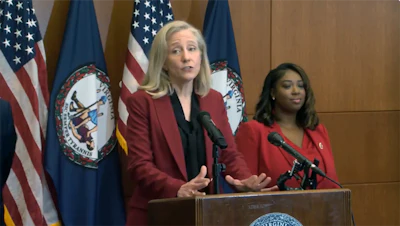
Gov. Abigail Spanberger announced June 16 that she reached a compromise with state lawmakers over legislation she vetoed last month, with new plans to establish a “safe, legal and well-regulated” market through the commonwealth’s budget process. The deal will allow dispensary sales to commence on July 1, 2027.
The governor was joined during Tuesday’s announcement by Sen. Lashrecse Aird, D-Henrico, and Del. Paul Krizek, D-Fairfax, who sponsored the now-vetoed adult-use legislation during the 2026 session in their respective chambers.
Spanberger said Tuesday she was excited to stand alongside her fellow Democrats to announce the new plan to commence a licensed program more than six years after Virginia legalized adult-use possession and home grows under former Gov. Ralph Northam.
“We will do it in a way that protects consumers, tamps down with the goal of eliminating the illicit market with clear enforcement and regulatory authority, and it creates a more competitive market for small businesses and farmers,” Spanberger said. “We have always shared the same priorities and goals for this marketplace, including measures to keep our kids safe once the marketplace is open. It’s important to all of us that retailers don’t advertise to young people, that they comply with the new laws in place about selling to minors.”
The budget proposal compromise aims to adopt or address several of the governor’s amendments that lawmakers rejected in April, when they declined to take up any of her proposed changes, ultimately leading to the veto.
The compromise deals Spanberger several wins, including a six-month delay for dispensary sales after Aird and Krizek originally wanted a Jan. 1, 2027, launch date. Spanberger also got her wishes for reducing the proposed possession limit from 2.5 to 2 ounces, and for increasing the excise tax on adult-use retail sales from 6% to 8% beginning on July 1, 2029. This is in addition to a 5.3% retail sales and use tax and a local tax rate of 1% to 3.5%.
“After I sent back amendments to the initial bill, we began talking in earnest about how to get this bill over the finish line,” Spanberger said. “And this is what good governing and collaboration looks like: bringing people together, listening carefully, focusing on solutions that are practical, enforceable and in the best interests of Virginians.”
Aird said the final agreement reflects that too many Virginians have been impacted by the “real harms” of prohibition policies.
Lawmakers also locked horns with Spanberger over a dispensary cap: Aird and Krizek wanted 350 stores, while the governor wanted to start with 200 locations. The budget proposal revives the 350-dispensary limit but provides state regulators the authority to determine how quickly to issue those licenses based on market conditions.
The compromise also retains lawmakers’ intentions to prevent localities from opting out of allowing adult-use cannabis businesses to operate in their jurisdictions.
“A safe, regulated retail market is not just about legalization; it is about public safety, consumer protection and finally given Virginians a legal marketplace that can compete with and displace the illicit market,” Aird said. “By restoring the retail cap to 350 locations … we are given the legal market a real opportunity to meet demand across Virginia, but I would emphasize that that 350 will not roll out all at once or right away.”
Perhaps one of the biggest sticking points of the vetoed legislation during the legislative session was Spanberger’s inclusion of escalating criminal penalties in her proposed substitute that Aird feared would only risk repeating the harms of the drug war.
As part of the compromise, the budget proposal includes a $250 civil penalty for those who violate public consumption laws beginning in 2027.
“Like any compromise, we all share the belief that recriminalization is not the answer,”
Aird said. “We have decades of evidence showing that criminalization alone does not eliminate demand or end the illicit market. So, we’ve taken several steps to ensure that this is the case. We ensure that several of the provisions for enforcement are strong and in place, but without criminalizing individuals.”
Spanberger had previously proposed a Class 4 misdemeanor penalty for public consumption, as well as a Class 1 misdemeanor for underage possession.
The governor said this week that one of her main concerns with an adult-use marketplace was ensuring safety for children. Under the compromise, the Virginia Cannabis Control Authority (CCA) will have the authority to create escalating penalties for businesses that fail to conduct age-verification checks.
“The place where we clearly found common ground was in ensuring that the penalties are significant and clear for those who sell to underage young people, recognizing that it’s an intoxicating substance. While recreational use is legal, we still want to make sure that we’re keeping our kids safe,” Spanberger said. “And so, I would say that what we see in this compromise is ultimately every priority that I had.”
Those priorities also included setting the marketplace up for success, she said.
To help ensure a timely rollout, the state’s five existing medical cannabis licensees can pay a one-time $10 million conversion fee to transition their operations to adult use.
But Virginia’s forthcoming market needs to provide for equitable opportunities, said Krizek, who emphasized that building the market correctly matters just as much as launching it.
“For decades, cannabis enforcement created real consequences for individuals, families, and documented disproportionate impacts to communities,” the delegate said. “A legal marketplace should not lock those same communities out of the economic opportunity created by reform. So, part of the responsible legalization that we have before you today is recognizing that those past cannabis policies did not affect every community equally.
“As we move into a legal marketplace, we have an obligation to make sure opportunity is not limited only to those who already have access to capital and political connections.”
Krizek said part of the compromise was to ensure that a regulated marketplace is competitive but also open to small businesses that “deserve a real chance to succeed.” More specifically, he said the budget deal sets aside 75% of license fee deposits in the first year for a Cannabis Equity Business Loan Fund, since access to capital is one of the largest barriers to entry in the industry. This fund will provide aspiring entrepreneurs “a fair shot to compete,” he said.
The compromise also grants the CCA the authority to issue up to 100 microbusiness licenses by May 1, 2027, which Krizek said will help prevent a market “dominated solely by the largest and best capitalized ventures.”
As part of Aird and Krizek’s original legislation, 30% of the state’s cannabis excise tax revenue was earmarked for a Cannabis Equity Reinvestment Fund, while 40% was for early childhood care and education, 25% was for the Department of Behavioral Health and Developmental Services, and 5% was for public health programs.
Spanberger struck out those specific percentages in her amended substitute but wanted to reserve the revenue to fund the same programs, which is now included in the compromise proposal.
The compromise budget proposal also:
- Prohibits cartoon advertisements, requires child-safe packaging, and prohibits products sold in the shape of animals, fruits, vehicles or humans;
- Prohibits dispensaries from being located within 1,000 feet of schools, hospitals, playgrounds and drug treatment facilities;
- Strengthens oversight of intoxicating hemp products, which are currently regulated by the Virginia Department of Agriculture and Consumer Services, by transferring regulation to the CCA; and
- Allows the CCA to maintain a public licensee registry, establish a tip line for members of the public to anonymously report concerns about illicit practices, investigate the ownership and control interests of licensees, and develop policies regarding the audit of ownership and financial relationships across licensees.
Spanberger said she appreciated Aird and Krizek working with her to create a regulatory framework that Virginians can trust.
“In the end, we all wanted to deliver a marketplace that the commonwealth could implement effectively for the long term. We have always had this same end goal, an end goal that has been years in the making,” the governor said. “Virginians have been waiting a long time for policymakers and the governor who wanted to do this and get it right. And today we are taking an important step forward.”