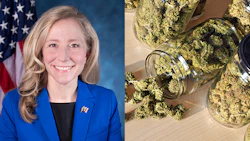

Virginia lawmakers voted on June 22 to send Democratic Gov. Abigail Spanberger legislation to legalize adult-use cannabis dispensary sales in a licensed and regulated framework as part of their $207 billion budget compromise.
It’s the third time this year that a legalization proposal has landed on Spanberger’s desk, with the governor offering amendments to an initial bill passed in March, and then ultimately vetoing that legislation in May when the bill’s sponsors declined to take up any of her amendments.
But the chief executive reached a deal earlier this month to find middle ground with her fellow Democrats who control the majority party in the state Legislature, keeping the reform proposal alive through the budget process.
The Senate voted, 23-16, and the House voted, 71-22, on Monday to approve a conference report for the budget that includes the compromise to commence adult-use sales by July 1, 2027.
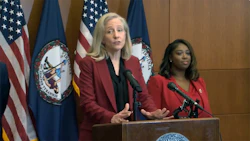
“We have always shared the same priorities and goals for this marketplace, including measures to keep our kids safe once the marketplace is open,” Spanberger said during a press conference last week.
With the budget now passed, the governor indicated on Monday that she would sign it.
"Today, the General Assembly has moved forward with a budget proposal — and that means we are keeping our government open and delivering for the 8.8 million people who call our commonwealth home," Spanberger said.
The deal will increase the state’s cannabis possession limit from 1 to 2 ounces for those 21 years and older; institute a 6% excise tax on adult-use dispensary sales, with an automatic increase to 8% beginning on July 1, 2029; allow up to 350 licensed dispensaries throughout the commonwealth; prevent localities from opting out of allowing adult-use businesses to operate in their jurisdictions; among many other provisions.
Existing medical cannabis companies will be allowed to transition to dual-use licensure through a one-time $10 million conversion fee, either paid in full by May 1, 2027, or through an approved installment payment plan.
However, to the dismay of reform advocates, the compromise deal includes a $250 civil penalty for those who violate public consumption laws beginning in 2027, an increase from the state’s current $25 fine.
A cohort of 18 advocacy groups sent a letter to Spanberger and state lawmakers on June 18 opposing the consumption fine and any other penalty increase that “lacks data and would deepen racial and economic disparities.” The letter’s signatories included the American Civil Liberties Union (ACLU) of Virginia, and cannabis reform advocacy organizations NORML, Marijuana Policy Project and Drug Policy Alliance.
“Higher fines and penalties for low-level marijuana offenses are not neutral,” they wrote. “They are enforced disproportionately against Black and Brown communities, create debt that low-income people cannot afford, and can trigger cascading harms in immigration, housing, education and employment. Virginia should not recreate over-policing and over-incarceration through fines and fees when the stated goal of legalization is public health, equity, repair and reducing criminalization.”
Spanberger had previously proposed a Class 4 misdemeanor penalty for public consumption, as well as a Class 1 misdemeanor for underage possession.
Sen. Lashrecse Aird, D-Henrico, brought her opposition to these criminal penalties to the forefront when lawmakers rejected the governor’s proposal in April.
“The governor’s substitute substantially introduces harsh escalating criminal penalties that risk repeating the very harm legalization was meant to correct, particularly in communities that have historically been harmed by prohibition,” Aird said at the time.
But after reaching a compromise deal that included lower penalties last week, the senator offered a different tone.
“Like any compromise, we all share the belief that recriminalization is not the answer,” she said. “We have decades of evidence showing that criminalization alone does not eliminate demand or end the illicit market. So, we’ve taken several steps to ensure that this is the case. We ensure that several of the provisions for enforcement are strong and in place, but without criminalizing individuals.”
Del. Paul Krizek, D-Fairfax, who sponsored the legislation in the lower chamber, also came to terms with the compromise, after previously taking issue with the delayed sales launch: The initial legislation would have allowed adult-use sales to begin six months sooner.
Virginians 21 and older have been allowed to possess 1 ounce of cannabis and grow up to four plants at home since 2021, but they’ve had nowhere to legally purchase it due to, in part, former Republican Gov. Glenn Youngkin’s repeated vetoes of adult-use sales bills.
A primary focus for Krizek was to establish a marketplace that not only redirects unlicensed sales into a regulated framework, but also to provide equitable opportunities with low barriers of entry for small businesses and those most adversely impacted by prohibition policies.
“As we move into a legal marketplace, we have an obligation to make sure opportunity is not limited only to those who already have access to capital and political connections,” he said last week.
Under the compromise, the Virginia Cannabis Control Authority (CCA) must deposit 75% of all annual licensing fees collected from May 1, 2027, to May 1, 2028, into the Cannabis Equity Business Loan Fund, established to help aspiring entrepreneurs with the technical assistance and capital they need to enter the new marketplace.
In addition, net profits from the state’s cannabis excise tax, after accounting for the CCA’s expenses, will be reserved for the following: a new Cannabis Equity Reinvestment Fund; the Department of Behavioral Health and Developmental Services; public health programs; and childcare and education.
While the initial legislation provided specific percentages to be allocated to each of those tax beneficiaries, the governor had those percentages stricken.
Additionally, the compromise deal will also prohibit consumable hemp products from containing more than 2 milligrams of total THC per package and strengthen oversight of intoxicating hemp products by transferring regulatory duties from the Virginia Department of Agriculture and Consumer Services to the CCA.
Finally, the legislation includes several health and safety guardrails, including those aimed at preventing youth exposure and use through prohibiting cartoon advertisements, requiring child-safe packaging, banning products sold in attractive shapes like animals or fruits, and requiring a 1,000-foot buffer zone between dispensaries and schools, hospitals, playgrounds and drug treatment facilities.
“The place where we clearly found common ground was in ensuring that the penalties are significant and clear for those who sell to underage young people, recognizing that it’s an intoxicating substance,” Spanberger said. “While recreational use is legal, we still want to make sure that we’re keeping our kids safe.”