
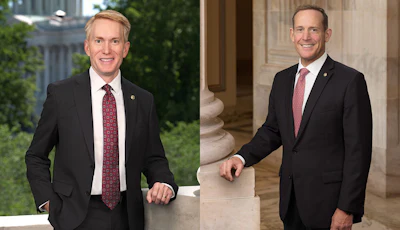

Two Republican lawmakers are attempting to legislate cannabis policies in a state they don’t represent, claiming that the Drug Enforcement Administration’s (DEA) “trust in state licensing schemes is not deserved” under a federal Schedule III control status.
U.S. Sens. James Lankford, R-Okla., and Ted Budd, R-N.C., wrote a letter Oct. 27 to Postmaster General David Steiner, urging the U.S. Postal Service (USPS) to maintain its ban on mailing all cannabis, even now that state-licensed medical cannabis products are classified as Schedule III substances under the Controlled Substances Act.
Their letter comes after Georgia Medical Cannabis Commission (GMCC) members voted in August on a new rule that would allow medical cannabis deliveries through the USPS or private mail carriers, such as FedEx, UPS or DHL, to the state’s patients, caregivers and health care institutions.
GMCC Executive Director Andrew Turnage said the intention is to improve patient access “to the medication that we regulate,” calling attention to qualifying patients who are permanent residents in long-term care facilities and cannot drive or are immobile.
This prompted Lankford and Budd to push the collision between federal and state cannabis policies.
“Many concerns have been raised about the consequences of rescheduling marijuana,” the senators wrote. “A growing concern is whether Schedule III marijuana will become a mailable item under United States Postal Service (USPS) regulations. It is our understanding that marijuana cannot currently be mailed at all using the USPS. However, some states are under a different impression. Georgia’s Access to Medical Cannabis Commission recently took steps to declare that medical marijuana can be shipped using USPS and private carrier services.
“While Georgia does not have the authority to alter current USPS regulations, we are concerned that USPS will alter its regulations to allow for these shipments. We strongly oppose any effort to allow the shipment of marijuana.”
Under USPS domestic shipping prohibition policies, “marijuana (medical or otherwise)” is listed as an item that cannot be sent in the U.S. mail. Hemp products, containing 0.3% THC or less, are allowed but restricted.
Still, cannabis regulators in Georgia are hoping to leverage an April 2026 order from U.S. Attorney General Todd Blanche, which “immediately” reclassified state-licensed medical cannabis under Schedule III, to allow the state’s dispensing licensees to be able to ship directly to a patient’s home.
Lankford and Budd, who have two of the strongest anti-cannabis reform records in Washington, called into question the basis of the Schedule III reclassification, suggesting that the government “relied on the fact that many states call marijuana ‘medical’ as evidence to support a currently accepted medical use,” a key distinction that separates all lower scheduled drugs from the most heavily controlled Schedule I drugs.
“Although ‘medical’ marijuana is classified as a Schedule III drug, it is unlike any other Schedule III drug,” the senators wrote. “Inhaled marijuana and marijuana edibles are not an FDA-approved prescription drug. The DEA rule put significant weight on state licensing schemes as proof that the marijuana being sold is safe and medicinal. This trust in state licensing schemes is not deserved. Some states have very low barriers to entry when it comes to being a licensed marijuana dispensary.
“At one point, Oklahoma had 9,178 licensed marijuana grow operations and 2,611 licensed dispensaries. While those numbers have come down, it is clear that state-licensed participants must be funneling products across state lines and into the black market. USPS should not give these actors access to the mail.”
Lankford and Budd also called attention to a common prohibitionist concern that cannabis legalization leads to increased youth access, a claim that has been debunked by the U.S. Centers for Disease Control and Prevention (CDC), whose data shows that teen cannabis use is at an all-time low, declining significantly in states that implement adult-use markets.
Lankford and Budd referenced an uptick in calls to U.S. poison centers for young children who accidentally ingest cannabinoids, something that cannabis advocates often attribute to unregulated products being sold in unlicensed storefronts following a loophole in the 2018 Farm Bill that allowed intoxicating hemp products to proliferate, especially in prohibition states.
“Despite being a controlled substance, marijuana is not at all under control in our country,” the senators wrote. “Allowing the shipment of marijuana will potentially give more access to children.
“While it may seem like marijuana is legal everywhere, Idaho and Kansas have not legalized it in any form. While bad actors find ways to funnel the drug into those states, the USPS should not facilitate the shipment of an illegal and controlled substance into a state that does not allow its use.”