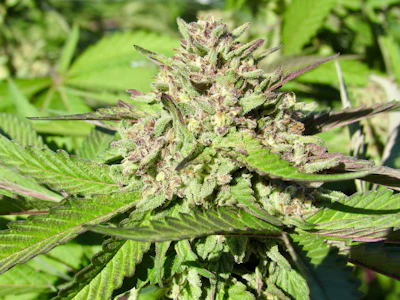

The forested, winding U.S. 101 in Mendocino County reeks of fresh, acrid skunk spray in the mornings and evenings right now.
“Down at the road gate, it smells like a turd,” one farmhand at Greenshock Farms in Mendocino said jokingly. He’s standing on a verdant hillside with nary a yellow leaf on his parcel.
Industry players, watchers, and consumers should expect the annual California outdoor harvest to be another big one this October in Humboldt, Mendocino, and Trinity counties – the Emerald Triangle – and beyond.
Weather has been mild and low-stress this year, and plant counts in the state’s track-and-trace system Metrc are at high levels.
Farmers are set to enter some 13 million to 22 million pounds of freshly harvested cannabis in the state’s legal database for October, Cannabis Business Times estimates. The annual spike in production corresponds with the finishing of the state’s outdoor crop, which comprises 75% of the licensed square footage in the state.
“It’s looking like a fantastic crop with lots of stellar batches,” said Eli Melrod, founder and CEO of the Solful chain of dispensaries, which specializes in selling “sungrown cannabis.” Solful-branded cannabis won 22 medals in the 2026 California State Fair Cannabis Awards.
What Is Croptober and Why Is It Important?
Oct. 1 kicks off “Croptober” – the industry slang term for the seasonal harvest of the full-term, annual outdoor and mixed-light (aka greenhouse-grown) cannabis crops. October is the peak month for cannabis entering the track-and-trace system each year. Department of Cannabis Control (DCC) data showing October spikes in wet weight in CaliforniaDCC
Cannabis is California’s No. 1 agricultural commodity at $12.9 billion, when illicit cultivation is factored in. Legal cannabis ranks as the state’s fifth-biggest agricultural commodity ($4 billion to $5 billion), roughly equal to cattle, almonds, or grapes.
Nationally, California remains a top source state for illicit cannabis for the country, according to Drug Enforcement Administration reports.
What Is Production (aka Supply) Looking Like?
In October 2026, California is set to harvest somewhere between 13 million and 22 million pounds of wet weight and enter it into the state’s track-and-trace system, Metrc, based on historical trends in California Department of Cannabis Control (DCC) data. (Three caveats: Dry weight will be 80% to 90% less than wet weight. Not all the crop is dried; a significant percentage of it is fresh-frozen for extraction. And not all the dried crop is A-grade buds for packaged flower; the harvest also includes lower-grade flower, trim, and stems.) Canna Country's drying roomPhoto by David Downs
CBT reporting indicates the harvest will be on the high side of historical data in 2026 when factoring plant counts and weather.
Plant counts high
For one, plant counts in August 2026, the most recent reporting period, were near all-time highs – 6.6 million plants. Plant counts last peaked in October 2025 at 7.6 million plants. The DCC defines “plant count” as harvested batches, so it doesn’t directly establish how many plants await October harvest.
Weather good
Second, farmers in the major production counties like Humboldt reported good weather and no major wildfires. The biggest production county, Santa Barbara, also experienced an average year of weather. Many Santa Barbara County farmers grow year-round in “mixed-light” greenhouses.
One major greenhouse cultivator, Glass House Farms, reported “record biomass” production in the second quarter, its most recent reporting period. The company also forecasts producing a record 1 million pounds of biomass for 2026.
One caveat: Licenses and square footage under cultivation down
These high plant counts are coming from fewer cultivation licensees and lower square footage under active cultivation, according to a license analysis from Higher Origins, a Mendocino-based distributor.
Both mixed-light and outdoor square footage under active cultivation have been pared back.
Mixed-light square footage under active cultivation has dropped about 57% from its peak to 10.8 million square feet as of Jan. 31, 2026, the most recent reporting period for which CBT could find analysis.
“I’ve seen a lot of people aren’t growing; they’re fallowing. They’re doing outdoor,” Higher Origins founder Matthew Browning said.
 Canna Country's Ted BlairPhoto by David Downs
Outdoor square footage under active cultivation is down from about 90 million square feet at peak to 61 million square feet in 2026.
“Everybody basically scaled back,” said Canna Country Farms operator Ted Blair in Humboldt County.
Indoor square footage under active cultivation is stable at about 9.6 million square feet.
What Will Prices Be?
Reports indicate that prices could slide a bit from their current historic lows this fall. Why? Price is generally a function of supply and demand.
Static retail sales
Legal cannabis sales have been relatively static in the California legal market, at about $325 million in retail sales per month, according to data from the industry analytics firm Headset. Why are sales static? Partially due to static levels of retail access. More than half (56%) of California cities and counties ban legal stores, thus limiting access. This year there has been no particular jump in retail licensing. And in general, there’s been a slight culling of delivery licenses. Headset
Furthermore, higher consumer prices, including gasoline prices, have squeezed consumers’ budgets. That’s putting downward pressure on demand.
“We have an oversupply and a downturn in the economy,” said Browning at Higher Origins.
Pricing weakness
If supply increases with the historic October market flood, and demand stays the same or is soft, then prices should slide.
For context, prices have shown historic weakness in California. Prices are likely to fall this October with the supply flood, which was a common past trend.
The overall pricing picture in California has been one of falling prices finding successively new bottoms, as economies of scale wring the cost of goods sold out from production. The pricing floor currently appears soft.
“We used to make a lot; now it costs a lot,” said Jason Gellman, operator of Ridgeline Farms in Humboldt County.
Outdoor prices
The average wholesale price for California outdoor-grown cannabis is $334 per pound, according to Cannabis Benchmarks data for the most recent reporting period as of press time, the week ending Sept. 25. That price is down 11% from the beginning of 2026.
“I think prices hit as high as they’re going to be. Outdoor is about to harvest. That’s when you usually see a price drop,” Browning said. “It's a dicey situation.”
One metric that smooths out price volatility is looking at the average wholesale price per pound of outdoor for the year-to-date. That price is down 2% compared to the average year-to-date price for the same week in 2025, according to Cannabis Benchmarks. This mild year-over-year change in the average price for the same week indicates a bottom – albeit a soft bottom – has been found.
Mixed-light prices
The average wholesale price for California mixed-light is $566 per pound, according to Cannabis Benchmarks, for the most recent reporting period as of press time, the week ending Sept. 25. That price is down 4% from the beginning of the year.
Still, the average year-to-date wholesale price for mixed-light is actually up 2% from the average year-to-date price for mixed-light from the same week in 2025. That indicates a new pricing bottom may have been found.
“I think the rec market will shrink in terms of dollars spent. I don’t think there will be much change on the price side of it. I think we’ve hit the bottom,” Browning said.
Indoor prices
More notably, the wholesale price for indoor-grown cannabis in California slid 31% this year to $983 per pound.
“That’s a very big decline,” said Jonathan Rubin, CEO and co-founder of New Leaf Data Systems, which operates Cannabis Benchmarks.
However, there is hope for a new bottom there as well. The average year-to-date price of indoor for the week ending Sept. 25 is actually up 1% from the same metric in 2025. Again, that indicates a price bottom has been found – for now.
How Is the Weather Affecting Supply?
Weather reports are generally positive. Emerald Triangle farmers spoke of a summer that was mild like fall, and a fall that has, so far, been warmer like summer.
“It was a weird year,” said Gellman in Southern Humboldt.
Melrod at Solful said, “Mild weather could mean lower yields in some cases; particularly for summer [mixed-light].”
Farmers mentioned an early shot of rain in August, which in some cases increased mold pressure in Humboldt County. But farmers also cheered the decreased likelihood of wildfire – the smoke from which damages production and crop value, aside from the threat of complete crop devastation.
Greenshock Farms’ operator Mark Greyshock reported that the Mendocino grow season weather was “beautiful – not too hot, not too cold.” Mark Greyshock smells the crop in Mendocino.Photo by David Downs
“It’s been great weather for up here,” said Browning in Mendocino. “Most farms I know were able to harvest three to four weeks early.”
In the Sierra Foothills, Nevada County weather this season was “fantastic” and “very normal,” said Greyshock, who operates a second Greenshock Farms location. “We have the best-looking harvest this year.”
A review of Santa Barbara County weather showed no anomalies in 2026. As noted, major grower Glass House reported “record biomass” production in their greenhouses in the second quarter, the most recent reporting period available. Glass House forecasted producing 1 million equivalent dry pounds of biomass in 2026.
El Nino is strengthening in the tropical Pacific, according to the National Oceanic and Atmospheric Administration’s (NOAA) Sept. 10 update. The Emerald Triangle saw early rains. But El Nino is still building, and in Mendocino, Greyshock said, “What we need is to get through Oct. 22,” the end of their harvest season.
Browning said he expects El Nino’s effects to be felt from the Bay Area south.
One Novel Factor Could Affect Some Supplies: Regional Fungal Blight
Other novel factors can affect supply, and in Mendocino County, that includes a reported outbreak of a fungal blight called Fusarium.
Browning estimated one in three farms he knows of is dealing with Fusarium this year. His parents run the Mendo Mystic farm. At Mendo Mystic, “we had half the crop die off from Fusarium wilt,” he said.
Heber Hall, a cultivation consultant with the farm consultant business Mycogasm, visited Mendocino in the summer and said Fusarium was the talk of the area.
“Every grow shop and every grower we ran into, that was the subject of conversation. It’s not just cannabis; they’re seeing it everywhere,” Hall said. “In California there’s an epidemic. In Washington it’s horrible, too.”
The vascular disease appears as a wilting of green leaves, as well as yellowing, wilting, and plant sickness as infected roots struggle to absorb nutrients and water.
A Complex Picture
California is so big, cannabis product streams are so diverse, and government reporting is generally so sparse, it remains difficult to fully capture a cannabis forecast for California.
Furthermore, the illicit market is much larger than the legal market in California, and it has national and international outlets that soak up oversupply from legal and illegal operators, sources conclude. And that’s before you factor in the trade in what has been dubbed “hemp” under changing federal definitions.
One of the few things you can say is that the length of day this time of year is getting shorter, it’s getting cooler, operators had a great growing season, plant counts are high, prices are soft, and just like every year, a big cannabis crop is coming in.
Award-winning journalist and best-selling author David Downs co-wrote the crop science book “Marijuana Harvest,” 2017, and Leafly’s Cannabis Harvest Reports in 2021 and 2022. He is based in San Francisco.