
Some strains you just never forget. The ones where the flavor stays in your mouth and cheeks after the joint is out, and even the secondhand smoke smells good, instead of just smelling like an ashtray. It’s not subtle either – sweet, nutty, sometimes straight-up candy or cherry, and it lingers in a way most smoke never does. For a long time, it was one of those je ne sais quoi things, something you recognize instantly but can’t quite explain. If you’ve been around enough genetic diversity, you know exactly what I’m talking about.
Most cannabis flavor conversations begin and end with terpenes. Citrus, pine, candy, and gas for example have become the industry’s shorthand for quality. Lab testing has reinforced the framework around flavor, but this language reduces complex plant chemistry to a handful of volatile compounds. Some phenotypes not only smell good, but they also taste different, almost like food instead of smoke. These experiences can be rare, inconsistent, and largely unexplained by terpenes alone. The question is, what compounds are responsible for that lasting impression, and why has that layer of chemistry remained so elusive?
Cannabis physiology is naturally biased toward producing monoterpenes (C10 compounds built from two isoprene units) such as limonene or pinene. Research shows these compounds are small, highly volatile, and evaporate quickly; they dominate the initial aroma but dissipate rapidly. Monoterpenes are cheaper (in carbon and energy terms), easier to synthesize, and highly effective for ecological signaling due to their volatility. These compounds readily diffuse into the air, helping with plant-to-plant communication and herbivore deterrence, so there has been strong evolutionary pressure to maintain that system.
In contrast, producing higher levels of sesquiterpenes, oxygenated derivatives, esters, and phenylpropanoid-type aromatics requires additional enzymatic steps, tighter metabolic regulation, and often diversion of carbon from primary growth processes (Gershenzon et al. 2007). That makes these profiles more metabolically expensive and less universally advantageous, so they tend to appear only in specific genetic lines or phenotypes where those pathways are upregulated or uniquely expressed.
To try and understand why some flower seems to have flavors that can’t be explained by terpenes alone, let's dive into the underlying chemistry. One possibility is that these exceptional phenotypes shift toward higher relative production of sesquiterpenes (C15 compounds built from three isoprene units) and other complex derivatives that are not routinely captured or characterized. While sesquiterpenes are common in cannabis lab testing, their diversity and transformation products are only partially reflected in standard analyses. These compounds are larger, less volatile, and more hydrophobic, meaning they evaporate more slowly, remain associated with the plant's resin, and may contribute to deeper, more persistent sensory effects rather than sharp, fleeting aromas.
As a result, two samples can look nearly identical on paper while delivering completely different sensory experiences.
Cultivars that offer these memorable experiences may synthesize higher levels of oxygenated terpene derivatives (such as terpene alcohols, ketones, and oxides), which are chemically modified forms of terpenes that are more stable under heat and often perceived as smoother or sweeter. In addition, esters, formed from the combination of alcohols and organic acids, are strong candidates for the “candy” or fruity character, as they are well known for producing sweet, confection-like flavors with moderate volatility. Another critical layer comes from aromatic ring–based compounds (phenylpropanoid-derived volatiles), such as benzaldehyde-type molecules, which are structurally different from terpenes and are responsible for cherry and nutty notes (Russo 2011). These compounds are highly potent even at low concentrations and tend to be more chemically stable, so they contribute differently than terpenes.
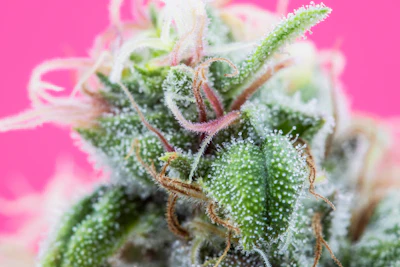
What ties many of these compounds together is their lipophilicity. That simply means they readily dissolve in and are transported by the plant's resin rather than existing solely as freely volatile compounds. During smoking, this resin is aerosolized into microscopic oil droplets that carry cannabinoids and aroma compounds into the mouth and respiratory tract. Because these heavier compounds are generally less volatile and more oil-soluble than monoterpenes, they may persist longer during consumption rather than being rapidly lost to the air. This may help explain the lingering “candy,” “cherry,” or “nutty” notes sometimes associated with certain cultivars (McPartland and Russo 2001).
In contrast to typical terpene-dominant cultivars that deliver a strong but short-lived aromatic burst, these phenotypes might allocate more energy to producing and retaining higher-molecular-weight secondary metabolites, potentially involving both terpene biosynthesis (methylerythritol phosphate (MEP)/mevalonate (MVA) pathways) and phenylpropanoid metabolism (Flores-Sanchez et al. 2008). The result may be a very different sensory profile, one that combines immediate aromatic impact with heavier resin-associated compounds.
The expression of these compounds depends on specific production conditions, making the product inherently difficult to reproduce. Small changes in light intensity, temperature, nutrient status, or stress signaling can shift carbon flow back toward more typical terpene production or reduce overall secondary metabolite complexity. Breeders may also focus on yield, potency, and strong initial aroma (volatile terpene expression) rather than more subtle lingering palate characteristics. These flavorful phenotypes likely represent a convergence of rare genetic regulation and favorable growing conditions, where multiple secondary metabolic pathways are simultaneously active and balanced in a way that produces the compounds and resin properties that create a persistent flavor effect.
RELATED: Beyond Terpenes: The Emerging Science of Cannabis Flavor
What’s different in these phenotypes is how they’re routing carbon and regulating secondary metabolism. Most plants run a relatively efficient program: push carbon into growth (primary metabolism) and a set of common, volatile terpenes for signaling and defense. These standout strains appear to divert more carbon into multiple secondary pathways at once, not just the basic terpene pathways (MEP/mevalonate), but also modification steps (oxidation, esterification) and possibly phenylpropanoid-type chemistry (Flores-Sanchez et al. 2008). That probably results in a broader and more layered chemical output, not just more of the same compounds i.e., a good-looking lab result.
These show-stopping flavors aren't necessarily the result of more complex genetics. Instead, they appear to be driven by a more complex metabolic profile. Think of it like two plants with the same hardware, but one is running a more sophisticated biochemical program, producing a wider range of compounds that interact in more nuanced ways.
What’s interesting is that the layer of chemistry responsible for these lingering, “edible-like” flavors is almost entirely invisible to current cannabis testing frameworks. Most labs and product labels focus on a narrow panel of terpenes, usually a dozen to maybe 30 compounds total. The compounds driving persistence, heavier sesquiterpenes, oxygenated derivatives, esters, and phenylpropanoid-type aromatics, are either not included in routine panels or fall below the threshold of what’s typically reported. As a result, two samples can look nearly identical on paper while delivering completely different sensory experiences.
Part of the issue is methodological. Standard terpene testing (typically gas chromatography-based analysis) is optimized for volatile compounds, the ones that readily vaporize and are easy to detect. The very compounds that seem to drive lingering flavor are, by definition, less volatile and closely associated with resin, making them harder to capture with conventional workflows. Some may degrade under the heat of analysis, while others simply aren’t part of validated target lists. On top of that, non-terpene aromatics, like certain esters or aromatic aldehydes, aren’t traditionally considered part of the “cannabis profile,” even though they play a major role in other crops, such as standard industry testing for fruit and wine. So, they’re not just underreported, they’re often not being looked for at all.
The industry is measuring the high notes but ignoring the bass line. Breeding decisions, marketing language, and consumer expectations are all being built around incomplete data. If the compounds responsible for persistence and depth aren’t being measured, they can’t be selected for, stabilized, or reliably reproduced based on lab analysis. That explains why plants with true lingering flavor seem to be rare and inconsistent. They’re not just genetically uncommon; they're also analytically invisible, falling outside the narrow chemical spectrum the industry currently uses to define aroma and taste.
This kind of chemistry sits at the intersection of genetics and environment. Selection determines whether the plant can produce these compounds, while cultivation determines whether it will. Because these pathways are more complex and resource-intensive, they are also more fragile, and small shifts in conditions can suppress them. That’s why these amazing experiences are difficult to consistently replicate, requiring both intentional selection and precise cultivation to bring out their full potential.