
Aiden Rafii had his cannabis distribution and manufacturing operations come to a screeching halt in April 2025, when California state regulators embargoed 390 pounds of product at his facility outside of San Fransico.
Rafii is the managing owner of Euphoric Life in Hollister, Calif., which has held adult-use and medicinal licenses since 2019, according to the state’s Department of Cannabis Control (DCC). He and his father, Ahmad Rafii, are listed as co-owners on the license. They run a small operation, regularly sourcing product from the Emerald Triangle, with the capacity to store about 1,000 pounds of fresh-frozen flower.
But the Rafiis have been fighting to keep their doors open for the past 17 months, with no clear route to appeal a subsequent product-destruction order from the DCC, despite a nearly passed legislative fix that could have provided such an appeal route for all California businesses facing destruction orders.
This 17-month battle began April 29, 2025, when DCC regulators inspected Euphoric Life’s facility while a new compliance officer was actively photocopying state-mandated unique identification tags to apply to fresh-frozen flower and cannabis concentrate in the company’s freezers, the younger Rafii told Cannabis Business Times. In other words, roughly 390 pounds of Euphoric Life’s product were temporarily untagged.
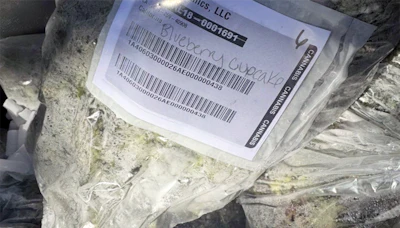
 Depicted here is the DCC's handwritten description of the Freezer 1 product that regulators placed under embargo during their April 2025 site visit. There were nine freezers containing products without proper tagging, according to the department.
According to a DCC investigative report, Euphoric Life’s head of operations attempted to provide the department’s investigators with documents showing the products were compliantly sourced and logged in Metrc, the state’s track-and-trace provider. Department officials declined to review the paperwork and instead embargoed the products on-site, according to the report.
Euphoric Life submitted a corrective action plan less than two months later, but the DCC rejected the plan 51 days later. Euphoric Life’s lawyer, Nooshin Dalili, sent a letter to the department asking what sourcing documents the company could provide to lift the embargo, but the DCC directed the company to instead submit a product-destruction plan in September 2025 –nearly five months after the site visit.
“Your demand that our client submit a destruction plan by 5 p.m. today, while continuing to ignore our outstanding concerns and evidence, is procedurally improper and inconsistent with BPC §26039.3(c), which expressly permits correction of misbranding or adulteration through labeling or processing,” Dalili wrote in response to the destruction order.
That’s when Euphoric Life’s long-standing legal battle ensued.
Editor’s note: Read more about what happened during the DCC’s inspection visit below under the subhead “How Did This All Start?”
Although a legislative fix appeared to exist for California cannabis businesses to appeal product-destruction orders, Gov. Gavin Newsom’s administration pushed back on a widely backed bill earlier this year over budget concerns (more on this later).
With no fix in sight, Euphoric Life’s series of legal battles with the DCC has led the company to perhaps its last hope: the state’s Sixth Appellate District in San Jose.
Such an appeal directly to a higher court is through what is called a writ of mandate petition only and is therefore discretionary, meaning the court can decide whether or not to take the case. A writ of mandate is a court order that forces a government entity, whether a trial court or an administrative body such as the DCC, to perform a legal duty or take a corrective action.
As the younger Rafii has come to learn, this means California’s state-licensed cannabis businesses have no guaranteed path to challenge a DCC condemnation order before their product is destroyed, creating a major due process problem for all California operators facing destruction of valuable property.
“To me, it’s a completely broken system,” said Rafii, who contends that the 390 pounds of cannabis at his facility were sourced legally and tracked lawfully in Metrc, the state’s seed-and-sale system provider.
The Rafiis declined the directive to destroy the product voluntarily in September 2025, when the DCC gave them fewer than eight hours to comply, and have faced an uphill legal battle ever since.
The Due Process Problem
Without a voluntary destruction plan from Euphoric Life, the DCC initiated condemnation proceedings – a legal effort to force the company to comply – through California’s Office of Administrative Hearings (OAH) in October 2025.
After two hearings in February 2026, Administrative Law Judge Juliet E. Cox ruled in the DCC’s favor and ordered Euphoric Life to destroy the embargoed products and pay nearly $36,000 to reimburse the department for its “reasonable costs incurred” to investigate and prosecute the matter.
The DCC argued in the proceedings that its destruction order was valid because the cannabis was not labeled and packaged according to state law, and therefore misbranded, and that Euphoric Life did not demonstrate the ability to correct the errors, according to the OAH ruling.
Euphoric Life argued that it properly proposed to correct, and can correct, any inadequate labeling and packaging issues. The company provided the court with sourcing documents, arguing it could prove the embargoed products were legally sourced through freezer-by-freezer records, Metrc transfer manifests and package histories (more on this later).
 Depicted is the DCC's photograph, attached to its investigation report, of Euphoric Life's freezer room, with the lights off, as filed. Blue rectangular labels are visible on the lids of three chest freezers. Euphoric Life's account is that the small tag on the rear freezer is a Metrc UID barcode tag on Freezer 9 (the concentrates) and that the blue tape on the two nearer lids carried UID numbers and weights written by hand; the photograph is not clear enough to read any of them. DCC's report says the freezers "did not have blue CCTT [California Cannabis Track-and-Trace] Metrc tags on the outside of the freezer door."
After the OAH ruling, Euphoric Life asked the California Superior Court of Santa Clara County to temporarily stop the DCC from enforcing its order. However, the court denied the company’s request to stay the order on April 17, 2026, concluding that it “lacks jurisdiction” to proceed under the state’s Business and Professions Code (Section 26045).
One day earlier, Euphoric Life filed a notice to appeal the DCC’s condemnation order with California’s Cannabis Control Appeals Panel (CCAP), which provides quasi-judicial, or “court-like,” administrative review of the DCC’s licensing decisions.
However, when CCAP interpreted California’s Business and Professions Code in June 2026, it, too, determined that it lacked jurisdiction over the DCC’s condemnation proceedings, calling the situation “untenable,” since a business could face the destruction of valuable product without having a clear path to appeal destruction orders.
“The consequences of this interpretation, however, are troubling,” CCAP’s three-member panel wrote in the order. “If appeal before higher courts is limited to parties affected by final orders of this panel, and this panel lacks jurisdiction over appeals from condemnation proceedings, then licensees subject to a department condemnation order are left with no venue for appeal. It is untenable that licensees faced with destruction of valuable property might have no clear route to appeal before either this panel or the courts.”
This was a head-scratcher for Rafii.
For starters, despite the CCAP stating that it has no jurisdiction over DCC’s orders to seize or destroy cannabis product or property, the DCC’s website specifically lists condemnation orders as one type of compliance or licensing action eligible for appeal; it states that once the OAH files a decision and the DCC adopts that decision, a cannabis company “can choose to appeal the final decision to the Cannabis Control Appeals Panel (CCAP).”
Furthermore, when Euphoric Life first sought relief in the Superior Court of Santa Clara County, the DCC argued that the company was wasting judicial resources and should have just gone straight to CCAP.
“Rather than exhausting its available administrative remedies and appealing the department’s final decision and order to the California Cannabis Appeals Board (CCAP), Euphoric improperly seeks a writ of mandate from the Superior Court, which is specifically divested of jurisdiction to hear ‘any order, rule or decision’ of the department,” the DCC argued in April 2026.
But once Euphoric Life actually appealed the DCC’s decision to CCAP, the department changed its tune, filing a motion to dismiss the appeal eight days later, arguing that it had “erroneously implied that the CCAP has jurisdiction over the condemnation order.”
When Cannabis Business Times asked the DCC whether licensees could appeal product destruction orders and, if so, what the proper venue would be, department spokesperson Jordan Traverso said, “After exhaustion of administrative remedies, the licensee may challenge the final administrative decision through the administrative writ procedure.”
However, this writ procedure leaves licensees with no choice but to go directly to an appeals, or appellate, court or the California Supreme Court, meaning, again, there are no guarantees their cases will ever get heard.
In July 2026, Euphoric Life petitioned the Sixth Appellate District Court in San Jose to review the CCAP order and provide a remedy to the OAH hearing’s outcome. On July 29, the Sixth District ordered a halt (a stay) to the DCC’s product-destruction order while the court considers whether to take on the case.
But in a preliminary court filing, the DCC opposed the company’s petition for the Sixth District to hear the case, arguing on Aug. 13 that Euphoric Life missed its 30-day window to challenge the DCC’s final decision to adopt the OAH’s condemnation order.
Rafii said he felt like the DCC misled him in a bait-and-switch maneuver.
“Basically, the DCC told us to file in CCAP; the CCAP ruling will take about 45 days,” he said. “Then after the CCAP ruling [in which the CCAP said it has no jurisdiction over the matter], they say, ‘Well, your time has run out to file in the Court of Appeals.’ … And so now they’re trying to kick us out of the Court of Appeals in the Sixth District as well.”
Before this latest development of the DCC’s 30-day-window argument had unraveled, the CCAP panel had scolded the DCC in its opinion and final order from two months earlier.
The panel wrote that if the DCC ultimately relies on orders to destroy and dispose of cannabis products as a widespread enforcement strategy, and funnels appeals from those orders directly to higher courts such as the Sixth District, then it would “represent an inexplicable waste of judicial resources.”
The CCAP panel also encouraged those who hold legislative and policymaker roles to “expressly identify” the appropriate venue for cannabis operators to appeal DCC condemnation orders.
The Legislative Fix Exists
Making matters more frustrating for Rafii, a legislative fix exists for cannabis operators facing similar circumstances – the ordered destruction of valuable product – via Assembly Bill 1826, which would provide licensees due process for recalls, embargoes and destruction.
The California Assembly voted unanimously, 78-0, to pass the legislation in May 2026, and the Senate Business, Professions and Economic Development Committee voted, 10-0, to advance it in late June.
Notably, the Senate committee amended the bill to include a provision pertinent to Euphoric Life’s case:
“Condemnation orders shall be subject to review by the Cannabis Control Appeals Panel [CCAP] pursuant to Section 26043,” the amendment reads. “The review of a condemnation order shall be limited to a determination of whether the department abused its discretion in the issuance of the condemnation order. Abuse of discretion is established if the respondent department has not proceeded in the manner required by law, or if the panel determines that the condemnation order is not supported by substantial evidence in light of the whole record.”
This provision would give CCAP the jurisdiction over DCC’s condemnation orders and would have provided Euphoric Life the due process it seeks.
But to Rafii’s dismay, the Senate Appropriations Committee tabled the bill (holding it on suspense) in August, meaning the legislation is considered dead for the year. In this instance, the bill failed to advance over budget concerns.
Gov. Gavin Newsom’s Department of Finance opposed the legislation during an Aug. 3 committee hearing because the DCC estimated it would cost roughly $2 million annually, money it said would be needed to hire two senior environmental scientists and six attorneys, equating to $250,000 in average annual salaries for those new hires.
Less than a month later, Newsom touted how the state’s licensed cannabis market has generated nearly $8.4 billion in tax revenue since 2018 to support various state programs, including child care and youth groups, environmental programs, medical research, law and justice organizations, and drug treatment and prevention centers.
From Rafii’s perspective, a $2 million legislative fix to a due process problem that has left his business in jeopardy should be a drop in the bucket compared to the $8.4 billion in revenue that the industry has provided the state.
“We’ve had to wind down completely to about one employee right now, and it’s solely because of this case, and yet we continue to fight it,” Rafii said. “At this point, I think it’s more of a thing where I have a really strong sense of justice with this case, because I hope that sometime down the line, if there is someone that has product condemned that is on Metrc, that’s clean, that’s organically farmed – that they won’t have to destroy it, and they can actually meet and confer with the DCC to figure out.”
How Did This All Start?
When DCC regulators visited his facility in April 2025, Rafii said Euphoric Life’s new compliance officer was actively photocopying Metrc tags in the distribution arm of his facility, where eight freezers containing 357 pounds of frozen flower and another storage unit with 23 jars containing 33 pounds of cannabis concentrate were momentarily without their unique identifier (UID) Metrc labels.
Rafii said he hired Compliance Officer John Calzada earlier that month after the company’s previous head of compliance went on medical leave.
According to the DCC’s investigation report, Calzada introduced himself as a “volunteer” and “consultant” who was “just helping out,” telling department staff he did not have an employee badge. “The licensee did not provide any employment documents for John Calzada,” DCC Special Investigator Ruby Ocegueda wrote in the report.
But Rafii contends that the company hired and onboarded Calzada on April 21, eight days before the inspection.
New to the role, Calzada used the transition as an opportunity to help overhaul Euphoric Life’s compliance procedures after a DCC inspection eight months earlier, in August 2024, left the company submitting a corrective action plan for a previous labeling issue, Rafii said.
Specifically, Rafii said the August 2024 issue centered on the company’s troubles with adhesives failing to keep original Metrc tags properly affixed to products in the company’s freezers.
“Adhesive doesn’t really work in freezers that well,” Rafii said. “The new compliance officer, what he preferred to do is hold the original Metrc tags in a binder and photocopy every Metrc tag to place the photocopies on the bags. Because what would happen is, a lot of times the Metrc tags would get oil on them, they would rip, they would get lost in transit.”
 Depicted here is Euphoric Life's former tagging system, where original Metrc tags traveled with product batches and often fell off when product moved.
In a follow-up email between Ocegueda and Euphoric Life dated Oct. 3, 2024 – which Rafii shared with Cannabis Business Times – Ocegueda wrote, “Please submit a photo with the bags labeled with the UID. You can put a photocopy of the blue tag on them if you would like, but just so long as each bag is easily and identifiable with the UID, not just the strain information.”
Euphoric Life responded two hours later with a photo attachment showing a bag with a photocopied label attached, apparently putting the 2024 issue to rest. Little did the company know that Ocegueda’s 2024 suggestion to use photocopied UIDs would lead to trouble down the road.
To prevent future compliance issues, Rafii said Calzada began implementing this photocopy strategy in 2025 and was actively retagging bays at Euphoric Life’s distribution facility when DCC personnel arrived for the visit in April 2025.
“We had pulled off these Metrc tags to photocopy, per DCC guidance,” Rafii said. “And when the DCC came, [Calzada] was in the middle of it. You could see all the photocopied tags everywhere. He had the [actual] tags on hand, and they said, ‘Oh, these [products] are still untagged,’ and then they embargoed them.”
What Rafii had interpreted as a DCC-approved corrective action plan from October 2024 turned his business upside down in April 2025.
 This photo of jars containing cannabis concentrate on the manufacturing-side shelving of Euphoric Life’s facility shows photocopied Metrc tags applied during the Department of Cannabis Control’s April 29, 2025, site visit. The company’s compliance officer had completed the photocopying process in this area, which was deemed compliant – unlike the distribution side of the facility, where tags were actively being photocopied.
The DCC inspectors inventoried the product and issued Euphoric Life an initial embargo notice, covering not only the 390 pounds of fresh-frozen flower and concentrate, but also 2,605 1-gram pre-rolls (nearly 6 pounds), according to court documents from the OAH condemnation proceedings.
That inventory represents roughly $80,000 to $90,000, Rafii said.
But for Rafii, the embargo represented more than the money attached to the specific inventory in his freezers. His entire business came to a halt because when the DCC embargoes a product, that product cannot be handled or removed from its storage location, meaning Euphoric Life could no longer utilize its freezer space.
“We can’t afford to go out and just buy more freezers and go buy product after our last year’s harvest hasn’t been processed. So, we have nowhere to store any other product,” Rafii said. “And this is the part that gets me, because we would source solely our fresh frozen from … a husband-and-wife-owned farm up in [Mendocino County], really good people … so, us going down has hurt them a bunch, too.”
The Genesis of DCC’s Investigation
During that April 2025 inspection, Rafii said that Euphoric Life Head of Operations Mike Sweeney offered to show Ocegueda and her DCC colleagues Metrc transfer manifests for the cannabis flower that Rafii said the company had received from licensed cultivators, as well as production records Rafii said linked the products in the company’s freezers to cannabis that Metrc showed as being in the company’s inventory, according to the OAH court findings.
Ocegueda declined to review the company’s records on the spot, instead informing Rafii and Sweeney that the DCC would embargo the items, according to the OAH court records.
“We offered the tags on-site,” Rafii said. “We offered them production records, metric logs – everything they would need to show that it was a licensed product. And they declined to review all of those. It’s actually in the DCC report that we showed them the tags, and they declined to look at them. They declined to look at Metrc.”
In the DCC’s investigation report filed on Oct. 15, 2025, more than five months after the inspection, Ocegueda indicated that staff members declined to review the paper documents on-site because she and her team had already been there for approximately four to five hours, and that Euphoric Life could “submit any records they felt would help trace and identify the fresh-frozen cannabis flower and the other products that were going to be placed under embargo.”
Euphoric Life did not submit sourcing documentation until the OAH condemnation proceedings, arguing that the DCC “never explained what documentation” would satisfy lifting the embargoed products. Six months before the OAH hearings, the company’s lawyer had asked the DCC, “What specific documentation does the department now require to release [the embargoed] items?”
The OAH judge found Euphoric Life’s argument “unreasonable,” adding that Rafii’s testimony regarding the documents was “aspirational but not credible.” Rafii hopes an appeal could straighten the record in his favor.
From the OAH hearing exhibits, Euphoric Life compiled a freezer-by-freezer summary of the DCC's inventoried product weights and strain names compared against the company’s Metrc weights, tags and sourcing in an attempt to prove that the embargoed products matched up with what the company entered into the state’s track-and-trace system.
 Depicted here are two fresh-frozen flower bags with handwritten labels "GO 10/30 #05" and "GO 10/30 #07" at Euphoric Life's facility. The DCC embargoed this product, inventorying it at 50.8 pounds. Euphoric Life contends it has the source manifests, sourcing dates and Metrc weight of 50.66 pounds to show this specific product batch was logged in the track-and-trace system and fell within the state's 5% discrepancy weight allowance.
Ocegueda also indicated in the DCC report that the April 2025 inspection was not a follow-up visit over the corrective action plan from 2024, but rather that she was assigned to investigate Euphoric Life after receiving a complaint alleging that the company was engaged in noncompliant sales outside of Metrc, as well as “inverting” noncompliant cannabis product into the licensed premises.
Rafii rejects these allegations.
“Euphoric Life has never engaged in diversion or black-market sales, and DCC has not charged us with or made a finding of either,” he said.
To date, the DCC has not taken any disciplinary actions against the company related to the allegations. The department’s only disciplinary action against Euphoric Life was its final decision to adopt the OAH condemnation proceeding order from February 2026 that instructed Euphoric Life to destroy the embargoed products and pay nearly $36,000, according to the DCC.
Ocegueda requested certain records from Euphoric Life one day after the April 2025 inspection. All her requests were related to the allegations; none were related to the embargoed products.
Despite Ocegueda’s report questioning the company’s records and compliance procedures, the DCC approved the company’s distribution permit renewal in May 2026 and its manufacturing permit renewal in June 2026.
Euphoric Life’s Attempt to Remedy the Matter
In June 2025, months before the DCC’s investigation report was formally prepared, DCC Supervising Special Investigator Nephtali Lopez issued Euphoric Life a written supplemental notice of embargo stating that “department staff could not source the cannabis products inside of the freezers,” directing the company to submit a written correction plan to Ocegueda within two weeks.
Euphoric Life submitted a timely corrective action plan attempting to address the issues the DCC cited. The plan included a new cold storage standard operating procedure (SOP) to maintain UID tag visibility at all times, eliminating the need for temporary tag removal.
 In Euphoric Life's new system, original UID tags maintain place with documents logging a lifetime of production and movement of batches in safe secure locations, while the actual product contains photocopied tags.
In conclusion, the elder Rafii wrote, “This embargo was issued during an active, transparent effort to improve internal compliance systems following a sudden leadership transition. No product was adulterated or diverted, and we remain fully cooperative with the department throughout.”
In August 2025, Ocegueda informed Euphoric Life that the plan was inadequate, according to the department’s notice of embargo determination. Specifically, Ocegueda wrote that the company had failed to “provide adequate information/records as to the source of the items.”
Euphoric Life maintains that it tried to provide the DCC with those records.
The younger Rafii said the proposed 2025 corrective action plan directly addressed the cited missing-tag violation: “We requested authorization to reapply photocopied UID tags consistent with the inventory’s existing Metrc assignments within 48 hours.”
Reattaching those tags would correct the missing-tag violation that prompted the embargo, he said.
“We therefore do not understand why that proposal was considered an inadequate corrective action plan,” he said. “It addressed the inventory already under embargo; the revised cold-storage SOP was a separate measure to prevent recurrence.”
‘We Didn’t Want to Appeal’
The younger Rafii said what was a labeling and misbranding issue from the April 2025 inspection suddenly became an unlicensed source issue. He compared it to getting pulled over for a broken taillight and being charged with a stolen vehicle despite having paperwork in the glove box.
“At that point, we didn’t want to appeal,” Rafii said. “We actually had our attorney reach out formally, write them a letter saying, ‘Hey, this is all in Metrc. This is all properly tagged product. What do we have to do? What documents do you all need from us to show you that this is proper product?”
Under the DCC’s embargo policies and procedures, when a licensee provides a sufficient written plan to correct a misbranding or labeling issue, the products under embargo are to be released. The department’s policy advises staff investigators to ask licensees for more information when needed.
According to Rafii, the DCC ignored its own policies.
“From our perspective, we still have not received an actionable explanation of what additional records we could have produced from the system to satisfy DCC,” he said. “Our concern is specifically that DCC did not trace the embargoed freezer inventory through its underlying UIDs.”
When Dalili, Euphoric Life’s attorney, sent Ocegueda the letter in late August 2025, asking what documentation the DCC needed, he wrote:
“The Supplemental Notice of Embargo [SNE] did not request UIDs, Metrc logs or sourcing documents, solely asking for a corrective action plan. Nonetheless, your determination now cites their absence as the basis for requiring destruction. My client has attempted multiple times to provide logs and documentation during the inspection, but [special investigators] explicitly refused them on camera, and this was not requested by you in the SNE.
“Retroactively requiring records that were refused is procedurally unjust and inconsistent with due process. As my client has stated many times prior, all material embargoed is fully compliant, in track and trace with exact weights and production logs, and is eager to provide UIDs should the [special investigators] not continue to refuse them.”
Ocegueda acknowledged the letter the following day and said she forwarded it to the DCC’s legal affairs division.
But Rafii said Euphoric Life never received an answer to what further documentation the company could provide the DCC to prove the embargoed products were compliant. (Cannabis Business Times reached out to the DCC for comment on this but as of the time of publication has not received a response.)
“That unanswered request is central to our frustration,” Rafii said.
Three weeks after Dalili sent the letter asking the DCC what documentation the department needed, Ocegueda sent Euphoric Life a letter on Sept. 18, 2025, directing the company to submit a destruction plan by 5 p.m. that day to avoid OAH condemnation proceedings. The letter provided the company fewer than eight hours to comply.
That was a year ago. Rafii has been digging in his heels ever since.
“It’s kind of absurd, right? We asked specifically, ‘What documents do you guys want?’ And they just didn’t respond or tell us,” Rafii said. “To this day, I still don’t know what documents they want. And so, we filed the appeal.”
As of the date of this publication, the Sixth Appellate District’s July 29 stay order remains in place, preventing the DCC from forcing Euphoric Life to destroy the embargoed product, while the court considers the case.
In the meantime, 390 pounds of Euphoric Life’s product continues to sit idle after 17 months, and the Rafiis’ business continues to hang in the balance.