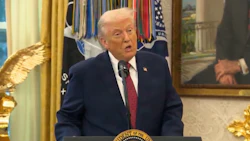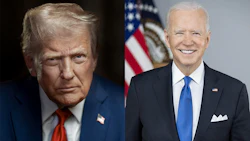
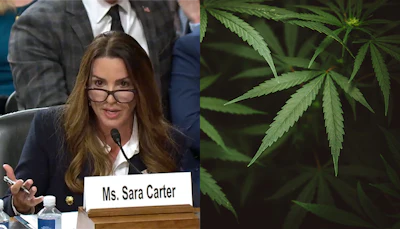

The U.S. Senate moved forward on confirming President Donald Trump’s nominee to be the White House’s top drug policy adviser on Dec. 15, when Majority Leader John Thune, R-S.D., presented a cloture motion to end debate.
The motion, signed by 17 senators, intends to end a filibuster barrier, paving the way for a final vote to confirm Sara Carter Bailey, a former Fox News contributor from Texas, as the director of the White House Office of National Drug Control Policy (ONDCP). Often referred to as the president’s “drug czar,” the ONDCP director is the executive branch’s top drug policy adviser.
The Senate still needs to vote on the cloture motion, with a simple majority needed to pass, before it can vote on her actual confirmation.
The Senate Judiciary Committee advanced Bailey’s nomination in early October, when she avoided providing specifics on her positions on cannabis rescheduling and medical cannabis legalization, perhaps because federal restrictions prevent the ONDCP from supporting the legalization of Schedule I substances ahead of U.S. Food and Drug Administration approval.
However, on her November 2023 podcast, Bailey said she supported medical cannabis and didn’t “have any problem” with cannabis being legalized and monitored, regardless of her personal opinions. “I do believe that cannabis for medicinal purposes and medical reasons is a fantastic way of handling … the illness and the side effects of the medication [for] those illnesses,” she said.
This could bode well for cannabis rescheduling hopefuls, who await an official decision from Trump. While the president said in August that his administration was “looking at” loosening restrictions on cannabis under the Controlled Substances Act, with a pending decision supposedly to come “over the next few weeks,” it wasn’t until Dec. 15 – the same day as the cloture motion – that Trump publicly confirmed that he’s considering a Schedule III reclassification.
Could Bailey’s confirmation be the “event” that Trump was waiting for?
A White House senior adviser said in mid-October that a press release announcing cannabis rescheduling had been “finalized,” but the Trump administration was “waiting on the conclusion of an event the president plans to tie into the rescheduling issue,” The Marijuana Herald reported.
It’s unclear what the mysterious event could be, but having the White House’s top drug policy adviser officially confirmed – not to mention someone who has a permissive stance on cannabis reform – could motivate Trump to pull the trigger on a potential executive order that directs his administration to reclassify cannabis.
While Bailey provided an openness to federal cannabis reform in 2023, U.S. Attorney General Pamela Bondi and Drug Enforcement Administration (DEA) Administrator Terrance Cole don’t share that same track record. Bondi opposed Florida’s medical cannabis proposal in 2013, and Cole indicated in 2024 that his position on cannabis aligned with former first lady Nancy Reagan’s “Just Say No” campaign that took off during the 1980s as part of the country’s drug war.
An executive order, if Trump goes that route, could direct Bondi and/or Cole to issue a final rule to relist cannabis as a Schedule III drug, removing it from the Schedule I status it currently shares with heroin, LSD and ecstasy.
Under the CSA, the attorney general holds the authority to “schedule, reschedule or decontrol drugs” (21 U.S.C. 811(a)); however, that authority has traditionally been delegated to the DEA.
Although the cannabis rescheduling process can be reignited without Bailey’s confirmation, having a drug czar in place to lead the office that’s responsible for developing and implementing the country’s $44-billion drug control strategy and budget makes sense.
While the Marijuana Herald’s anonymous source tied a presidential rescheduling announcement to an unknown event shortly after the Senate Judiciary Committee had advanced Bailey’s nomination, her full confirmation on the Senate floor has been held up for the past two months.
Sen. Michael Bennet, D-Colo., delayed Bailey’s confirmation from advancing earlier this month when he blocked an en bloc bundle of 88 nominees from being confirmed through a simple majority vote.
“I just blocked 88 Trump nominees from confirmation – including Sara Carter Bailey, a former Fox News contributor nominated to be our country’s drug czar,” Bennet said. “I will not allow unqualified nominees, this White House, or the president to undermine the rule of law and our national security.”
Although Bennet stopped the Senate from expediting consideration on Bailey’s nomination on Dec. 4, this week’s motion to invoke cloture could move her confirmation process forward.
Could it move Trump’s rescheduling decision forward, too?
The president said on Dec. 15 that “a lot of people want to see” cannabis reclassified because it would unlock “tremendous amounts of research.”
Under cannabis’s current Schedule I status, a federal statute prevents the ONDCP from expending federally appropriated funds for “any study or contract” related to legalizing the medical or nonmedical use of the plant.