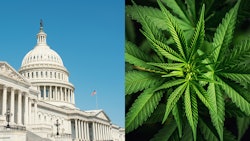
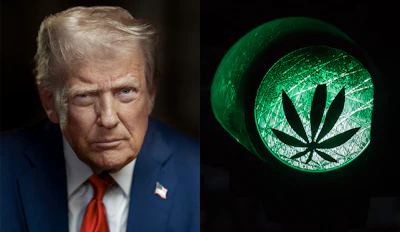

After weighing the “good” and the “bad,” President Donald Trump finally appears ready to direct his administration to follow through on a campaign promise to “unlock the medical uses of cannabis” as a Schedule III drug.
After holding a meeting that included cannabis industry executives on Dec. 10 in the Oval Office, Trump “is expected” to issue an executive order directing top officials in his cabinet to reclassify the plant to a less restrictive status under the Controlled Substances Act (CSA), The Washington Post reported on Thursday.
Health Secretary Robert F. Kennedy Jr. and Centers for Medicare and Medicaid Services chief Mehmet Oz also attended the meeting, while the president phoned in U.S. House Speaker Mike Johnson, R-La., who opposed the plan, arguing that several studies and data don’t support the move, the media outlet reported.
Under its current Schedule I listing alongside heroin, LSD and ecstasy as drugs with the highest potential for abuse, the federal government does not recognize cannabis as having a currently accepted medical use in the U.S. This would change under the White House’s expected plan to reschedule the plant; however, the president cannot unilaterally reschedule cannabis, and he hasn’t finalized his decision.
Within the executive branch, the CSA “vests” the attorney general with the authority to “schedule, reschedule or decontrol drugs” (21 U.S.C. 811(a)), meaning U.S. Attorney General Pamela Bondi holds the keys. While the attorney general has traditionally delegated this authority to the Drug Enforcement Administration (DEA) since the agency’s establishment in 1973, some cannabis legal experts argued that former Attorney General Merrick Garland “undelegated” this authority for a Schedule III proposal under President Joe Biden.
The report that Trump plans to direct his cabinet to ease restrictions on cannabis comes four months after the president told reporters during a press conference on Aug. 11 that his decision would come “over the next few weeks.”
“It’s a very complicated subject—the subject of marijuana,” he said in August. “I’ve heard great things having to do with medical, and I’ve [heard] bad things having to do with just about everything else. But [for] medical and for pain and various things, I’ve heard some pretty good things. But for other things, I’ve heard some pretty bad things.”
This pending decision could mean that the proposed rule that Garland signed in May 2024 to relist cannabis as a Schedule III substance would be back in play after being sidelined by the administrative process since early January.
While relisting cannabis as a Schedule III substance wouldn’t legalize or decriminalize the plant or solve industry banking problems, it could open the door for Food and Drug Administration (FDA) approval of more cannabinoid-based medicines and further sway public opinion and state reform efforts.
Perhaps most notably related to the longevity and legitimacy of the licensed industry, a Schedule III listing would allow state-sanctioned cannabis businesses to deduct ordinary business expenses – such as payroll, rent and utilities – from their federal taxes under Section 280E of the Internal Revenue Code.
“This monumental change will have a massive, positive effect on thousands of state-legal cannabis businesses around the country,” Brian Vicente, founding partner at Vicente LLP, said in a statement provided to Cannabis Business Times. “One dominating inequity cannabis businesses face is the inability to deduct regular business expenses, since they sell a Schedule I substance. Rescheduling releases cannabis businesses from the crippling tax burden they have been shackled with and allows these businesses to grow and prosper. We work with hundreds of licensed cannabis businesses, and the ability to deduct ordinary operating costs under the Schedule III proposal is a game-changer for them.”
Leading up to this point, Trump has had several options for his administration, including:
- Picking up the rescheduling process where the Biden administration left off with an administrative law judge hearing;
- Skipping straight to publishing a final rule to reschedule;
- Starting the process from square one with a new scientific and medical evaluation under the U.S. Department of Health and Human Services (HHS); or
- Killing the proposed rescheduling rule and keeping cannabis listed in Schedule I.
Should Trump pull the rescheduling trigger, it would continue a years-long executive process that Biden initiated in October 2022, when he directed his cabinet to review how cannabis is classified. Under Biden, the HHS recommended to former DEA Administrator Anne Milgram in August 2023 that cannabis be moved to Schedule III after conducting a scientific and medical evaluation.
Rather than fast-track Garland/the Department of Justice’s (DOJ) rescheduling proposal by issuing a final rule, Milgram announced in August 2024 that she would grant an administrative law judge hearing process to allow rescheduling opponents and proponents to debate the merits of the proposal in a public forum. That hearing process has been sidelined by an interlocutory appeal since early January.
Should Trump issue an executive order from up top to reschedule cannabis – something Biden failed to do – it could bypass the hearing process and accelerate the Schedule III proposal directly to a final rule.
Although former Vice President Kamala Harris urged the DEA in March 2024 to act “as quickly as possible" on its cannabis rescheduling review, Biden never showcased that same sense of urgency. When Garland signed the proposed rule two months later, a document typically signed by someone in Milgram’s capacity, some rescheduling proponents took it as a sign of the DEA’s “hostility” toward the HHS recommendation.
Some speculated at the time that Milgram’s resistance in the DEA came after the HHS used a two-part test fleshed out from the 1980s to determine whether cannabis has “currently accepted medical use” rather than the DEA’s five-part test from the 1990s.
RELATED: DEA’s 5-Factor Test Makes Rescheduling Cannabis Impossible
In January 2024, the HHS released an unredacted version of its 250-page rescheduling evaluation, including its finding that cannabis has currently accepted medical use in the U.S. and therefore cannot be classified as a Schedule I substance.
In July 2024, when the 60-day public comment period closed for Garland/the DOJ’s proposed rescheduling rule, nearly 70% of the more than 43,000 commenters indicated support for full descheduling, decriminalizing or legalizing cannabis at the federal level, urging the Biden administration to go a step further than rescheduling. This was according to an analysis conducted by the advocacy group Drug Policy Alliance.
Although support for federal cannabis legalization has slipped slightly from an all-time high of 70% in 2023, it remains strong at 64% in 2025, according to Gallup pollsters. This six-percentage-point dip is mostly attributable to dwindling support from the GOP (40%) under Trump.
Leading up to his 2024 election, Trump promised to “unlock the medical uses of marijuana to a Schedule III drug” and also said he’d work with Congress to create a legislative fix that allows state-licensed businesses to access traditional banking services.
Trump also reaffirmed his stance during the 2024 campaign trail that Americans shouldn’t face imprisonment for simple cannabis use and possession.
“As I have previously stated, I believe it is time to end needless arrests and incarcerations of adults for small amounts of marijuana for personal use,” Trump wrote on Truth Social in September 2024.
However, the president’s administration appeared to veer from this stance when the DOJ issued a memo in September 2025 to all U.S. Attorneys, which prompted at least one federal prosecutor – from the District of Wyoming – to “promptly” direct law enforcement agencies in his jurisdiction to start “rigorously” prosecuting simple cannabis possession offenses occurring on federal land.
Will Trump’s signals for rescheduling be different?
Although the president seemed willing in this week’s Oval Office meeting, The Washington Post reported that no final decisions have been made.