
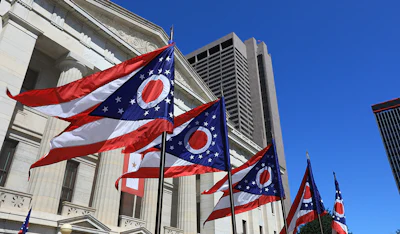

Ohio’s licensed cannabis operators hoping to jump ship from Schedule I to Schedule III under the federal Controlled Substances Act (CSA) haven’t found the answers they’re looking for from their state regulators.
That’s because the Ohio Division of Cannabis Control (DCC) “hasn’t had any clear guidance or feedback from the federal government” on what the Trump administration’s cannabis rescheduling order means for the Buckeye State’s dual-use licensing system; therefore, state regulators can’t advise industry operators on the matter, DCC Deputy Chief Legal Counsel Kathryn Cornelius said June 16.
“Here in Ohio, we are truly dual-licensed entities, and so each one of our licensees, to us, truly are both a medical as well as a nonmedical licensee until the point of sale,” she said. “I know that our licensees, as well as the public, have been requesting our position on how we will address that. Ultimately, frankly, the state of Ohio needs to acquire better and more direct feedback from the federal government before we’re able to really take meaningful next steps and answer some of those questions.”
Cornelius’ comments came during the Ohio State University’s (OSU) Drug Enforcement and Policy Center’s (DEPC) webinar, “A Tale of Two Schedules: What DOJ’s Partial Rescheduling of Medical Marijuana Means in Practice.”
The webinar addressed the bifurcated nature of U.S. Acting Attorney General Todd Blanche’s April 22 order to reschedule FDA-approved cannabis and state-licensed medical cannabis to Schedule III, while keeping adult-use cannabis in Schedule I, pending the outcome of an administrative law judge hearing process that’s scheduled to commence on June 29.
For Ohio’s licensed cannabis program, this order created uncertainty for companies hoping to reap the tax benefits of taking ordinary business deductions that are disallowed for Schedule I and II substances under 280E of the Internal Revenue Code.
After Ohio voters legalized adult-use cannabis with a 57.2% majority in the 2023 election, the state’s existing medical operators transitioned to adult-use activities under a dual-licensed system – one license that covers both marketplaces. With more than 22% of all sales still coming from the medical market in 2025, the stakes remain high.
The Drug Enforcement Administration’s (DEA) expedited registration process for state-licensed medical cannabis businesses to apply for Schedule III recognition closes later this month, and many of Ohio’s dual-use operators are still questioning whether they’re eligible.
Cornelius said she doesn’t have answers to many of the inquiries she’s received from licensees, lobbyists, attorneys, the public and other industry stakeholders, and that “it’s something that we are internally struggling with as well.”
While Ohio regulators await guidance or feedback from the federal government, Cornelius said the DCC is contemplating its next steps, trying to cover every permutation the department would need to update.
“Licensing is the biggest issue,” she said. “Whether we would have to, you know, reissue or do another licensing event for medical licenses only is still to be determined. Additionally, our regulations apply equally to both nonmedical as well as medical licensees … and so, we are also faced with uncertainty as to whether we will need to once again amend our rules to address this new impact.”
Ohio isn’t alone in this unique situation: Never before has a substance been listed in two separate schedules simultaneously under the CSA.
Sam Kamin, the Chauncey G. Wilson Memorial Research Chair and a professor at the University of Denver Sturm College of Law, said states like California, Colorado and others are facing similar unknowns.
He said Blanche’s order creates a “very nonsensical, complicated and ultimately impossible status quo,” where the same cannabis product on the shelf at a dispensary is treated very differently depending on who’s making the purchase.
“Here in Colorado, we have lots of stores that sell both adult-use and medical marijuana,” Kamin said. “If they’re selling that same product, I want to emphasize the same product in the same package to someone with a medical recommendation, they’re selling a Schedule III drug. If they sell it to someone who walks in off the street without a doctor’s recommendation, they’re selling a Schedule I drug. It is the same drug in the same package. But it is treated very differently by law, in a way that isn’t sort of justified by the chemical makeup of the thing that’s being sold.
“So, that’s weird, it’s unstable, it’s not forward-going.”
He further questioned if this split cannabis scheduling status will be a two-month problem or a forever problem, depending on whether adult-use cannabis is moved to Schedule I under the DEA’s forthcoming administrative hearing or medical cannabis is moved back to Schedule III under a current legal challenge.
Either way, the cannabis industry will remain up against the federal Food, Drug and Cosmetics Act (FD&C Act), which prohibits the marketing of any drug that has not been FDA-approved, said Robert Mikos, the LaRoche Family Chair in Law at Vanderbilt University Law School.
Under the FD&C Act, Schedule III substances can only be lawfully sold to consumers as FDA-approved prescriptions through DEA-registered entities, such as pharmacies, and it’s unlawful to introduce an unapproved drug into interstate commerce.
Mikos said it’s unprecedented to have a drug listed on Schedule III that’s not FDA-approved or akin to FDA-approved.
“That’s important, because a lot of the headaches that the state-licensed marijuana industry now faces, it stems … not uniquely from the CSA, but from the fact that what they’re doing, all their business activities, are unlawful under federal law,” he said. “For example, it’s difficult to impossible, in fact, to register a trademark with a federal [Patent and Trademark Office] because you’re not engaged in lawful commerce. Well, that will remain true.
“Likewise, banks are leery of dealing with companies in this industry because all their activities are unlawful, and therefore, arguably, every transaction involving the money from this industry implicates the bank in money laundering. So, as long as the activities of this industry remain unlawful, they’re going to continue to face a lot of the same headaches they’ve faced historically.”
From enforcement to banking, and now rescheduling, federal guidance remains an ongoing hurdle for the industry. But states haven’t quite been in the position of needing a federal preemption quite like this.
Of course, state cannabis regulators want to be in a position to help support their licensed operators with accurate information, said Cat Packer, a distinguished cannabis policy practitioner at OSU’s DEPC, who also is the director of drug markets and legal regulation at the Drug Policy Alliance.
Packer, the former executive director of the City of Los Angeles Department of Cannabis Regulation, said most cannabis regulators across the country whom she’s spoken with have “way more” questions than answers.
“I’ve had lots of conversations in the last several weeks with different cannabis regulators across the country, and I think that they’re similar to Kathryn; struggling to answer questions, feeling like they’re not in the best position to interpret or translate what this means on behalf of the DEA to their individual operators, and there is an ecosystem of confusion that exists,” Packer said.
She also pointed out that concerns remain for cannabis operators who don’t apply for the expedited DEA registration within the 60-day window that closes next week.
“Are they supposed to cease operation? What are the related enforcement implications?” Packer questioned. “It seems as though there was at least clarification recently that the DEA will continue to receive applications for DEA registration beyond that 60-day window. But I think that this whole process has left a lot to be desired in terms of understanding what the ramifications are just of participating in the process itself, but then what are the actual consequences of these state medical marijuana licensees also being DEA registered.”