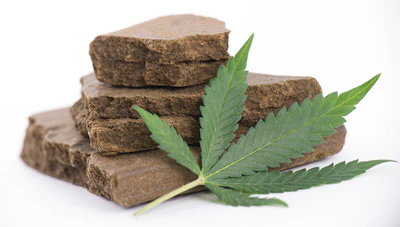
For cannabis brands, hash is turning out to be a difficult market to enter simply based on its physical format, but rosin and oil derived from hash are attracting customers, several cannabis experts tell Cannabis Business Times.
An interesting wrinkle is how hash’s potential in the U.S. is being felt in more mature geographies where consumers are already familiar with a range of cannabis products. Also, some brands are producing hash formats they believe are appealing to younger consumers.
Hash remains a tiny sliver in the sales pie for cannabis brands: Concentrates in total capture just 5.2% of total U.S. cannabis sales as of Q1 2026, according to Headset data supplied to CBT. Looking specifically at black hash and bubble hash, the gummy black substance only makes up 0.16% of the total market.
 Photo courtesy of Willamette Valley Alchemy
Hash’s low pole position isn’t a surprise to Rizik. “It’s almost a self-fulfilling prophecy when it's up against something so large like rosin,” she says. “Rosin pops up in gummies, vapes, pre-rolls, and hash isn’t coming up often in those types of infusions. Brands aren’t then producing more hash, and customers are having less access to hash.”
BDSA reports have found hash (whether as a concentrate or extract) has sold more briskly in more mature markets such as Colorado, California and Michigan. “These markets have consumers who know more about what they are buying, know more about the history of hash, and they have bought several iterations of cannabis products,” Rizik says.
Despite this positive outlook, many hash brands have endured a slow start to the year. Of the five leading hash brands in the U.S., Hudson Cannabis has seen its hash sales plummet by 43% in Q1 2026 compared to the same quarter last year, according to BDSA. The Greenery’s hash products have also lost performance, with a 26% sales decrease in the same time period.
Offering a different trajectory, Tutti’s hash products have skyrocketed in 2026 with an impressive 191% sales bump for the opening quarter, according to BDSA.
CBT attempted to reach Tutti, The Greenery and Hudson Cannabis, but interview requests were not answered by the time of publication.
 Photo courtesy of Willamette Valley Alchemy
Lack of Convenience, Discreet Factor Hurt Hash Brands
In Oregon, Willamette Valley Alchemy (WVA) is known as a top extracting business that produces its most popular hash product, Liquid Live Rosin, for Oregon consumers. The company actually once dabbled in bubble hash, but the returns weren’t worth the effort.
 Colin Miller, Sales Director, Willamette Valley Alchemy Photo courtesy of Willamette Valley Alchemy
He also points to a more social reason that hash isn’t flying off the shelves. “Hash has to be put on top of something, or like a nail rig, and that’s not convenient,” Miller says. “Cartridges are a lot easier and more discreet for consumers, and with the rise of remote work, someone can puff on a vape, and it won’t stink up their house.”
At Curaleaf, hash-derived rosins are also top-sellers. “Oil-based products, especially in the vape category, are consistently in consumer demand,” says Jessie Kater, the company’s senior vice president of innovation, research and development. “That comes down to a combination of product quality, hardware innovation and a more predictable experience.”
Kater goes on to say, “The core appeal of hash – the richness of the plant and its expression – is still very relevant. We’re just seeing that expressed through newer formats and technologies that resonate strongly with today’s consumer.”
 Organigram's SHRED Rip-Strip Hash product.Photo courtesy of Organigram
“The invention of modern concentrates such as resin, wax and shatter has displaced the antique hashish product in the eyes of the small crowd of concentrate consumers who may or may not have even known the history of hash in the first place,” he says.
Hash in the traditional sense has never been as popular as it is in Europe, North Africa or the Middle East, Laferla says, but that may be in part due to the lack of informing consumers how to enjoy it, its medical advantages and where it came from.
Miller says state regulations in the U.S. provide one reason why.
“Look at how limited brands are in marketing any kind of educational content about cannabis in the U.S.,” Miller says on state restrictions on what can be posted on social media or in print ads. “Then you have budtenders who are generally filling entry-level positions, and it’s hard to keep pushing the narrative of, say, the medical benefits of hash to budtenders who end up leaving the cannabis space after a few months, who don’t stick with it.”
 Borna Zlamalik, SVP of Innovation and International R&D, OrganigramPhoto courtesy of Organigram
The company released SHRED Rip-Strip hash, which allows consumers to peel off a small strip of hash and add it to a joint, similar to how baby boomers would crumble balls of hash and pepper them into a joint. “That’s less sketchy than other hash formats, and it adds flavor and aroma,” Zlamalik says.
He isn’t too worried about the future of the hash market when he surveys data from Headset and BDSA. He suggests cannabis business leaders look elsewhere. “The signals I’m seeing from what the illicit market is selling, their top products, tells me hash is still very popular in the U.S. and around the world,” Zlamalik says. “There are more consumers for hash than you might expect.”
 Photo courtesy of Willamette Valley Alchemy