
A multistate CBD and kratom retailer with a store in St. Louis is already testing Missouri Attorney General Catherine Hanaway’s enforcement arm after the chief legal officer sent 33 cease-and-desist letters this month.
The attorney general accused the retailers – primarily smoke shops – of selling intoxicating cannabis products outside Missouri’s regulated marketplace, claiming they are misleading consumers into believing they are licensed dispensaries under the state’s Department of Health and Senior Services.
Of the 33 businesses, four have the word “dispensary” in their name. Hanaway said the businesses are often marketing their products as “marijuana” in violation of the state’s Merchandising Practices Act.
“These unlicensed dispensaries are peddling dangerous, deceptive and intoxicating cannabis and marijuana products. A storefront and a sales counter do not magically convert an illegal drug operation into a legitimate business,” she said on March 25. “My office is prepared to use the full extent of our authority to hold bad actors accountable.”
But one letter recipient is already pushing back.
CBD Kratom, a Missouri-based, privately owned retailer with 50-plus stores across Chicago, Dallas, Houston, New York, Philadelphia and St. Louis, said it received a letter from Hanaway on March 17, accusing the business’s Tower Grove location in St. Louis of selling products that exceed the 2018 Farm Bill’s definition of hemp based on a 0.3% delta-9 THC dry-weight limit.
The company said in a March 26 press release that it “respectfully disagrees” with the attorney general’s allegations and believes that Hanaway’s office has a “fundamental misunderstanding” about “federally lawful” hemp-derived products under the farm bill.
CBD Kraton said that the letter it received did not identify any specific product, testing data or methodology supporting the attorney general’s claim.
“We share the attorney general’s goal of protecting consumers and ensuring a responsible marketplace,” said Craig Katz, the government relations and compliance manager at CBD Kratom. “However, it is important that enforcement actions are grounded in accurate information and applied appropriately. We remain committed to compliance, transparency and constructive engagement.”
Hanaway said the letters were part of an ongoing effort to “protect communities from the detrimental effects of the illegal retail drug trade.” Her office sent the letters to 18 retailers in the St. Louis region, 13 in the Kansas City region and two in the Springfield region, “all believed to be selling intoxicating products in violation of Missouri law.”
The attorney general said lab testing confirmed that “many” of the businesses were selling products that contained lead, arsenic, mercury, ethanol, and other contaminants, solvents, pesticides or unknown byproducts.
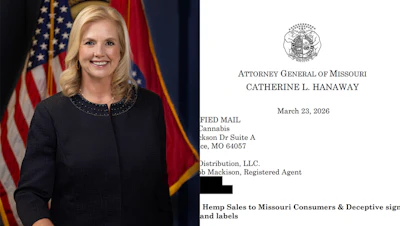
Hanaway’s office provided an example of a letter that it sent on March 23 to Gray Area Cannabis in Independence, just outside of Kansas City.
“In addition to selling marijuana without a license, you have sold products that contain a foreign and unsafe substances that pose a risk of, or causes, a substantial injury to consumers in violation of [state law],” Hanaway wrote in the letter.
The letter included four accusations:
- The sale of intoxicating hemp in violation of the Missouri Merchandising Practices Act (MMPA);
- Signage, packaging or labeling in violation of the MMPA;
- The sale of intoxicating hemp products in a manner designed to confuse consumers; and
- The sale of products containing foreign and unsafe substances, including pesticides, solvents and heavy metals, that pose a risk of, or cause, a substantial injury to consumers.
In CBD Kratom’s March 26 response, the retailer said all of its products undergo third-party testing, are clearly labeled and supported by certificates of analysis that the company makes available to consumers.
Also, the multistate retailer “strongly disputes” the attorney general’s allegations that CBD Kratom represents itself as a licensed cannabis dispensary, arguing that it does not use the terms “marijuana” or “weed” in advertising, signage or product descriptions. In addition, the company pointed out that the word “cannabis” is scientifically accurate to describe both low-THC hemp and high-THC marijuana, which both fall under the Cannabis sativa L. plant species.
“Under both federal and Missouri law, hemp is defined as cannabis containing no more than 0.3% delta-9 THC on a dry-weight basis,” the company said. “Use of this terminology is consistent with established scientific and legal definitions and correctly identifies products sold at CBD Kratom.”
While CBD Kratom defends its operations as compliant under both federal and Missouri laws, those laws could soon change.
The Missouri House voted, 109-34, in February to pass legislation, the Intoxicating Cannabinoid Control Act, which would prohibit most hemp-derived cannabinoid products from being sold outside the state’s licensed cannabis market by Nov. 12, 2026, aligning the state law with a forthcoming federal ban that is set to be implemented on that same date.
The federal policy change will prohibit hemp products containing synthetic (delta-8 THC) or unnatural (HHC) cannabinoids, as well as those with more than 0.3% of total THC (including THCA) or 0.4 milligrams of total THC per container.
“The federal government is saying, if it is an intoxicating product, then it could not be sold out publicly. Any intoxicating product has to be sold in a regulated market,” said Rep. Dave Hinman, R-O’Fallon, who sponsors the Missouri legislation. “Basically, what we are doing is just following the federal government’s new law.”
Under current law, CBD Kratom said it “remains confident” in its compliance practices and that it will continue to serve its customers in accordance with applicable laws and regulations, setting up a potential legal battle with the attorney general.
In the March 23 example letter that Hanaway’s office provided, she indicated that her office is prepared to use the full extent of its authority to enforce state law.
“Your continued unlawful correspondence with Missouri residents may result in subsequent legal action under the MMPA, an injunction against you, imposition of civil penalties, and you being required to pay the attorney general’s costs of investigation and litigation, including attorney’s fees,” she wrote.