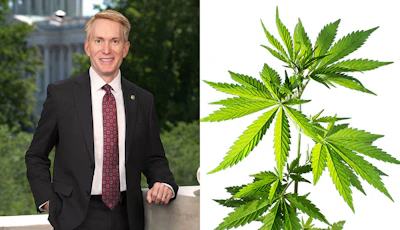

A prohibitionist-minded Republican senator made the case to his peers in Washington that anything other than a ban on intoxicating hemp-derived cannabinoid products would be condoning marijuana legalization.
U.S. Sen. James Lankford, R-Okla., sent a letter on Nov. 12 to his fellow members in the upper chamber, asking them to back off attempts to delay, halt or alter the federal government’s forthcoming ban that takes effect on Dec. 11.
Lankford made his letter public on Nov. 20, writing that the ban will help protect children from products that are “disguised as harmless hemp” under a loophole in the 2018 Farm Bill.
“They come packaged in gas stations as candy-flavored gummies, sodas and vapes,” he wrote. “A vote to extend the THC limits is a vote for nationwide legalization of marijuana.”
Congress already voted once to delay most provisions of the ban – from Nov. 12 to Dec. 11 – when lawmakers passed a continuing resolution in September to keep the government temporarily funded, and Lankford is hoping to avoid providing hemp industry stakeholders another reprieve during the lame-duck sessions.
If he gets his wish, products containing more than 0.4 milligrams of total THC per container or any amount of synthetic cannabinoids will be federally illegal in less than three weeks. Products containing unnatural cannabinoids like THC-O became illegal as of Nov. 12.
The prohibition language, which lawmakers attached to an appropriations package to end a 43-day government shutdown in November 2025, also redefines hemp as a cannabis plant containing no more than 0.3% total THC, replacing the delta-9 THC definition in the 2018 Farm Bill that allowed intoxicating products like delta-8 gummies and THCA flower to proliferate in vape shops, gas stations and convenience stores.
“They contain high amounts of either delta-8 THC, delta-10 THC or another synthetic cannabinoid that can get you high,” Lankford wrote. “Many intoxicating products even have a disclaimer on the package that claims it is compliant with the 2018 Farm Bill. The population that suffers the most is children.”
The senator pointed to a Journal of Medical Toxicology article that found children represented more than half of delta-8 THC product exposures in the National Poison Data System data from 2021 and 2022, with 58% of critical care admissions represented by those aged 6 or younger.
Lankford told his colleagues that it’s “critical that we remember how we got here” – the “here” being a roughly $30 billion market around products that mimic the effects of high-THC cannabis but often without the same strict regulatory standards.
“The goal of [the 2018 Farm Bill] definition was to remove nonintoxicating hemp from Schedule I of the Controlled Substances Act,” he wrote. “Supporters of that provision claimed the focus was to protect industrial hemp – the plant that is used to make rope, fabric and other consumer goods. I remember that conversation and was supportive of that farm bill because it seemed straightforward that a nonintoxicating plant should not be classified as a Schedule I drug.”
With many states having regulated or prohibited hemp-derived cannabinoid products in the aftermath of the 2018 Farm Bill, some in Washington believe a federal framework that respects states’ rights is a better approach than a broad ban.
Most recently, U.S. Sens. Tim Sheehy, R-Mont., and Amy Klobuchar, D-Minn., filed the Hemp Guardrails Act on Nov. 17, legislation that would require child-resistant packaging, labeling, manufacturing and testing; impose a 21-year minimum age limit for purchasing; ban smokable hemp flower and products with synthetic cannabinoids; and increase the allowable THC threshold for hemp cultivation to 1% total THC on a dry-weight basis.
“Minnesota is a national leader in hemp, and our state has shown that we can protect kids and support responsible hemp businesses,” Klobuchar said. “But a looming federal ban on hemp products is threatening farmers, brewers, small businesses and consumers across Minnesota and the country.”
The bipartisan senators introduced this bill five days after Lankford’s letter, with the possibility of attaching it to a continuing resolution that would keep the government funded beyond Dec. 11.
Sens. Ted Budd, R-N.C., and Pete Ricketts, R-Neb., said on social media they wouldn’t support the Sheehy-Klobuchar proposal and instead align with Lankford
“Congress decided this issue years ago,” Lankford wrote. “Our communities deserve for these drugs to be taken off the shelves and out of reach of children. It is time for Congress to close the loophole we created in 2018. Hemp producers can sell CBD oil and hemp fibers, but they should not be allowed to sell intoxicating products disguised as harmless hemp.”