
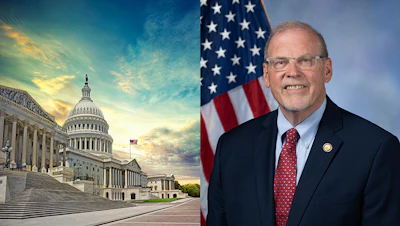

U.S. House Rep. Morgan Griffith, R-Va., on Monday unveiled his plan to prevent the federal government’s forthcoming ban on intoxicating hemp products from going into effect on Dec. 11.
Griffith, who chairs the House Committee on Energy and Commerce Subcommittee on Health, said he plans to attach legislation that would regulate, not prohibit, cannabinoid hemp products to an anticipated reconciliation package during the lame-duck session after the November midterms, Roll Call reported.
Unlike non-budgetary measures, reconciliation bills, often used to fast-track changes to federal spending, only require a simple majority to pass and cannot be filibustered. Either way, the U.S. Senate voted, 61-32, in August to delay the ban on certain hemp-derived products by four weeks – from Nov. 12 to Dec. 11 – indicating there is appetite in the upper chamber for an alternative to prohibition.
The prohibition language, to criminalize the sale of hemp-derived products that contain more than 0.4 milligrams of total THC per container or cannabinoids that are synthesized or unnatural, was originally included in a November 2025 appropriations package to end a 43-day government shutdown. The intent was to close a 2018 Farm Bill loophole that opened the door for intoxicating hemp products to land on the shelves at gas stations, smoke shops and convenience stores during the past six years.
In January 2026, Griffith and Rep. Marc Veasey, D-Texas, introduced the Hemp Enforcement, Modernization and Protection (HEMP) Act, legislation that would create a federal regulatory framework for hemp-derived products for those 21 and older, including placing an intoxicating cannabinoid limit (such as THC) of 5 milligrams per serving and 30 milligrams per package, should the U.S. Food and Drug Administration (FDA) continue to take a hands-off approach to regulation.
“I think we need to get my THC regulatory bill passed, and if we could get that into a reconciliation bill before the 11th of December, that’d be fabulous,” Griffith told reporters on Monday. “I truly believe if we don’t do something before that December 11th deadline, that it’s going to create all kinds of issues.”
The Virginia congressman indicated that federal prohibition doesn’t work and that an adequate regulatory framework would go a long way toward age-gating purchases and ensuring products are third-party tested for consumer health and safety.
“If you’re going to look at it from a federal level, I don’t think we can stop it,” he said.
Griffith also called attention to the Beverage Regulatory Parity Act, legislation that Reps. Beth Van Duyne, R-Texas, and Greg Landsman, D-Ohio, introduced in August as an attempt to tax and regulate hemp-derived beverage products by establishing a three-tiered distribution system for manufacturers, wholesalers and retailers.
Under the proposal, a hemp-derived beverage could contain up to 5 milligrams of total THC per serving, defined as a single-use 12-ounce container or a multi-serving container with a total volume of 750 milliliters.
“I’ve heard directly from people across North Texas who consume hemp-derived beverages, and businesses who sell them, that they need clarity, not a ban that pushes this market underground,” Van Duyne said. “The Beverage Regulatory Parity Act brings long-overdue certainty to the industry by regulating these beverages with the same proven structure that has successfully governed alcohol for decades.”
In a state like Texas, which bans adult-use cannabis and has one of the most restrictive medical cannabis programs in the nation, with a THC cap of 10 milligrams per dosage unit, intoxicating hemp products have flourished to an estimated $4.3 billion retail sector, outpacing California’s regulated adult-use marketplace.
In states that have fully fledged cannabis programs that license and tax commercial activities, operators facing myriad profitability barriers argue that the intoxicating hemp marketplace circumvented 2018 Farm Bill language that never intended to allow products like delta-8 THC gummies or HHC vapes to proliferate in interstate commerce and directly compete against tightly regulated cannabis programs.
This reality has pitted high-potency marijuana and low-potency hemp – both considered cannabis – stakeholders against each other, as well as industry advocacy organizations and trade associations.
Marijuana Policy Project (MPP), a cannabis reform organization dedicated to ending prohibition and advancing regulated cannabis programs throughout the U.S., asked its supporters earlier this month to encourage their U.S. senators and representatives to “support sensible hemp regulation” over prohibition.
For some, recriminalizing a plant over normalizing its use goes against the decades-long fight to defeat the war on drugs.
For others, the hemp plant’s derivatives were never meant to be manipulated in a lab to mimic high-potency marijuana – a practice they believe undermines the ongoing effort to destigmatize public perception of the natural properties of cannabis and threatens broader legalization.
The U.S. Cannabis Roundtable (USCR), which advocates on behalf of America’s regulated cannabis industry, and the American Trade Association for Cannabis and Hemp (ATACH), which works to protect and support regulated cannabis businesses, sent representatives to Washington this fall to ask lawmakers to reject the hemp industry’s regulation-over-prohibition campaign.
When Congress provided hemp industry stakeholders the four-week reprieve in September, Chris Lindsey, the vice president of policy and state advocacy at ATACH, said his association was “disappointed” with the delay.
“The loophole empowers bad actors, threatens public health and undermines state regulations,” he said. “We urge Congress to end the scourge of ‘gas station weed.’”