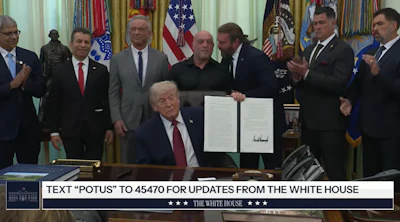

President Donald Trump politely asked on April 18 whether his administration would follow through on his executive order to reschedule cannabis, four months after he directed the Department of Justice (DOJ) to do so.
“You’re going to get the rescheduling done, right, please?” Trump asked. “Will you get the rescheduling done, please? Joe, they’re slow-walking me on rescheduling. OK, you’re going to get it done, right?”
The president’s inquiry came during a separate executive order on Saturday that he signed in the Oval Office, directing his administration to accelerate medical research into the therapeutic benefits of psychedelic drugs, such as ibogaine compounds, which he said could help treat those with severe mental illness and depression, “including our cherished veterans.”
Podcaster Joe Rogan, who regularly advocates for cannabis legalization on his show, The Joe Rogan Experience, was standing directly behind Trump, who was also flanked by federal health officials such as Health and Human Services Secretary Robert F. Kennedy Jr., Centers for Medicare and Medicaid Services Administrator Mehmet Oz, and Food and Drug Administration (FDA) Commissioner Marty Makary.
The president looked to his right, appearing to ask an administrative official whether they’d follow through on his cannabis rescheduling order, pointing to someone off-camera. Makary was the farthest official to his right, but Trump’s comments were not directed toward him, as the FDA provides input but has no authority over the drug rescheduling process.
Instead, Trump’s order from December directed the DOJ, specifically former U.S. Attorney General Pam Bondi, to “take all necessary steps” to reclassify cannabis as a Schedule III drug under the Controlled Substances Act “in the most expeditious manner.” The order did not include a deadline date.
Earlier this month, Trump removed Bondi as his attorney general in a move that many presumed stemmed from the DOJ’s handling of the Epstein files and the public scrutiny that came along with it, although the president never said that or provided a specific reason for the ousting, instead calling Bondi a “great American patriot and a loyal friend” in an April 2 Truth Social post.
Trump announced that Todd Blanche, the U.S. deputy attorney general, would step in to serve as his acting attorney general in the interim. While Blanche currently holds the pen for potentially signing off on a final cannabis rescheduling rule, he was not among those who attended Trump’s psychedelic signing ceremony on April 18.
Following Blanche’s confirmation hearing with the U.S. Senate Judiciary Committee in February 2025, Sen. Peter Welch, D-Vt., asked in written questions for the record (QFR) if he supported loosening restrictions on cannabis under a Schedule III listing.
Blanche provided similar answers that other Trump-nominated officials – such as Bondi and White House Office of National Drug Control Policy Director Sara Carter – provided in their QFR responses.
“If confirmed, I will give the matter careful consideration after conferring with all relevant stakeholders, including DEA personnel,” he said. “Coordination between federal and state authorities is critically important. However, I have not had the opportunity to study this particular issue. If confirmed, I will consult with the necessary stakeholders and give this matter careful consideration.”
Blanch also said he felt it was important to “empower” U.S. attorneys to follow DOJ rules when it comes to using their prosecutorial discretion for low-level cannabis crimes.
While Trump indicated that he personally has never used, or intends to use, cannabis leading up to his December rescheduling order, calling it a “very complicated subject,” the president offered a different tone during his April 18 order on psychedelic drug research.
Trump called attention to more than 14 million American adults with serious mental illnesses, with about 8 million taking prescription medications for their conditions, suggesting that psychoactive drugs could potentially provider an alternative to help treat these Americans.
The president referenced a 2024 study at Stanford University, where medical researchers found that ibogaine “safely led to improvements in depression, anxiety and functioning” among veterans with traumatic brain injuries (TBIs). TBIs are a leading cause of post-traumatic stress disorder, anxiety, depression and suicide among veterans, according to the researchers.
“Thirty special operation veterans with traumatic brain injuries underwent – it’s called ibogaine treatment,” Trump said, “and experienced an 80 to 90 percent reduction in symptoms of depression and anxiety within one month.”
Trump paused and looked at his White House health officials standing behind him.
“Can I have some, please? I’ll take it,” he said. “I’ll take whatever it takes. I don’t have time to be depressed. If you stay busy enough, maybe that works too. That’s what I do.”
Also attending the signing ceremony was retired Navy SEAL Marcus Luttrell, who said ibogaine treatment “absolutely changed my life for the better.”
Luttrell gained national fame for his “Lone Survivor” memoir and the subsequent movie based on that memoir, which chronicles a 2005 Afghanistan mission in which a Taliban ambush killed three of his teammates.
“I went through a lot of the programs that the veterans are going through, and I always kind of felt like I was a victim coming out of them,” Luttrell said. “When I came out of this, I felt like I had gotten my life back. That was five years ago. I literally live the best days of my life every single day.”