
Sometimes, it takes a tragic accident to invoke change.
But when a man in his 20s who worked as an inventory specialist at a California cannabis processing facility collapsed on the job and died from work-related asthma in 2020, there were no news headlines. There were no viral posts on social media. There were no federal health agency reports to alert the rest of the U.S. cannabis industry.
Details about the worker’s death did not become public until a four-state study was published in 2025. (See “Details of California Worker’s Death Emerge” below.)
In California, employers are required to report work-related fatalities immediately to the state’s Division of Occupational Safety and Health (DOSH), better known as Cal/OSHA. Meanwhile, the California Department of Public Health (CDPH) monitors workplace health and safety risks, maintaining information on cases like work-related asthma.
While the 2020 California worker’s death represents the first known fatality related to new-onset asthma in the U.S. cannabis industry, federal public health officials were never notified.
In 2022, it happened again – this time in Massachusetts, to 27-year-old Trulieve worker Lorna McMurrey, and under similar circumstances. Both decedents worked around dried cannabis and did not have asthma before they started working in the industry, according to public health officials from each state.
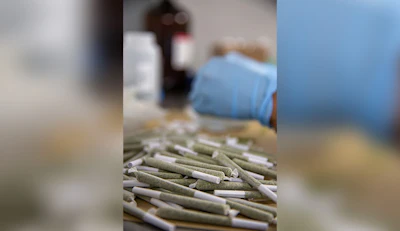
 A vibrating box was used to shake ground cannabis down into paper rolls that were loaded into this rack, as production workers in Massachusetts moved the ground cannabis around a tray to evenly distribute and fill the pre-rolls.Massachusetts Department of Public Health
When McMurrey died from a cannabis-related occupational asthma attack in January 2022 in Massachusetts, it was incorrectly reported as the first work-related asthma death in the U.S. cannabis industry, both by media outlets and national health experts.
“In 2022, the first death attributed to occupational asthma in a U.S. cannabis production worker occurred in Massachusetts,” the Centers for Disease Control and Prevention (CDC) inaccurately concluded in a November 2023 report detailing McMurrey’s death.
McMurrey collapsed while filling pre-rolls with ground-up cannabis dust in Trulieve’s now-closed Holyoke, Mass., processing facility, suffering a life-threatening asthma attack that led to cardiopulmonary arrest before EMS arrived, according to the CDC. She never regained consciousness and died in the hospital three days later, according to the CDC. She worked for Trulieve for roughly seven months.
“This case illustrates missed opportunities for prevention, including control of workplace exposures, medical surveillance and treatment,” according to the CDC report. “Occupational allergic diseases, including asthma, are an emerging concern in the rapidly expanding U.S. cannabis industry.”
Despite the “missed opportunities,” it’s often more difficult to prevent something that’s presumably never happened before.
But it had happened before.
Getting to the Bottom of It
Cannabis Business Times recently learned that the California worker’s death predated McMurrey’s by two years, according to two spokespersons with the CDPH.
“The California Dept. of Public Health (CDPH) cannot provide other details about the fatality except that it occurred in 2020,” CDPH’s Grant Boyken told CBT in September. “The company has since changed its processes,” he said, referring to the employer where the fatality occurred.
The year 2020 is a meaningful detail that hasn’t been reported until now. Even CDPH researchers involved in a four-state study published in 2025, which shed light on the 2020 fatality (see below), appeared unaware that the California worker’s death predated the Massachusetts worker’s death: They referred to the California worker’s death as the second fatality.
“The fatal case from California presented here is the second documented WRA fatality among U.S. cannabis industry workers known to the authors at the time of this writing,” the researchers wrote in the 2025 report, despite the California case representing the first known work-related asthma (WRA) fatality.
 Cannabis Business Times | Tony Lange
Matt Conens, also with the CDPH communications team, denied CBT’s public records request seeking the decedent’s name, exact age and place of work. Conens said that the “patient’s right of confidentiality” exempts the CDPH from disclosing information about the cannabis worker’s death. The CDPH did not provide further explanation for not disclosing the place of work for the incident.
Conens confirmed that the CDPH was investigating the death in 2024 – four years after the incident – and has since closed the investigation.
“CDPH is not investigating this workplace,” Conens said. “During a 2024 visit to observe the work practices at the facility where the asthma death occurred, we concluded that the exposures likely experienced by the decedent were no longer happening at the workplace.”
Following the worker’s death, the company discontinued its grinding and packaging operation, according to the four-state report published in 2025. Instead, dried products now arrive in sealed bags and are shipped to other companies that manufacture the products.
CBT made a public records request with Cal/OSHA in October and followed up with the state’s Department of Industrial Relations (DIR) in November. While DIR provided a tracking number for the request, the agency failed to meet a 10-day statutory deadline under Gov. Code §7922.535 to notify CBT about its determination of whether it had the requested records, and if those records would be disclosed.
In December, the DIR informed CBT that Cal/OSHA did not “find any responsive records” related to the request. CBT questioned if that meant the cannabis company where the worker died never reported the work-related death to Cal/OSHA, as required by state law, and asked, “Will Cal/OSHA be investigating this [apparent] violation of state law?”
The DIR never responded.
Also in December, CBT asked the California Department of Cannabis Control (DCC) if it was aware of the 2020 worker’s death or of the CDPH’s 2024 investigation into the workplace. (The DCC was established in July 2021 through the merger of three previous regulatory bodies.)
“No one recalls us taking any action against a licensee for a worker death,” DCC spokesperson Jordan Traverso said.
Nicole Niermeyer, an associate government program analyst within the DCC’s Legal Affairs Division, told CBT in early December that the DCC “identified potentially responsive records … and the DCC is preparing them for disclosure.”
On Jan. 2, Niermeyer told CBT that, after review, the DCC actually “determined it does not possess or maintain the records you have requested.”
In other words, three California agencies – CDPH, Cal/OSHA and the DCC – have no records to provide the public on the 2020 worker’s death, yet details were revealed in a four-state study co-authored by CDPH officials.
Details of California Worker’s Death Emerge
This publication’s push to provide transparency to U.S. cannabis businesses and their workers comes after the four-state study on work-related asthma in the cannabis industry was published in June 2025 in the Journal of Occupational and Environmental Medicine. The study included findings from California, Massachusetts, Michigan and Washington.
The study details the California worker’s death from 2020.
 Cannabis Business Times | Tony Lange
About 100 feet away in the same warehouse, the dried cannabis was later ground up and packed into pre-rolls. He had also spent time working in the packaging department before his promotion. He was also “solely responsible” for destroying product batches that had failed testing for mold, pesticides or other harmful contaminants, according to the study.
After a few months of working at the company, the man developed new-onset asthma, including shortness of breath and wheezing, according to the study. He self-medicated with his mother’s albuterol inhaler. After a year and a half of working there, he took paternity leave for six weeks, and his symptoms “markedly abated.”
When he returned to work, his symptoms returned. Two months later, he collapsed at work with an asthma attack and died, according to the study. He was scheduled to see his mother’s asthma physician the next week.
While this happened in 2020, these details were not made publicly available until the 2025 published study, which was co-authored by public health officials in each of the four states and funded by the National Institute for Occupational Safety and Health (NIOSH), which is part of the CDC.
Massachusetts Takes Transparent Approach
CBT reached out to multiple co-authors from California; they either referred this publication to the CDPH communications office or did not respond.
While it’s unknown to CBT how involved California health experts were in learning from the California worker’s death, and perhaps how to prevent similar deaths from occurring in the broader U.S. cannabis industry, Massachusetts experts offered more transparency.
“In Massachusetts, a few years ago, we had a worker, a very tragic case of a cannabis production worker, have fatal work-related asthma – a tragic, tragic case here in Massachusetts,” said Emily Sparer-Fine, the director of the Occupational Health Surveillance Program at the Massachusetts Department of Public Health (MDPH).
Sparer-Fine, who has a doctorate in science, co-authored the four-state study.
“We were very involved in the reporting on that case and trying to learn from it and create some prevention recommendations,” she said.
In a November 2023 report, the MDPH’s Fatality Assessment and Control Evaluation (FACE) program identified three previously “unrecognized hazards” that were key contributing factors to McMurrey’s 2022 death:
- failure to recognize ground cannabis as a potential occupational respiratory hazard;
- failure to adequately control the spread of airborne cannabis dust; and
- lack of a comprehensive safety and health program and overall health training.
 Cannabis Business Times | Tony Lange
Since McMurrey’s death, Massachusetts public health officials have taken a closer look at ongoing non-fatal cases of asthma in the cannabis industry to identify anything else that can be learned, Sparer-Fine said.
“We think that there are a lot of really important occupational health concerns within the cannabis industry, and there are clear prevention strategies to have the industry operate safely and to keep people safe,” she said. “So, we wanted to document what we know, highlight some of these hazards, and pull our data to share the lessons learned across these states.”
2025 Study Sheds Light on Risks to Cannabis Workers
From medical cannabis legalization dates in California (1996), Massachusetts (2012), Michigan (2008) and Washington (1998) through 2023, the researchers identified 30 work-related asthma cases in the cannabis industry, with two-thirds involving those aged 18 to 34 years.
 Adobe Stock | katrinshine
“The numbers aren’t huge, but they are, as we described in the paper, what we think is sort of the tip of an iceberg,” Sparer-Fine said. “And there’s a lot of underreporting – so definitely a huge underestimate.”
In general, work-related asthma and respiratory diseases are underrecognized and underdiagnosed by health care providers nationwide, who don’t always connect a patient’s symptoms to their work environments, she said.
Underreporting isn’t unique to cannabis, but there are “additional, unique challenges” related to diagnosing a work-related cannabis allergy, according to the study.
“Workers may be unwilling to seek medical assistance or report potential work-related exposure to their health care provider due to legal and ethical concerns regarding cannabis,” the co-authors wrote.
Hospital data and workers’ compensation data are also sources for public health officials to track work-related asthma cases in their state-based surveillance systems. However, less than half of the workers with work-related asthma in the cannabis industry were known to have filed for workers’ compensation, according to the study.
Of the 30 work-related asthma cases identified in the four-state study, roughly half were classified as new-onset asthma (NOA) caused by the workplace, while the other half were classified as work-aggravated asthma (WAA) for those whose preexisting conditions were exacerbated by the workplace. Most cases (69%) involved workers employed at indoor cultivation and processing facilities.
“Workers in the cannabis industry may be exposed to a number of different respiratory hazards, including the cannabis itself, ozone (an irritant gas), mold, endotoxin, and pesticides, including disinfectants,” the co-authors wrote. “The health impacts of these hazards are becoming increasingly apparent.”
The most frequently reported work-related asthma exposures from the study’s cases were for plant materials, primarily cannabis dust, followed by mold and other microorganisms.
The Hierarchy of Controls: Elimination, Substitution, Engineering Controls, Administrative Controls, PPE
The clinical significance of the study’s findings is that there are takeaways that the cannabis industry can use as a guide for preventative strategies to help inform and promote workplace safety.
Roughly 70% of the work-related asthma cases identified in the study were associated with tasks such as growing, harvesting, trimming, grinding, processing and packaging. The workers with WRA most frequently reported that they were exposed to cannabis dust and/or the plant.
Sparer-Fine pointed to the “hierarchy of controls” as a framework preventative strategy to support workplace health and safety.
 National Institute for Occupational Safety and Health
“The most effective strategy for prevention would be elimination; eliminating the hazards altogether,” she said, providing mold as an example of something that can be eliminated (or significantly minimized) in cannabis facilities to promote a healthy workplace.
The next line of defense is substitution. For example, cannabis facilities can switch to less hazardous disinfectants. Certain disinfectants formulated with asthma sensitizers, such as sodium hypochlorite (bleach), benzalkonium chlorides, and mixtures of hydrogen peroxide and peroxyacetic acid, are implicated in causing WRA, according to the study.
Another step down in the hierarchy is engineering controls, such as reducing worker exposure to certain hazards through actions like ventilation.
“Cannabis dust itself is a known allergen. Obviously, we can’t eliminate cannabis dust in the cannabis industry. That’s part of it. But there are ways to reduce,” Sparer-Fine said. “This kind of gets us to the next level down on the hierarchy of control. So, you can reduce the dust level by having good ventilation. You can have dust control systems, air filtration, things like that.”
After that, cannabis employers can change the way work is done through administrative controls, which would include improved standard operating procedures, specialized employee training, and warnings in the workplace, such as signs, alarms, labels and instructions. Dust cleanup with HEPA vacuums instead of dry sweeping is one example of an administrative control, according to the study.
“When you get into things that we call administrative controls, maybe the number of hours that different people are exposed to the work,” Sparer-Fine said. “And then finally you get to personal protective equipment. [PPE is] the last line of defense … ‘Here, put on a mask, put on a respirator,’ or something like that.”
Eye and skin protection also fall under the PPE hierarchy category for cannabis workers.
Before implementing a preventative program, employers should thoroughly evaluate the different layers of control in the hierarchy for their specific workplace, Sparer-Fine said. And not all industries are the same.
In cannabis, different strains may impact some individuals’ reactions to allergens more than others, according to the study.
Specifically, the study included four case reports – one from each state. In Massachusetts, a cannabis processing agent in his 20s developed work-aggravated asthma. His employer suspected that a particular strain exacerbated the worker’s asthma and was causing respiratory issues and dermal rashes among other workers, according to the study. The employer removed that strain from production.
“One thing that I always tell employers is, well, if you know that there are some workers that have a certain adverse reaction to those strains, just have them do something else on the days that that specific strain is being ground up,” Sparer-Fine said. “There are things like that that can be done to reduce exposures either individually or more widespread.”
Final Takeaway: Early Recognition Is Crucial
In May 2024, during asthma awareness month, the California Department of Public Health posted an “Occupational Health Watch” on its website stating that “the cannabis industry emerges as a cause of work-related asthma.” This was four years after the male cannabis worker in his 20s died from WRA.
“To date, two workers in the cannabis industry are known to have died due to new-onset work-related asthma,” according to the CDPH’s May 2024 post. “They both worked around dried cannabis and did not have asthma before they started working in this industry. One death occurred in Massachusetts and the other in California. The California fatality is currently being investigated.”
This is the first known mention of the California worker’s death.
With a focus on understanding the prevalence and risk factors associated with occupational asthma and allergies in the cannabis workplace, the authors of the four-state study determined that early recognition of WRA “is crucial to preventing deaths,” such as the deaths of the 2020 California cannabis worker and 27-year-old Trulieve worker Lorna McMurrey in 2022.
“The best way to ensure early recognition is for employers to institute a medical surveillance program that provides clinical evaluation for early signs and symptoms of respiratory disease, and if signs and/or symptoms are noted, provides for the necessary job reassignment or medical removal to reduce WRA morbidity and mortality,” the authors wrote. “As of this writing, there are two known asthma-related fatalities among workers in the U.S. cannabis industry following exposure to cannabis dust; one previously reported, and one newly reported here.”