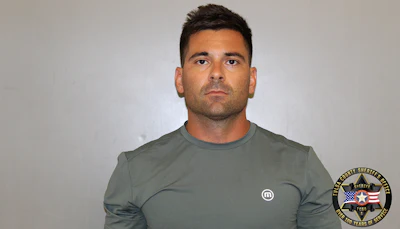

Ryan Bassham, 35, was charged with two counts of first-degree murder on Aug. 30, according to the Tulsa County Sheriff’s Office, following an explosion at a licensed medical cannabis extraction facility that killed two people in Oklahoma.
The Sand Springs Police Department responded to the explosion at approximately 1:14 a.m. on Aug. 27 at 411 South Lincoln Ave. in Sand Springs, Okla., where they found the business “severely damaged,” according to the Oklahoma State Bureau of Investigation (OSBI).
The explosion damaged at least 25 nearby businesses in the Morrow Gill complex, blowing out roofs, caving walls and twisting heavy metal beams, local media outlets reported via CNN Newsource.
While processing the scene, officers found Stephen Scott, 28, dead and Michael Newman, 41, critically injured, according to OSBI. Newman was transported to a local hospital where he later died, according to OSBI. Both men were employed at the cannabis processing facility, according to OSBI.
County officials called for Bassham’s arrest the next day.
“Based on the information and evidence obtained, the Tulsa County District Attorney’s Office filed a felony arrest warrant for 35-year-old Ryan Bassham on two counts of first-degree murder,” according to an OSBI press release. “On August 30, 2026, Bassham turned himself in to the Tulsa County Sheriff’s Office and was booked into the Tulsa County jail."
Bassham’s bail was set at $1 million for each charge. He was released on bond the same day he was booked, according to a court affidavit.
According to the district attorney's office in Tulsa, Bassham owns Solos Extract Co., which holds an active medical cannabis processor license, according to the Oklahoma Medical Marijuana Authority (OMMA).
The week before the explosion, Sand Springs Fire Marshal Mike Nobles had ordered the business to cease operations after a failed inspection, Tulsa World reported.
Cannabis Business Times reached out to Nobles on Monday morning. He said to call him back in the afternoon but did not return several calls.
CBT also reached out to the OMMA, specifically asking whether Solos Extract was authorized to use flammable solvents under its license, whether it was restricted from operating during certain hours, and whether Bassham is the owner/license holder for the business, as other media outlets reported. (The Tulsa County District Attorney's Office confirmed with CBT that he is the owner.)
"Local, state and federal law enforcement authorities are currently investigating this matter," OMMA told CBT in a statement provided by Communications Director Carmin Acupan. "OMMA is coordinating with law enforcement and providing all requested information. Because this is an active investigation, we cannot comment further at this time."
The OMMA declined to answer a question regarding the state's processor regulations, instead pointing CBT to a general rules section of the authority's website.
Sand Springs Deputy Police Chief Todd Enzbrenner told CNN Newsource, "We’re trying to figure out the status of their licenses and what they could and couldn’t do, what they should be doing and didn’t do. Those kinds of things. Those are the questions that are going to have to be answered."
While Bassham bonded out of jail on Aug. 30 for the charges connected to the Solos Extract explosion, he was arrested again on Aug. 31 by agents with the Oklahoma Bureau of Narcotics (OBN) on charges connected to a separate unlicensed cultivation and processing facility near Kellyville, Okla., according to the OSBI.
"OBN agents booked Bassham into the Creek County jail on charges of aggravated trafficking of a controlled and dangerous substance, aggravated manufacturing of a controlled and dangerous substance and possession of a firearm during commission of a felony," according to OSBI.
While cannabis businesses often use chemical solvents in the extraction process, Oklahoma processors receive either a hazardous or non-hazardous license based on the types of chemicals they plan to use (or not use) in extraction, according to the OMMA, which relies on the federal Occupational Safety and Health Administration (OSHA) Hazard Communication Standard to help keep workplaces safe.
Under most state-licensed cannabis programs, extractors using flammable solvents such as butane are required to use a closed-loop system that recycles the solvent, meaning a machine recovers the compound to prevent it from escaping into the “open,” where it could be inadvertently ignited, according to extraction requirements for cannabis processors operating in Washington state.
Many states also require processors working with solvents and gases to do so in properly ventilated environments, while also controlling all sources of ignition.
Some states, such as Ohio, prohibit residents from processing home-grown cannabis by hydrocarbon-based extraction due to safety concerns.
In Oklahoma, state regulations prohibit the use of extraction equipment in or on residential property, as well as processing utilizing butane, propane, carbon dioxide or other potentially hazardous material.
In addition to preventing explosions, many state cannabis regulators adopt consumer health and public safety rules to help prevent toxic residue in finished products and pollution in local communities during extraction processes, requiring facilities to receive fire code approval before operating.
In the wake of the Solos Extract explosion, the OSBI is coordinating its investigation with the Sand Springs Police Department, the Sand Springs Fire Marshal, the Oklahoma State Fire Marshal, the Office of the Oklahoma Attorney General, the Bureau of Alcohol, Tobacco, Firearms and Explosives (ATF), and myriad local agencies.