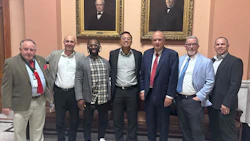
[PRESS RELEASE] – BOSTON, Oct. 27, 2026 – The No on 8: Stop the Repeal Campaign announced the endorsement of nearly a dozen social justice organizations, including ACLU Massachusetts, which join more than 60 state legislators, including Senate President Karen Spilka and House Speaker Ronald Mariano, regional leaders, public health officials, law enforcement, small business owners and advocates fighting to protect Massachusetts’ legal cannabis law.
The groups endorsing include the American Civil Liberties Union (ACLU) of Massachusetts, Progressive Massachusetts, the Black Economic Council of Massachusetts (BECMA), the Mass Reentry Coalition, Mass Healing, the National Association of Social Workers, the Coalition for Social Justice, Massachusetts Cannabis Equity Council, Equitable Opportunities Now, Springfield No One Leaves and Urban League of Eastern Massachusetts.
In the decade since voters made a clear choice to replace restrictive policies with a safe, regulated cannabis market, Massachusetts has built a system that prioritizes public health, consumer safety, responsible regulation and equitable opportunities.
“Repealing highly-regulated recreational cannabis would deeply affect our Black and Brown communities and the overall state economy,” Stop the Repeal Chairperson Ryan Dominguez said. “The Massachusetts cannabis industry has worked to give back and support geographic areas that have been disproportionately harmed by cannabis prohibition and enforcement through providing training and financial grants – all of which would be eliminated by a repeal. We are grateful to have the support of these social justice organizations in helping us to defeat this damaging ballot question and protect communities across the state.”
Legalization of recreational marijuana built an economic engine that, in the last decade, has created over 400 new storefronts, more than 27,000 jobs and generated over $2 billion in tax revenue benefiting our municipalities and the Marijuana Regulation Fund, supporting public health programs, law enforcement and schools, as well as regulatory oversight.
Question 8, if passed, would bring Massachusetts back to a system under which the arrest rate for marijuana sales disproportionately impacted communities of color. Black people were more than seven times higher than the arrest rate for white people before legalization. Even after legalization, Hispanic and Latino individuals were three times as likely as non-Hispanic and Latino respondents to report a prior cannabis-related arrest.
Supporting Quotes
“Question 8 would reinstate failed policies that disproportionately put Black men and women behind bars. This is not speculation. We have the data. We know the war on drugs devastated communities of color, both here in the commonwealth and across the nation. Why would we ever want to go back?” said Carol Rose, executive director, ACLU of Massachusetts. “We urge a ‘No’ vote on Question 8 to protect civil liberties for all Massachusetts residents. Let's maintain access to safe and legal marijuana for adults – and focus our collective energy on eradicating racial bias from the criminal legal system.”
“BECMA was formed to drive, rebuild and grow the economic well-being of the Black community in Massachusetts by addressing the racial wealth gap,” BECMA President and CEO Nicole Obi said. “A repeal of cannabis legalization would not only reverse progress. It would undermine the very framework designed to create opportunity, dismantle the social equity program and jeopardize the entrepreneurs, jobs and small businesses that are helping build a more inclusive economy across the commonwealth.”
“NASW-MAPACE has endorsed a ‘No’ position on this question, given the significant and historical negative impacts substance criminalization has had on communities of color and low-income communities,” said National Association of Social Workers Political Action Manager Beth Morrison. “Preserving a harm reduction approach that centers participant autonomy and the safety provided by a regulated system are approaches NASW-MA supports. Recriminalizing marijuana will not make the drug go away; it will just make it less safe, in an unregulated, underground market.”
“The Urban League of Eastern Massachusetts understands that the consequences of the war on drugs have never been borne equally. For decades, Black communities experienced disproportionate arrests, incarceration and barriers to economic opportunity because of discriminatory drug enforcement. Legalization created a pathway to begin addressing those harms through economic opportunity, entrepreneurship and community reinvestment. While Massachusetts still has significant work to do to fulfill the promise of cannabis equity, Question 8 threatens to undermine that progress. We cannot advance racial and economic justice by returning to policies that helped create the disparities we are still fighting to overcome,” said Rahsaan D. Hall, Esq., president and CEO of the Urban League of Eastern Massachusetts.
“Massachusetts voters said loud and clear in 2016 that we want to leave the drug war behind us. Question 8 would turn the clock backwards, bringing us back to an era of costly, ineffective and racially biased policing and causing havoc to city and state budgets,” Progressive Massachusetts Policy Director Jonathan Cohn said. “An out-of-state dark money group is trying to insert itself into Massachusetts, and voters should tell them ‘No.’”
“We all know what prohibition looked like: Our neighbors were arrested, families separated and futures derailed. Low-income and Black and Brown communities paid the highest price. Our communities felt it, and Massachusetts voters chose a different path a decade ago. Since then, we’ve been building toward repair: social equity licenses, local jobs and public revenue flowing back into our cities,” Coalition for Social Justice Co-Executive Director Anabel Santiago Gibson said. “Repealing legalization would drag us backward when we should be building on our progress. We’re voting ‘No’ because justice doesn’t move in reverse, and we refuse to go back to a system that criminalized our communities without making anyone safer.”
“Massachusetts legalized cannabis with a promise to begin repairing the damage caused by decades of discriminatory drug enforcement and create economic opportunities for communities that were hardest hit,” said Co-Founder and Executive Director of Equitable Opportunities Now (EON) Shanel Lindsay. “Question 8 would take us backward by recriminalizing cannabis sales while destroying opportunities for small business ownership, jobs and community reinvestment. We still have a long way to go to fulfill the promise of legalization, but repealing it would be a devastating step in the wrong direction.”
"Massachusetts encouraged people who were harmed by cannabis prohibition to become entrepreneurs and build generational wealth through the legal industry. We have spent years navigating an expensive and complicated licensing process, investing savings and fighting for a fair opportunity to succeed,” said Armani White, co-founder of the Massachusetts Cannabis Equity Council and co-owner of Firehouse dispensary. “Question 8 would pull the rug out from under us just as we're beginning to realize that opportunity. We cannot claim to support economic justice while shutting down the very businesses that were supposed to help deliver it.”
“Equity means making sure every community has a seat at the table and a fair opportunity to thrive. Voters made a decision to legalize adult-use cannabis a decade ago, which was an important step toward addressing the deep and lasting harms of prohibition, particularly in communities that have historically been left behind,” Springfield No One Leaves Executive Director Rose Webster-Smith said. “Repealing legalization would put that progress at risk and could once again place the greatest burden on the very communities that have already paid the highest price. Keeping cannabis legal protects the progress we’ve made and ensures that no community is left behind.”
“Massachusetts residents deserve evidence-based drug policies rooted in science, compassion, personal freedom and harm reduction – not misleading prohibitionist rhetoric driven by an out-of-state organization whose agenda is out of step with public opinion,” Mass Healing co-founder and Executive Director Jamie Morey said. “Nearly a decade ago, Massachusetts voters made the historic decision to legalize cannabis, establishing a regulated market that has generated substantial tax revenue, created thousands of jobs and introduced important consumer protections. Mass Healing proudly endorses the No on 8 campaign and urges Massachusetts voters to uphold existing responsible and regulated cannabis policy.”
The campaign’s growing coalition includes labor organizations, cannabis industry leaders, small business owners, community advocates and voters who believe Massachusetts should preserve the legal, regulated cannabis industry rather than repeal it.
Those interested can learn more about efforts to keep regulated recreational marijuana legal in Massachusetts here.