
Establishing a reliable in-house nutrient monitoring kit is an essential part of proactive crop management. Early detection of root zone changes allows growers to respond quickly and prevent problems and long-term damage.
While the market offers a wide array of pH and EC meters, it’s important to recognize that an effective diagnostic setup doesn’t need to be complex. A simple, easy-to-operate kit can still yield similar results – the key is selecting tools that consistently deliver accurate, repeatable readings.
This article outlines the essential components and best practices for assembling and using a cannabis grower-friendly monitoring system.
Understanding pH and EC Measurement
Substrate pH reflects the concentration of hydrogen ions in solution, expressed as the negative logarithm of that concentration. Put simply, as hydrogen ion levels increase, the solution becomes more acidic, and the pH value decreases. Most pH meters use a single probe containing two electrodes: one measures hydrogen ion activity, while the other provides a stable reference voltage. The meter calculates the difference between these signals to display the pH.
Electrical conductivity (EC) indicates the total concentration of soluble salts in a solution. It does not identify specific ions or their individual concentrations. Substrate EC is measured by passing an electrical current between two metal probes spaced at a fixed distance. Results are typically reported in millisiemens per centimeter (mS/cm) or millimhos per centimeter (mmhos/cm).
Some meters may instead display total dissolved solids (TDS) in parts per million (ppm), but most greenhouse recommendations are expressed in mS/cm. To convert ppm to mS/cm for comparison with greenhouse guidelines, divide the ppm value by 640.
Choosing the Right Meter for Your Operation
Meters come in various formats, each suited to different workflows. Portable meters are ideal for quick spot checks and on-the-go sampling, while benchtop models may offer greater precision for detailed analysis.
When selecting a meter, consider the range and resolution required for your production system. Some models cap EC readings at 4.00 mS/cm, which may be insufficient for high-fertility environments. If your meter cannot read high EC values, dilute the sample 1:1 with distilled water, take the reading, and multiply the result by two to estimate the original EC.
In general, a recommended cannabis substrate pH range is 5.8-6.2, and can be accurately read by most meters; however, EC values will vary by both sampling and production methods.
Calibration
In-house nutrient monitoring is only as accurate as the last calibration and the use of proper standards. Calibration procedures vary between meters; however, there are common points that apply to all meters.
First, most pH meters include samples of calibration solution upon purchase; however, over time, these standards will drift, and it is important to replace calibration solution as needed.
Second, it is important to submerge the probe tip to ensure an accurate reading.
Lastly, it is important to ensure that the probe has not been damaged during calibration or sampling. A damaged probe can result in inaccurate values even if the calibration procedure has been completed correctly.
Storage
1. Store the electrode in a storage solution if recommended by a meter manufacturer. A piece of a cotton ball may be useful to place in the cap to help retain some solution.
2. Regularly clean the probe by soaking it in a cleaning solution as recommended by the manufacturer.
3. Always recalibrate the probe before each use.
Developing an In-House Monitoring Kit
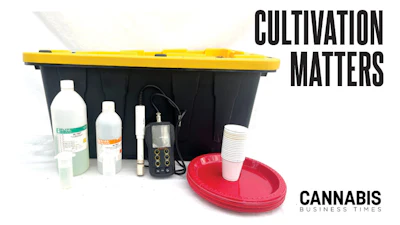
A simple in-house monitoring kit can allow for rapid decision-making and prevent small problems from turning into large economic losses. Developing an easy-to-use kit that can be used accurately by all growers is important for tracking crop values from year to year (Fig. 1, above). A basic kit can be developed at relatively low cost and may include:
dry, weather-proof container stored out of the elements;
pH and EC meters;
calibration solutions (pH and EC);
a gallon of distilled water (fertilizer irrigation water cannot be used for sample collection);
saucers/plates for collecting leachate; and
three-ounce cups .
Summary
Regularly measuring pH and EC gives growers the ability to make quick, informed adjustments to root zone chemistry before issues escalate. A consistent sampling routine, paired with a simple and reliable monitoring kit, helps ensure that readings are comparable over time and across staff members.
By standardizing the tools and procedures used on-site, growers can detect shifts in root zone conditions early and take corrective action prior to negative impacts on cannabis growth.