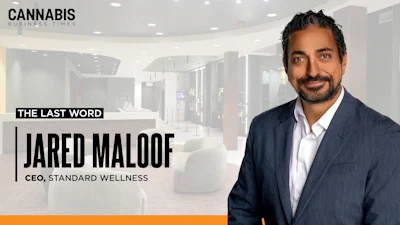

Standard Wellness CEO Jared Maloof recently made the difficult and emotional decision to sell his company’s dispensary, The Forest, in Sandusky, Ohio.
Sandusky was the site of the state’s first legal medical cannabis sale in January 2019, more than two years after then-Gov. John Kasich signed a legalization bill into law in September 2016, when lawmakers wanted to take matters into their own hands rather than allow a citizen-initiated constitutional amendment to determine the Buckeye State’s cannabis policies that November.
At the time, Maloof worked for billionaire businessman Carl Icahn in the scrap metal business as chief financial officer of PSC Metals, when a close friend had convinced him to help spearhead Ohio’s legalization effort and eventually co-found Standard Wellness in 2017. The multistate operator now employs 400 workers.
Nearly eight years after Ohio’s first medical cannabis sale, the state’s operators continue to reposition in a still-developing $1.3 billion adult-use market that launched in August 2024. Earlier this year, Standard Wellness sold its retail facility in Sandusky to Missouri-based Greenlight as part of a strategic move that Maloof calls the retail chessboard of Ohio’s marketplace.
“Sandusky was the site of the first-ever cannabis sale in the state of Ohio, and so it was really emotional to let that one go, but it plays into a theme we talked about earlier,” Maloof said. “Sandusky’s proximity to Michigan is so close that it made it very difficult to run that store profitably. Now, as Michigan companies continue to fail, I do think there is some upside for the buyer of that dispensary, and I’m proud of the group that we sold to. Greenlight is a great operator, and they’re going to do great things with it.”
 Flower grown in 2021 at Standard Wellness' cultivation facility in Gibsonburg, Ohio. Photo by Tony Lange
To date, the Ohio Division of Cannabis Control (DCC) has issued certificates to operate to 233 dispensaries, 37 cultivators, 45 processors and six testing labs, which employ nearly 10,000 workers. Supply in the state’s limited-license structure is “somewhat tight right now,” Maloof said.
Ohio’s average retail price per gram for dried flower has hovered around $6.50 for the past three months, or roughly $185 per ounce, according to the DCC.
Conversely, Michigan’s unlimited-license structure of 935 growers, 270 processors and 837 dispensaries, according to the state’s Cannabis Regulatory Agency, has led to an oversupply, putting the average retail price of cannabis flower at $60 per ounce in recent months – a buyer’s market with more than $3 billion in sales in each of the past three years.
Knowing this dynamic, Standard Wellness sold two dispensaries earlier this year and opened two new locations in Northeast Ohio, including its flagship store in Cleveland Heights and another The Forest facility in Lakewood. The company is also developing Northeast Ohio facilities in Kamm’s Corner and Sheffield Village, and continues to operate its Northeast Ohio dispensary in Seville and its Southwest Ohio storefront in Cincinnati.
“You’re only allowed to have eight of these things, and it’s kind of like a chessboard,” Maloof said. “We’re trying to upgrade our locations so that we can attract the most market share.”
But capturing that market share goes much deeper than retail locations alone. Ohio’s shortfall from what was initially projected to be a $2 billion adult-use market stems from myriad factors, including local moratoriums, intoxicating hemp products, advertising restrictions and, again, Michigan’s low prices next door, Maloof said.
But the Buckeye State’s cannabis market has not stalled and is far from reaching its potential.
Here, Maloof discusses Ohio’s market growth, competition, regulatory challenges, and what’s next as the state and federal government continue to crack down on intoxicating hemp products.
Tony Lange: Can you start by telling me a little bit about Standard Wellness’ history and why you entered the cannabis industry?
Jared Maloof: I was working for Carl Icahn in scrap metal. We shredded automobiles and provided scrap to steel mills, but I got a call from a close friend, Kevin Murphy, who’s an attorney, who had been representing the cannabis space for a bit. And he indicated that he was spearheading an effort to legalize medical cannabis in Ohio and asked if I wanted to be a part of it. And at that time, being in scrap metals, we had very, very thin margins, and we were heading into the bottom of a commodity cycle, and I said, “What the heck? Let’s do it.” And Kevin and Brandon Lynaugh, a couple others, raised a bunch of money to try to put cannabis on the [2016] ballot, medical marijuana, that is. And we were halfway home when the Legislature viewed us as likely winning, and so they wrote their own law, and they passed it.
It took the Department of Commerce and Board of Pharmacy about a year or so to articulate the applications and get that started, but we waited patiently, and when it was our time to apply, we applied.
Lange: Not knowing completely what you were getting into almost 10 years ago, how do you look back on your decision to start a cannabis company in Ohio? Any regrets?
Maloof: No, I don’t have any regrets. We’ve built a company that has 400 people who rely on us for their jobs. And so, I’m really proud of what we’ve built. We’ve got operations in Ohio, Missouri, Utah, and a minority interest in a Maryland operation, and I'm super proud of what we’ve built. Had I stayed on the path that I was on, would it have been more financially rewarding? Possibly. I guess I’ll never really know, but no, I wouldn’t change anything.
 Cannabis plants grown in 2021 at Standard Wellness' cultivation facility in Gibsonburg, Ohio. Photo by Tony Lange
Maloof: The importance of retail. In the beginning, everyone thought that cultivation was king, and really the shoe’s on the other foot. It’s really retail that is the more important component of the business.
Lange: The national adult-use legalization wave has really slowed down since Ohio voters approved Issue 2 in the 2023 election, and the retail marketplace in Ohio is now 2 years old. Are things shaping out how you expected them to?
Maloof: I think that most experts would’ve predicted that Ohio would be a $2 billion market by now, but here we sit at about $1.3 billion. So, I think there’s room to grow, but I think that most of the operators would tell you that we’re satisfied and happy to grow slowly rather than have a big boom and then a crash later.
Lange: Why do you think it’s been slower than maybe anticipated from what people were projecting a couple of years ago?
Maloof: Well, there are a few things, and I don’t know exactly how to attribute percentages to them, but intoxicating hemp has certainly been a big issue. There were 3,000 vape shops at one point in time, so that has captured a lot of the illicit market or customers of ours. I think that the draw to Michigan is still there. Michigan prices are certainly lower than what we experience here in Ohio, and so many people still make the trip up to Michigan. And then I think the third issue, and it’s harder for me to quantify, is lack of awareness. There are still people who don’t know that cannabis is legal in Ohio, and part of that’s by design. If you go to Michigan or Missouri or other states, you’ll see billboards for cannabis dispensaries or cannabis brands. You don’t see that in Ohio. There’s, of course, no TV advertising, no radio advertising. So some people just simply still don't know that it’s legal.
 Flower grown in 2021 at Standard Wellness' cultivation facility in Gibsonburg, Ohio. Photo by Tony Lange
Lange: And some cities remain opted out of participating through their local moratoriums on cannabis businesses. So, how has Standard Wellness pivoted over the last couple of years to meet the market where it is?
Maloof: Standard Wellness, specifically, we’ve tried to go deep on pre-rolls. And so, we have three brands of our own: the Standard, the Solid and Fish Whistles, and we’ve also brought in a few brands from outside of the state. We produce pre-rolls for Lowell Farms, Miss Grass, Tom and Berry's and Clout King. And so, when you look at the statistics, you might not see that Standard Wellness sits atop the pre-roll market, because we don’t, but when you aggregate all the brands that we are licensing, we certainly crack into the top five there.
Lange: Tell me about that, because obviously pre-rolls are new to Ohio. Smoking wasn’t technically allowed under the medical program. Why did you partner with some of these out-of-state brands for the pre-rolls category?
Maloof: We knew that pre-rolls were going to be a new market or a new category in the marketplace, and I was determined to try to exploit every advantage I could, and that meant partnering with some of the brands that have done it best elsewhere.
Lange: What are some of the main operational pressures in Ohio right now that cannabis companies are facing in the current landscape of the marketplace?
Maloof: Boy, that’s a tough one. I think that for us specifically, when we got started, our advisers highly recommended greenhouses. This was in 2018, when greenhouses were very, very popular. It took the industry a couple of years to learn that greenhouses were not the best way to grow cannabis, particularly in the Midwest where it’s hot and humid in the summer. We have indoor grows as well, but dealing with the greenhouse is an operational challenge that we have to manage. And that means in the summertime, if it’s 90 degrees, 95 degrees outside, it’s oftentimes over a hundred degrees on the inside of the greenhouse. And at those temperatures, plants are struggling to stay alive, not really focusing their efforts on terpene and THC development.
 One of Standard Wellness' grow rooms in Gibsonburg, Ohio. Photo by Tony Lange
Lange: What about more broadly?
Maloof: In Ohio's market now, I think many operators are struggling with capacity issues. There’s certainly plenty of marijuana on shelves if you go into any dispensary, but the supply is somewhat tight right now. There’s new capacity coming online, and I think that will relieve some of this tightness where the market is a little bit short.
Lange: There are 37 licensed cultivators in Ohio. I think Michigan has, gosh, close to a thousand because of their unlimited license structure. So, from a business standpoint, is that a little bit of a good thing for Ohio, because the prices aren’t crashing from an oversupply like in Michigan?
Maloof: Yes. Ohio has done a really nice job of a slow rollout in the program so that the market doesn’t experience wild fluctuations in supply that lead to crashes. By contrast, Michigan gave out as many licenses as they could, and that market’s really suffering right now. They had a few great years, and I’m sure some people were able to get in and get out and exit, but for the most part, a lot of cannabis companies in Michigan are struggling.
Now, is 233 the right number of dispensaries for the state of Ohio? Probably not. I think that somewhere around 300 would be a healthy number, maybe slightly north of that. The Legislature has capped it at 400, and so we’ll see what the state decides to do about distribution of new dispensary licenses. But one of the real problems, honestly, is the sheer quantity of cities that have opted out and have moratoriums.
Lange: Speaking of dispensaries, The Forest has four locations open right now because you sold two, and then you have two more that are being built out, correct? Yes, and we have a seventh license in central Ohio that is yet to be sited. And one of the reasons is that the moratorium issue is so pervasive in our region; we’re having a heck of a time finding a city that will welcome us.
Lange: When it comes to customer loyalty/retention, how are you using technology to either change the customer experience or make the most out of your locations?
Maloof: Certainly, online menus and online ordering are extremely important. We try to drive as much of our traffic to fill their cart online, and that’s for a few reasons. One, it’s much less pressure. When you’re sitting on your phone, or you’re sitting on your computer, building a cart is less pressure than when you’re in the store with a bunch of people around you. And it helps us improve our supply chain, whereby orders are fulfilled long before the customer ever walks in the door.
But we also have really slick kiosks that are about 6 feet tall. The size of the screen might remind you of the size of the screens that you see at McDonald’s, but I think the unit is far sleeker and cooler. And we have a host who will guide someone through the menu process, or if a customer prefers to walk up to a counter the old-fashioned way and converse with a budtender and hear that person’s recommendations on what products to buy, that’s also available. We're also trying to incorporate pickup windows into as many stores as we possibly can. We see that 30% to 40% of our revenue comes through the pickup window when we have one.
 The Forest cannabis dispensary in Cleveland Heights, Ohio.Photo courtesy of Standard Wellness
Lange: After opening in August, why do you consider your Cleveland Heights location your flagship store?
Maloof: The look and feel of the dispensary is a really cool experience, and we think so highly of it; that’s the design that we are going to implement everywhere. But from a marketing perspective, we are employing all sorts of approaches to attracting customers, so obviously email and text messages, but there’s a firm called Surfside; they deliver digital banners to telephones, to smartphones based on a customer’s purchase history. Alpine IQ is a loyalty program that we utilize at the dispensaries and communicate with customers that way. Print mail is also available now in the state of Ohio, and so it’s a costly way to reach consumers, but it is effective.
Lange: Consumer trends can pivot quickly in cannabis. How does your team try to anticipate a customer’s purchasing decisions before those decisions are made?
Maloof: The first thing we try to do is have a broad selection of products available for customers. So probably 30% of the stuff that you see on The Forest shelves comes from Standard Wellness, the parent company, but 70% of the product is from other companies, and that’s really for two reasons. One, we want to give customers as much choice as we can manage, short of having thousands of SKUs.
But secondly, we save shelf space for our competitors with the hopes that they’ll do the same for us in their stores. But as far as trying to predict what a customer might like, well, the first clue is if they’ve already been a customer, we know what they like, and we can tailor emails and communications to them around their likes and desires. And while we’re not there yet, we’re working really hard on it. And AI tools are certainly helping with all of that data mining and analysis, but it’s just meeting the guest where they are. If a guest likes gummies, they’ll tell you.
And then our employees are trained on understanding the wide spectrum of the gummy category, which includes minor cannabinoids like CBN, and effects-based gummies or solventless gummies. Our team is experienced enough to know that if someone wants something for sleep, you can bet they’re going to be suggesting something that has CBN in it. Interestingly, though, in Ohio, there’s a concern that CBN may not be around very long because CBN doesn’t occur in the plant naturally in very high levels, and so there’s a lot of synthetic CBN on the marketplace, and Senate Bill 56 and the state’s rules are clamping down on some of those minor cannabinoids.
Lange: Right, Senate Bill 56 went into effect in March – aside from temporary restraining orders for some operators and others. What are some of the other big impacts, whether good or bad, that Ohio operators have felt?
Maloof: One of the ones that I think is not good – other states have done it, and I don't think it's a good idea – but there’s now a limit for recreational customers on the number of milligrams you can get in a gummy; so it’s a 10-milligram limit. Medical patients can still walk in and get up to 55 milligrams, but the concern from the governor's office is children with access to their parents’ edibles and ensuring that, at 10 milligrams, the effects of that dose might be less harmful. But the reality is that every human being metabolizes THC differently, and I know people who can take a thousand milligrams and not feel it, and it's just shocking to me, but these people exist. And so, I think that it’s long-headed to limit. I understand the knee-jerk reaction, but ultimately, I come down on the side of allowing patients to choose.
Lange: Intoxicating hemp products in Ohio have been prohibited since March, with a narrow exception due to ongoing lawsuits. But do you think that those products are actually off the market in Ohio, or are they still being sold?
Maloof: Initially, everyone stopped, but the opposition threw a number of court cases into the mix. And so, upon suing, a lot of these shops started to open up again. And then they got a temporary restraining order, followed by a preliminary injunction that prevented the enforcement of S.B. 56. So that TRO and the preliminary injunction, those were not binding on all producers. So certain confusing rulings have allowed these shops to stay open. When the federal ban goes into place, knock on wood, in December, I think things will change once again.