Although price compression and regulatory challenges have affected growth plans for some operators, the cannabis industry in many locations has experienced significant growth.
Some operators have started production with the intention to grow modularly to meet market demands and are finding themselves in a position for growth. In some cases, regulatory bodies have granted expansion permits only after demand has grown sufficiently to justify additional supply, effectively freezing expansion plans for years.
 Cannabis plants grow inside one of Galenas' flowering rooms in Akron, Ohio.Christine DeJesus | Galenas
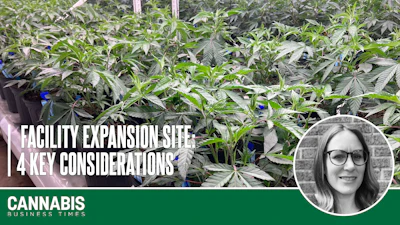
Expansion plans require a great deal of thoughtful consideration prior to launching into the active phase of the design and construction project. An important first step when the time is right for growth is to carefully consider the purpose of the expansion space. A second production site can duplicate the original facility function and layout or offer a refreshed format on either point.
Growing into a new space provides an ideal opportunity to incorporate tested and successful systems, but also to improve upon initial design flaws or workflow constraints. Additionally, the regulatory landscape may have changed substantially since the first site was constructed, and new rules may accommodate a more efficient footprint.
Building out a new site, whether it is a brand-new building or a retrofit of an existing building, requires collaboration among many parties, including owners, operations team members, and often professional consultants. Before examining crucial components like infrastructure, zoning, and regulatory requirements, it’s important to first flesh out the idea for use and refine operation-specific design details.
Doing adequate research before any expansion project is always an integral task. Consulting experts at this crucial stage is a great way to find guidance. In a 2022 Cannabis Conference session, “10 Ways to Build a Better Indoor Cultivation Facility,” experts weighed in on the many pre-planning steps that should occur prior to breaking ground.
Sometimes expansion in one department is clearly needed, and this may instigate the desire for adding equivalent production space; however, the overall vision must consider the operational needs. It is critical to plan how the expansion site will pair with the premier facility. Carefully and conscientiously designing and dovetailing the functions of multiple facilities can benefit the dynamic of the entire operation, and often, two sites can combine processes to enhance the production output of the business as a whole.
1. Consider Compliance Points
 Harvested cannabis from Galenas.Christine DeJesus | Galenas
Consult local regulations to study changes that could benefit an expansion project that may have limited the initial buildout. Plan designs with a full understanding of all compliance rules and updates to ensure there will be no unexpected setbacks, and that the new site is making use of any ease or adaptations in initial compliance regulations.
Compliance points such as secured entry areas, employee and visitor clearance, unobstructed camera views, inspections, tagging and tracking plant movements, and regulated waste disposal may need to be specifically accommodated in a second production site. Depending upon state regulations, moving plants or products between facilities can add substantial track-and-trace tagging and inventory management. Planning ahead for regulatory requirements can make compliance processes more efficient. Consider upgrades to compliance equipment like stationery scanners, label-printers, and auditing software in the design stage.
2. Evaluate Process Division
 Cannabis plants grow inside one of Galenas' flowering rooms in Akron, Ohio.Christine DeJesus | Galenas
If state regulations allow, explore consolidation of some post-harvest processes in a second facility to create a cleaner, streamlined setting, with transport of plant biomass between facilities. Or consider removing certain plant phases from the main operation to consolidate labor, improve energy efficiency, and protect genetic stock.
Housing extraction or processing work and cultivation processes in the same facility create myriad challenges in food safety, biosecurity, and quality control management. Also, these very different production systems often require unique skilled labor forces, specialized environmental control systems, varying security needs, and specific sanitation standards.
One planning option is the relocation of certain post-harvest or laboratory-grade processes to a second facility, which may offer a way to mitigate the risks of combining manufacturing processes with plant growth environments. Having a dedicated facility specified for extraction and processing can streamline regulatory compliance, eliminate cross-contamination points, and enhance operational efficiency.
Another option for a second site could be the division of plant growth phases. Consider the establishment of a plant nursery where seedlings, clones, and even vegetative plants could work through the growth stages until transfer to a flowering-only site. This format could also allow for the conversion of growth space in the premier facility to additional flowering canopy.
Nursery facilities have different environmental requirements than flowering facilities, and light, temperature, and humidity setpoints can often be achieved with less dehumidification and cooling capacity, lower light supplementation, and overall reduced energy and labor use. Additionally, separating plant growth phases and the tasks that accompany them allows staff to avoid cross-contamination of nursery plants with the pests and diseases often present on older, flowering production plants, while also refining stage-specific cultivation techniques.
If siloing parts of the larger production process to a second facility, the distance between locations becomes important. Transfer of plants or biomass between facilities may be frequent, and climate-controlled vehicles might be required to maintain quality control during transfers. Additionally, personnel may be required to move between facilities to complete compliance, inventory, or staff management tasks. A second facility in close proximity to the first allows labor hours to be focused on important tasks versus commute time.
When moving plants or plant biomass, a short trip is often more secure and efficient. Locating in the same community also consolidates compliance work when dealing with the regulatory requirements of only one jurisdiction and may keep you under the umbrella of the same compliance department or agents. Depending upon the plans for the facility, infrastructural needs may be easier to meet with co-located facilities.
Bear in mind that different locations may present a variable set of challenges. Rural versus urban areas expose plants to different pests and contaminants, and even small variations such as proximity to factories or farms may increase risk. When moving plants between facilities, opportunities for contamination and exposure to the elements increase. Consider wrapping carts or pallets to minimize risks. Additionally, plants can be treated with state-approved pesticides or beneficial organisms preventatively to minimize risk during live-plant transfers.
3. Learn From Mistakes and Overcome Challenges
 Hand-trimmed cannabis at Galenas.Christine DeJesus | Galenas
Listen carefully to employees and stakeholders when reviewing all facility-related stress points. Pay close attention to departmental employees to illuminate the small issues, which often add up to larger problems like inefficient labor or resource use. Capitalize on success and incorporate processes or techniques that may have taken years to discover directly at the design stage.
Examine things such as the distance between supplies and processes, inefficient or unnecessary equipment, inadequate workspace for specific tasks, and safety and compliance operational concerns. Pull together production data to see where there could be room for improvement in turnaround times and work backward to determine if new tools or equipment could expedite tasks and potentially build those directly into the facility design.
4. Focus on Operational Efficiency
 Cannabis plants grow inside one of Galenas' flowering rooms in Akron, Ohio.Carlos Genao | Galenas
Consider installing similar equipment across facilities to avoid unexpected or inconsistent results. Outfitting a second grow site with the same type of grow lights, for example, can lead to seamless growth without concern for transitions if plants move between facilities. Highly functional production workflows should be replicated to avoid downtime due to adjustments for employees who transition regularly between facilities. Task management software can pair both facilities and streamline access for managers and supervisors. Security systems can interface to allow surveillance of both facilities to be easily accessible.
Expansion is a great time for technology upgrades, so decide if there is a worthwhile investment to build across both locations. Expansion can also be an ideal time to incorporate sustainability practices into a new location to reduce energy use. Climate control equipment, artificial intelligence for crop management, and data collection software are all good options to vet for technological advancements that could reduce touch points or provide an enhanced environment for production.
Investing time in the purposeful design of an expansion site must be strategic, and fleshing out the exact purpose and function of the expansion site is the critical first step toward continued success.
Christine DeJesus is the General Manager at Galenas, a licensed dual-use cannabis cultivator in Akron, Ohio.